
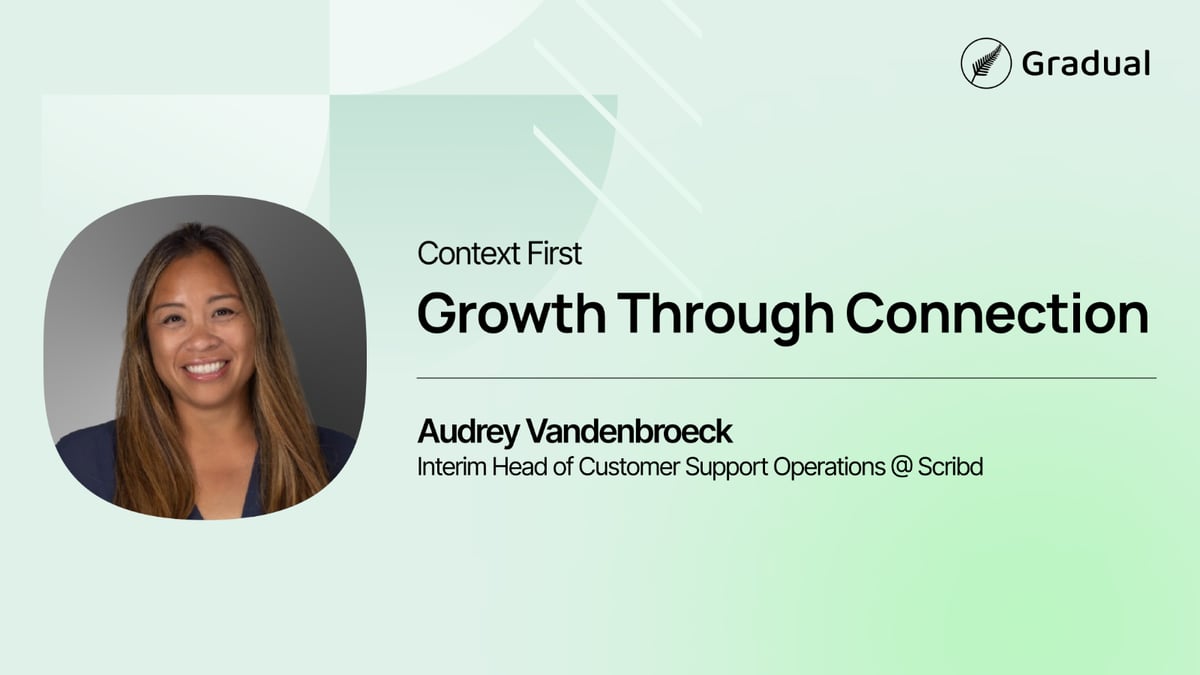
Context First With Audrey Vandenbroeck: Turning Customer Stories Into Shared Context
# Customer Success & Support
# Community
# Format: Event Recaps
How structured customer conversations can help teams understand what customers actually need, why they make decisions, and where the business should pay attention.
May 1, 2026
Joshua Zerkel

Audrey Vandenbroeck
In our Context First conversation, Audrey Vandenbroeck shared a practical approach to something many teams talk about but don’t always operationalize well: listening to customers in a way that actually changes how the business makes decisions.
Most teams already have plenty of customer signals. Product data, support tickets, survey responses, call recordings, community posts, and account notes all create some view of what customers are doing or saying. The harder part is understanding what those signals actually mean.
That’s where Audrey’s work with Campfire Stories at Issuu felt especially useful. She wasn’t trying to create another feedback channel just to collect more input. She was creating a more intentional way for customers to explain their business, their goals, their expectations, and their experience with the product.
As Audrey put it, product recordings and behavior data can show how someone moves through a product. They can show where someone clicks, pauses, or gets stuck. What they usually can’t show is what the person was thinking, what they expected, or why the product mattered to their business in the first place.
That gap is where conversation still matters.
How Campfire Stories worked
Campfire Stories started with a simple prompt from Audrey’s CEO. The company wanted to do something different with customers, and it needed to involve the broader organization.
Audrey built a format that was intentionally straightforward. Customers joined a 30-minute conversation to talk about their business, why they chose Issuu, how they used the product, what was working, and what could be better. People from across the company were invited to listen and ask questions.
The “campfire” framing was intentional. Audrey wanted the conversation to feel relaxed and human, more like people sitting around telling stories than being pulled into a formal interview. That tone helped customers open up.
At the same time, the conversations were structured. Audrey used a consistent set of questions, inspired by Inside the Actors Studio, where James Lipton asked each guest the same questions and got very different answers. That consistency gave the team a way to compare what they were hearing across customers, industries, and roles, while still leaving room for follow-up questions and natural conversation.
That balance mattered. The format had enough structure to be repeatable, but enough openness to let customers explain what was really shaping their decisions.
What stories revealed
When I asked Audrey what Campfire Stories uncovered that other channels missed, she came back to the “why.”
Why did the customer choose Issuu? Why did they choose it over another option? What were they actually trying to accomplish? How did they expect the product to support their work? Where did it fit into the way their business operated?
Those questions often get flattened in surveys or written feedback. People write differently than they speak. They edit themselves. They compress ideas. Sometimes they soften what they mean. In a live conversation, the answer is usually more immediate and more revealing.
Audrey made an interesting point here. As AI becomes more common in how people write, even customer feedback can start to lose some of the customer’s actual voice. A live conversation creates a different kind of signal because you hear the tone, hesitation, emphasis, and detail that don’t always come through in text.
The conversations also helped the team build personas from actual people. Rather than relying only on assumed buyer profiles, Audrey’s team used what they heard from real customers to shape and refine their understanding of who was using the product, what they cared about, and how those needs changed over time.
Why the whole company needed to hear it
One of the strongest parts of Audrey’s approach was that Campfire Stories weren’t contained inside customer success.
The whole company was invited. Product, engineering, marketing, finance, HR, leadership, and others could hear directly from customers. That changed how customer insight moved through the organization.
Instead of feedback being filtered through multiple handoffs, people had a shared reference point. Audrey talked about teams bringing Campfire Stories into product syncs, sprint conversations, standups, and planning discussions. Someone could say, “Remember what that customer said?” and others knew the moment because they had heard it too.
The value wasn’t that everyone interpreted the story the same way. They didn’t. Audrey said different functions often heard different things. An engineer, a marketer, a designer, and someone in finance might all take away something different from the same conversation.
That was part of the benefit. It created better internal dialogue.
It also changed how customers experienced the company. When customers saw people from across the organization show up to listen, it signaled that the company was paying attention. Some customers were intimidated at first, but Audrey said they still used the opportunity to be candid, including about what wasn’t working.
That kind of visibility can build trust quickly.
How customer context shaped decisions
Campfire Stories worked because the conversations didn’t stop at being interesting.
The team used what they heard.
The stories helped marketing understand the language customers used and the reasons they chose the product. They helped product teams see pain points and expectations more clearly. They helped customer-facing teams validate patterns they were already hearing. They helped the company make better decisions because more people had access to the same customer context.
Audrey connected this to business outcomes in a practical way. Better context helped teams build more useful product roadmaps. Better roadmap decisions could improve adoption. Better adoption could support retention. Retention could support revenue.
That’s the operator lesson here. Customer listening matters most when it changes the work.
Audrey was also clear that executive buy-in matters. If leaders don’t reinforce the value of these conversations, they can become one team’s side project. With leadership support, customer context has a better chance of becoming part of how the company operates.
What to avoid
Audrey shared one caution that felt especially useful.
At one point, she tried shaping a Campfire Stories conversation around questions another department wanted her to ask. It didn’t work as well. The conversation became too focused on that department’s needs and less useful to the broader organization.
That’s an easy trap. Product wants roadmap validation. Marketing wants language. Sales wants competitive insight. Customer success wants renewal context. All of those needs are real, but if the conversation becomes a checklist of internal requests, the customer’s experience gets squeezed out.
Audrey’s advice was to trust the facilitator’s understanding of the customer and keep the conversation centered on the customer’s story. Internal teams will still get value, but the value comes from asking broader questions that reveal context many teams can use.
What stayed with me
What stayed with me most is how manageable this idea is.
Campfire Stories didn’t require a massive program, a large team, or a complicated research process. It required one strong facilitator, a clear format, prepared customers, executive support, and a company willing to listen.
That’s probably why it worked.
For teams already swimming in data, another dashboard may not be the next useful step. Sometimes the better move is creating a stronger room for the conversation to happen, then making sure the right people are listening.
Audrey’s approach worked because it gave customers space to explain what they were trying to do, and it gave the company a shared way to hear it.
That’s the kind of customer context that can actually shape decisions.
Key takeaways
- Customer signals can show behavior, but customer context helps teams understand the thinking, expectations, and business needs behind that behavior.
- Campfire Stories worked because the format was structured enough to be repeatable and relaxed enough for customers to speak honestly.
- Customer conversations become more valuable when people across product, GTM, CX, support, finance, HR, and leadership hear them directly.
- The best customer stories create shared reference points that teams can use in planning, prioritization, messaging, and customer experience decisions.
- Executive buy-in helps turn customer listening from a one-off activity into a repeatable company practice.
FAQ
What are customer signals?
Customer signals are data points or observations that show how customers behave or what they say. Examples include usage data, survey responses, support tickets, community posts, and call recordings.
What is customer context?
Customer context is the deeper understanding behind customer behavior and feedback. It includes the customer’s goals, pressures, expectations, decision process, and real experience using the product.
What were Campfire Stories?
Campfire Stories was a structured customer conversation program Audrey Vandenbroeck launched at Issuu. It brought customers into casual conversations that people across the company could attend and learn from.
Why are structured customer conversations useful?
Structured customer conversations help teams ask consistent questions, hear customers in their own words, and turn individual stories into useful context for product, GTM, CX, adoption, and retention decisions.
Like
Comments (0)
Popular

Dive in
Related
Resource
The Context First Framework: Turning Customer Signals Into Strategy
By Joshua Zerkel • Apr 16th, 2026 • Views 21
Resource
Playbook: Turning Peer Exchange Into Shared Direction Across Teams
By Joshua Zerkel • Feb 13th, 2026 • Views 26
30:27
Video
Context First: Community Converts – Turning Skeptics into Champions
By Ashley Williams • Apr 1st, 2026 • Views 33
Resource
Playbook: Turning Customer Context Into Repeat Revenue
By Irwin Hipsman • Mar 31st, 2026 • Views 27
Resource
The Context First Framework: Turning Customer Signals Into Strategy
By Joshua Zerkel • Apr 16th, 2026 • Views 21
30:27
Video
Context First: Community Converts – Turning Skeptics into Champions
By Ashley Williams • Apr 1st, 2026 • Views 33
Resource
Playbook: Turning Customer Context Into Repeat Revenue
By Irwin Hipsman • Mar 31st, 2026 • Views 27
Resource
Playbook: Turning Peer Exchange Into Shared Direction Across Teams
By Joshua Zerkel • Feb 13th, 2026 • Views 26