
How to Structure a Community for Clarity, Engagement, and Scale
# Community
# GTM Strategy
# Format: Playbooks
# Gradual: How-Tos
A practical playbook for designing content, conversation spaces, groups, and onboarding so members find value quickly and communities grow without fragmentation.
February 6, 2026 · Last updated on March 3, 2026
Joshua Zerkel
Most communities don’t struggle because people aren’t interested; if they weren’t interested, they wouldn’t have shown up in the first place. Instead, communities stumble because people aren’t sure where to go, what to engage with, or how different parts of the community fit together. When structure isn’t clear, even motivated members hesitate. They read instead of participating, or they leave with the intention of coming back later, but probably don’t.
Community structure isn’t about taxonomy for its own sake. It’s about reducing friction. When someone joins your community, they’re quietly asking a few simple questions. Where should I start? Where do I find useful resources? Where do conversations like mine happen? How do I know I’m in the right place?
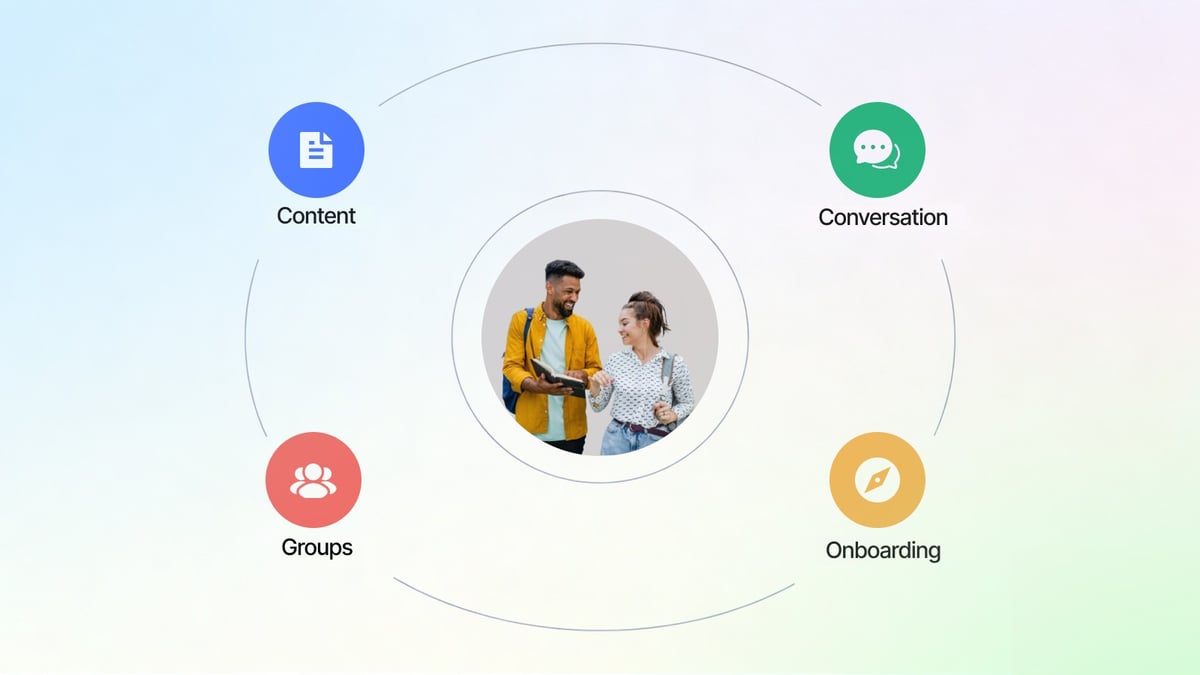
The answers live in your content, your conversation spaces, your groups, and your onboarding flow. When those pieces are thoughtfully designed and connected, the community feels welcoming and intuitive. When they’re fragmented or overbuilt, the experience feels heavy and confusing.
This playbook walks through how to design durable content, how to create clear spaces for conversation, when and why to introduce groups, and how onboarding ties it all together. The goal isn’t to get everything perfect at launch. It’s to create clarity that can grow with your community.
Start with durable content that anchors the community
Every community needs a foundation. In most cases, that foundation is content.
Durable content gives members something to orient around. It provides shared context, answers common questions, and creates a starting point for engagement. This might include guides, playbooks, walkthroughs, research, event recaps, or product updates, depending on the type of community you’re building.
Content works best when it’s organized by themes or challenges rather than by internal teams or roles. This makes it easier for members to cross-pollinate and see relevance beyond their immediate function.
When deciding what should live as content, ask a simple question. Is this something people will want to reference again? If the answer is yes, it probably belongs in a content collection rather than a conversational space.
Well-structured content:
- Is easy to find and scan.
- Can be updated over time without breaking context.
- Serves as a shared reference point for discussion.
- Reduces repetitive questions elsewhere in the community.
Starting with strong content doesn’t mean you’re prioritizing broadcasting over engagement. It means you’re giving conversations something solid to build on.
Design conversation spaces that are few, clear, and cross-functional
Once content is in place, conversation needs a home.
Conversation spaces might be forums, discussion boards, channels, or another format depending on the platform. The key isn’t the surface itself. It’s that conversations are clearly organized and easy to participate in.
One of the most common mistakes teams make is creating too many conversation spaces too early. Too much choice creates hesitation. Members shouldn’t have to stop and think about where something belongs.
Strong conversation structures usually start with a small number of spaces that are broad, cross-functional, and clearly named. Each space should serve a distinct purpose and be easy to explain in a single sentence.
Conversation spaces that consistently work well include:
- Introductions and connection, where people can say hello and share context.
- Practical tactics and playbooks, where members exchange concrete approaches and frameworks.
- Strategy and trends, where higher-level perspectives and big-picture conversations live.
- Peer advice and AMAs, where questions, discussion, and follow-ups naturally gather.
These spaces should be designed around how members think and behave, not around internal org charts. Role-based or segment-specific spaces usually work better later, once there’s enough activity to support them.
Clear descriptions and pinned guidance help members feel confident they’re engaging in the right place. This isn’t about rules. It’s about reducing friction and building participation.
Use tags to connect content and conversation without adding clutter
Content and conversation don’t exist in isolation. Tags are what tie them together.
Instead of creating new spaces for every topic, audience, or content type, tags add flexibility without increasing surface area. They help members filter, discover, and navigate without fragmenting the community.
Effective tagging systems are intentionally limited and consistently applied. They typically include:
- Theme tags that describe what the content or conversation is about.
- Format tags that describe how it shows up.
- Optional role or challenge tags that add context when it’s genuinely helpful.
Tags should feel obvious. If someone has to stop and debate which tag to use, the system is already too complicated. A smaller, well-maintained set of tags is far more effective than an exhaustive one.
Tags work best when they’re shared across content, conversation spaces, and events. This creates a consistent mental model where members can move between reading, watching, and discussing using the same language.
It’s also important to resist launching every possible tag on day one. Start with what you know you’ll need. Review usage regularly, merge duplicates, and add new tags only when clear patterns emerge.
Be deliberate about when and why to introduce groups or subcommunities
Groups and subcommunities can be powerful, but they’re also one of the fastest ways to fragment a community if they’re introduced too early.
The instinct to create groups usually comes from a good place. Teams want spaces for specific roles, customers, partners, regions, or programs. On paper, it feels organized. In practice, launching too many groups before there’s real density often leads to empty rooms, duplicated conversations, and members unsure where to engage.
A helpful rule of thumb is this: content creates shared understanding, conversation builds shared learning, and groups support sustained relationships around a clear, ongoing reason to gather.
Before creating a group, it’s worth asking a few grounding questions. What will people do here that they can’t already do elsewhere? What conversations will happen repeatedly, not just once? Who is responsible for stewarding this space over time?
Healthy communities tend to follow a progression. Conversations start in shared spaces. Patterns emerge. Only then do more focused or private spaces make sense.
Groups tend to work best for:
- Closed or curated cohorts, such as customer advisory boards or partner councils.
- Ongoing programs with a defined lifecycle, like beta testers or certification cohorts.
- High-density audiences with shared context, such as a large population in the same role or company stage.
- Sensitive or private discussions that don’t belong in open conversation spaces.
Groups are usually a poor fit when they’re created to mirror internal org charts, to “clean up” conversations prematurely, or to serve a hypothetical future need.
Another way to think about this distinction is that shared spaces answer “where does this conversation belong,” while groups answer “who should be having this conversation together, over time.”
If that second question doesn’t have a clear answer yet, it’s often better to wait.
How to decide what lives in content, conversation spaces, or groups
Clarity improves when each surface has a clear job.
A simple decision framework helps:
Content is for durability.
If something needs to be referenced, updated, or reused over time, it belongs in a content collection. This includes guides, product documentation, playbooks, and announcements.
Conversation spaces are for shared learning.
If something benefits from discussion, questions, or peer input, it belongs in a shared conversation space where others can learn from it.
Groups are for sustained relationships.
Groups should exist only when there’s clear evidence of ongoing engagement that benefits from a more focused or private space. They’re not a shortcut to engagement. They’re a response to it.
This framework also makes structure easier to explain to members. People don’t need to understand every feature. They just need to know where to start and how things connect.
Example: what this looks like during a product launch
It helps to see how these pieces come together in practice.
Imagine you’re launching a new feature.
First, you create durable content:
- A blog post announcing the feature and explaining why it matters.
- A walkthrough guide showing how to use it step by step.
These live in a content collection, since they’re meant to be referenced over time and updated if needed.
Next, you create a conversation entry point.
In a shared conversation space like Product Updates or Tactics & Playbooks, you publish a post that:
- Links to the blog post and walkthrough guide.
- Summarizes what’s new.
- Asks a specific question, such as how people plan to use the feature or what they want to explore next.
That post becomes the conversation hub. Members share reactions, ask questions, and offer feedback. The discussion stays in one place instead of being scattered across multiple assets.
As engagement grows, you may notice a subset of people who want deeper access or ongoing discussion. That’s the moment when a temporary group, like a beta or early adopters cohort, might make sense.
The loop stays clear. Content provides the foundation. Conversation enables shared learning. Groups deepen relationships only when there’s a sustained reason to do so.
Design onboarding to reinforce structure through action
Onboarding is where structure becomes real.
Most members won’t read long explanations of how your community works. They learn by doing. Onboarding should guide people toward a small number of meaningful actions that reinforce how the community is organized.
Effective onboarding often focuses on steps like:
- Completing a profile with just enough context to be useful.
- Exploring one or two high-value content areas.
- Joining a shared conversation and seeing how others participate.
- Introducing yourself in a dedicated space if one exists.
Each step quietly teaches structure. Members learn where to read, where to engage, and how different parts of the community connect.
It’s important not to overwhelm new members with options. Fewer paths early on lead to more confidence and participation later. Groups, in particular, should usually be introduced after someone has engaged and built context.
Onboarding is also the right time to set expectations. Make it clear that the community isn’t a support queue or a broadcast channel. It’s a space for shared learning, peer exchange, and thoughtful participation.
Evolve structure based on real signals, not guesses
Community structure is never finished.
The healthiest communities treat structure as a living system. They pay attention to how people actually behave, then adjust deliberately.
Useful signals to watch include:
- Similar questions or discussions appearing repeatedly.
- Members consistently using the same tags together.
- Content being referenced again and again in conversation.
- Requests for more focused or private spaces.
These signals tell you where to refine. Sometimes that means clarifying descriptions. Sometimes it means introducing a group. Sometimes it means simplifying what already exists.
What matters most is restraint. Every new surface adds complexity. Changes should solve real problems, not theoretical ones.
When members see that structure evolves in response to how they actually use the community, trust grows. The space feels cared for, not over-engineered.
Community structure principles cheat sheet
Use this as a quick reference when designing, reviewing, or explaining your community structure.
Start with clarity, not completeness.
Launch with only what members actually need. It’s easier to add later than to undo early complexity.
Content creates shared understanding.
Durable content anchors the community, reduces repetition, and gives conversations something to build on.
Conversation enables shared learning.
Conversation spaces exist so members can learn from each other, not just interact with content.
Groups are earned, not assumed.
Only introduce groups when there’s a clear, ongoing reason for the same people to gather over time.
Fewer surfaces beat perfect taxonomy.
Every new board, group, or channel adds cognitive load. Simplicity drives participation.
Design for how members think, not how teams are organized.
Avoid mirroring internal org charts. Structure should reflect member needs and behaviors.
Teach structure through action.
Onboarding should guide members to do the right things in the right places, not explain everything upfront.
Let behavior lead structure.
Patterns in usage are signals. Use them to evolve the community intentionally.
Optimize for confidence, not control.
When members feel sure they’re in the right place, engagement follows naturally.
Key takeaways
- Start with durable content that provides shared context.
- Design a small number of clear, cross-functional conversation spaces.
- Use tags to connect content and conversation before adding new surfaces.
- Treat groups as an earned layer, not a default.
- Introduce groups only when there’s density and a sustained reason to gather.
- Use onboarding actions to teach structure naturally.
- Let real usage patterns guide how structure evolves over time.
FAQ
What is the best way to structure a community?
The best community structures start with durable content, add clear spaces for shared conversation, and introduce groups only when there’s a sustained reason to gather. Each layer should have a distinct purpose and build on the one before it.
Do all communities need forums or discussion boards?
No. Some communities rely more on content, events, or programs. What matters isn’t having a forum, but having a clear place for conversation when discussion and peer learning are part of the experience.
How do I decide what should be content versus a discussion?
If something needs to be referenced or updated over time, it should live as content. If it benefits from questions, feedback, or shared learning, it should live in a conversation space that others can learn from too.
When should a community add groups or subcommunities?
Groups make sense once there’s clear engagement density and a repeated need for deeper or more private interaction. They work best as a response to existing behavior, not as a default structure at launch.
Why do too many groups hurt engagement?
Too many groups split attention and energy. When activity is spread too thin, conversations stall and members become unsure where to participate, which often leads to disengagement.
How many conversation spaces should a community start with?
Most communities do best starting with a small number of broad, cross-functional spaces. Fewer, clearer spaces reduce friction and make it easier for members to participate confidently.
What role does onboarding play in community structure?
Onboarding teaches members how the community works through action. When onboarding reinforces where to read, where to engage, and how things connect, members participate more quickly and confidently.
How often should community structure be revisited?
Structure should be reviewed regularly, but changed deliberately. Look for repeated patterns, confusion, or requests from members before making adjustments.
Like
Comments (0)
Popular

Dive in
Related
Resource
Mapping and Managing Your Community Ecosystem for Clarity and Impact
By Joshua Zerkel • Dec 3rd, 2025 • Views 59
Resource
Playbook: How to Measure Community Engagement During a Migration
By Patricia Feitosa • Jun 4th, 2026 • Views 18
31:24
Video
Event Replay: How to Drive Community Engagement (Live Q&A)
By Joshua Zerkel • Jul 22nd, 2026 • Views 30
Resource
Mapping and Managing Your Community Ecosystem for Clarity and Impact
By Joshua Zerkel • Dec 3rd, 2025 • Views 59
31:24
Video
Event Replay: How to Drive Community Engagement (Live Q&A)
By Joshua Zerkel • Jul 22nd, 2026 • Views 30
Resource
Playbook: How to Measure Community Engagement During a Migration
By Patricia Feitosa • Jun 4th, 2026 • Views 18