
Gradual Community
Ask

Playbook: How To Explain The Difference Between Community And Audience Inside Your Company
Playbook: How To Explain The Difference Between Community And Audience Inside Your Company
# Community
# Marketing & Growth
# Format: Playbooks
# Format: Resources

A practical guide for teams that need better internal language for what community is, how it works, and why it creates different kinds of value.

May 19, 2026 · Last updated on May 6, 2026
Ashley Williams
Ashley Williams
Joshua Zerkel
Joshua Zerkel
Playbook: How To Explain The Difference Between Community And Audience Inside Your Company
A surprising amount of internal confusion starts with a language problem. Many stakeholders hear the word community and map it to a channel, a mailing list, a Slack group, or a customer communication surface. From there, the strategy gets flattened before it has even been discussed.
That is why teams need a better internal explanation of the difference between community and audience.

Start with the relationship model

The simplest useful distinction is relational.
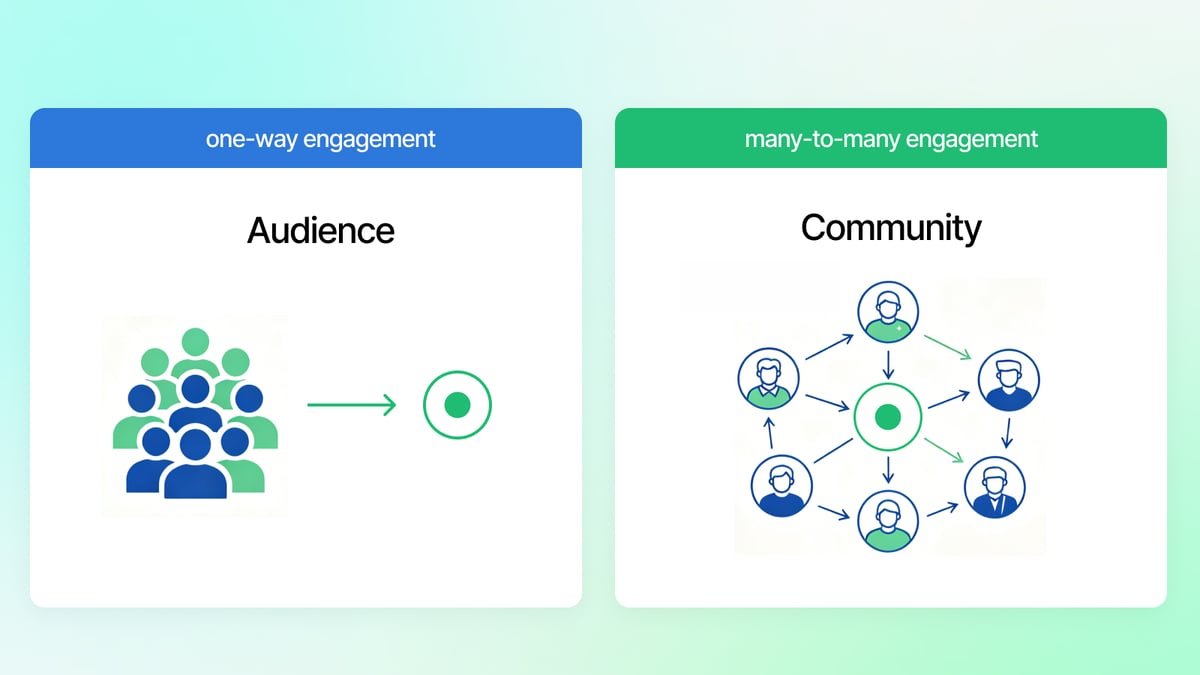
An audience is a group a brand speaks to. A community is a group people participate in together.
That difference shapes everything that follows. In an audience model, the primary motion is one-way distribution. The brand publishes, sends, announces, or broadcasts. People may react, but they are not the center of the exchange.
In a community model, the brand helps create the conditions for people to learn from one another, build relationships, and contribute back into the shared space. The brand is still involved, but it is not the only node that matters.
This is why Ashley described the brand less as a broadcaster and more as a facilitator. The role is closer to creating the environment than controlling every interaction.

Explain why the difference matters to the business

The difference between community and audience is not semantic. It affects what kind of value the business can expect.
An audience can be effective for reach, awareness, distribution, and direct response. Those are legitimate goals.
A community can produce something else:
  • Stronger peer trust
  • Richer qualitative signal
  • More resilient engagement
  • Ongoing feedback loops
  • Member-to-member support and learning
The point is not to diminish audience-building. It is to explain that community creates a different kind of system. That system can support business goals in ways that one-way communication cannot fully replace.

Show how confusion tends to happen

Many organizations confuse community with a communication channel. A common example is launching a Slack group so the company can send updates more easily and then calling that a community.
That does not mean the effort is worthless. A communication channel can still be useful. But the presence of a channel does not automatically create community.
Community depends on more than access. It depends on shared purpose, repeated interaction, mutual value, and space for people to connect with one another. Without those elements, the channel stays mostly transactional.
Explaining this internally can help teams avoid building strategy backward. The channel should support the community model. The model should not be invented after the channel has already been chosen.

Help stakeholders move from tool-thinking to strategy-thinking

Internal stakeholders often start with the most tangible question first: what platform should be used? That is understandable, but it can create false clarity. A team may feel like it is making progress because it has chosen a tool when the more important questions are still unresolved.
A better internal sequence is:
  • Why does this community need to exist?
  • Who is it for?
  • What value should participants get from it?
  • What business value could emerge from that?
  • Which channel or platform best supports that strategy?
This approach moves the conversation from tools to design. It helps stakeholders understand that a strong community strategy is not created by selecting software first.

Use examples that connect to their work

Internal education works best when it reflects the stakeholder’s own goals.
For marketers, explain how audience reach and community trust serve different purposes. For product teams, explain how a community can surface richer, contextual feedback. For customer success teams, explain the difference between broadcasting information and creating peer learning. For executives, explain why communities create earlier, more nuanced signal than dashboards alone.
The goal is to make the definition usable, not abstract.

Keep the explanation simple enough to repeat

The strongest internal explanation is usually the one that can survive repetition. It should be simple enough to use in meetings, strategy docs, onboarding conversations, and internal presentations without changing meaning every time.
A repeatable explanation might sound like this:
Community is not just a place to send updates. It is a structured way to bring people together so they can learn from one another, build trust, and create signal the business can act on.
That kind of language does not capture every nuance, but it gives the organization a more stable starting point.

Key takeaways

  • An audience is something a brand speaks to. A community is something people participate in together.
  • The difference matters because the business value is different.
  • A channel does not become a community just because people are present in it.
  • The strategy should come before the platform choice.
  • Internal explanations work best when they connect directly to stakeholder goals.

FAQ

What is the difference between community and audience?

An audience receives communication from a brand. A community creates space for people to engage with one another, not just with the brand.

Why do companies confuse community with a channel?

Because channels are visible and easy to name. Community is more relational and strategic, which makes it harder to define quickly.

Can a Slack group be a community?

It can be, but only if it creates shared purpose, repeated interaction, and member-to-member value. A Slack group used mainly for announcements is still mostly a channel.

Why should strategy come before platform?

Because the right platform depends on the purpose, audience, and relationship model the community is meant to support.
Comments (0)
Popular
avatar

Table Of Contents
Dive in

Related

Resource
Playbook: Mapping and Managing Your Community Ecosystem
By Bill Johnston • Dec 5th, 2025 Views 20
Resource
Playbook: Applying Peer and Engagement Insight Inside GTM Decisions
By Joshua Zerkel • Feb 13th, 2026 Views 18
Blog
Building Together: Inside the Gradual Community
By Joshua Zerkel • Oct 30th, 2025 Views 63
Resource
Playbook: How to Track Revenue Signals from Community
By Anthony DeShazor • Oct 1st, 2025 Views 48
Resource
Playbook: Mapping and Managing Your Community Ecosystem
By Bill Johnston • Dec 5th, 2025 Views 20
Blog
Building Together: Inside the Gradual Community
By Joshua Zerkel • Oct 30th, 2025 Views 63
Resource
Playbook: How to Track Revenue Signals from Community
By Anthony DeShazor • Oct 1st, 2025 Views 48
Resource
Playbook: Applying Peer and Engagement Insight Inside GTM Decisions
By Joshua Zerkel • Feb 13th, 2026 Views 18
© 2026 Gradual Community
Privacy Policy
Your Privacy Choices