
Gradual Community

Playbook: How To Turn Internal Skeptics Into Community Champions
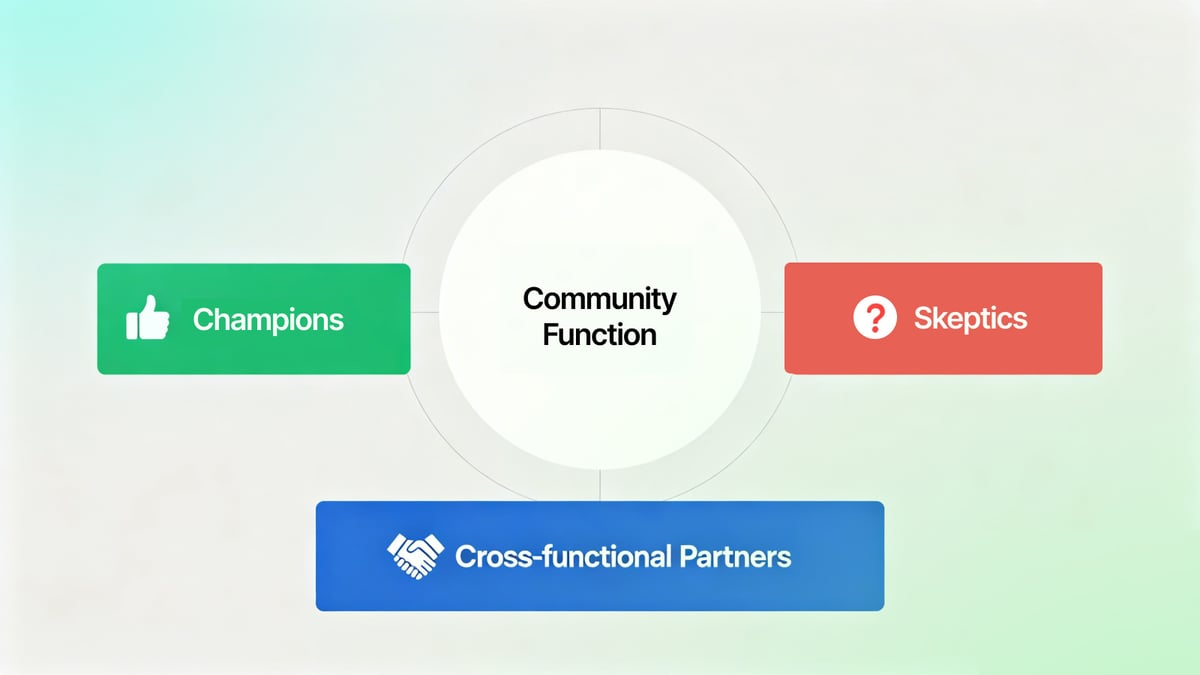
Playbook: How To Turn Internal Skeptics Into Community Champions
# Community
# GTM Strategy
# Format: Playbooks
# Format: Resources

Practical steps for earning buy-in, building trust, and making community easier for the rest of the business to understand.

May 7, 2026 · Last updated on May 6, 2026
Ashley Williams
Ashley Williams
Joshua Zerkel
Joshua Zerkel
Playbook: How To Turn Internal Skeptics Into Community Champions
Internal skepticism is one of the most common barriers to strong community work. It slows decisions, fragments support, and makes it harder for the function to grow. Most of the time, though, skepticism does not begin as active resistance. It begins as uncertainty.
A skeptical stakeholder may not understand what community is, how it differs from other channels, or how it helps their team. That makes internal trust a clarity problem before it becomes a persuasion problem.
This playbook outlines a practical process for turning skepticism into support.

Start with stakeholder discovery

Before trying to persuade anyone, get a clearer view of the internal landscape. That means identifying not only formal stakeholders, but also adjacent teams, likely champions, and likely skeptics.
The goal at this stage is not to pitch. It is to understand what people think community is for, what they hope it can unlock, and where confusion already exists.
Useful questions include:
  • What do you hope community could help your team accomplish?
  • Where do you see overlap between your work and community?
  • What would make community more useful to you?
  • Who else should be part of this conversation?
This process often reveals two things at once. It surfaces the expectations people already carry, and it shows where education will be needed. It also helps build a working map of who is likely to advocate, who will need more context, and where early partnership is most realistic.

Clarify the “what” and the “why”

Many community teams spend too much time describing activities and not enough time describing intent. A clearer explanation starts with purpose.
A good internal explanation of community should answer:
  • What the team is building
  • Why that strategy makes sense for the company right now
  • How the work connects to business goals
  • Where a specific stakeholder fits into the picture
This is where a strong elevator pitch matters. The pitch should be short enough to use in live conversation and specific enough to avoid vague category language.
For example, instead of saying the team is “building community,” explain how the function helps connect users, surface insight, support adoption, strengthen peer relationships, or create feedback loops that other teams can act on. The goal is to make community legible in business terms without flattening what makes it distinct.

Spend more time with skeptics

Community leaders often stay close to people who already understand the work. That support matters, but it rarely changes the broader internal narrative.
More progress usually comes from spending time with skeptics. These conversations can feel slower and less comfortable, especially when the stakeholder is unclear, frustrated, or dismissive. Still, they are often where trust begins.
A productive skeptic conversation usually includes three moves:
  • Start with their goals, not the team’s talking points
  • Explain the strategy in plain language
  • Connect the work to something they already care about
This does not always lead to immediate enthusiasm. Some stakeholders need to see the impact before they believe in the value. That is normal. The point is to keep the conversation moving until the work becomes easier for them to understand and easier to support.

Build repeatable internal communication

Trust grows through repetition. One clear meeting can help, but most organizations need to hear the same message several times in several places before it lands.
That is why internal communication should be treated as operational work, not as a side task.
A strong internal communication rhythm often includes:
  • A recurring update with progress, outcomes, and next steps
  • A short deck or one-pager explaining the strategy
  • Clear, reusable language for common questions
  • Live presentations to teams that want deeper context
The most effective updates are easy to scan. They avoid large blocks of text, show concrete progress, and make stakeholder alignment visible. When possible, include which teams are involved, what decisions have been made, and what outcomes are starting to appear. This does two things. It builds awareness, and it reduces the amount of repetitive clarification needed later.

Answer the questions before they’re asked

Every community team hears the same internal questions over time. Has this been approved? Who is this for? Why this platform? How does this help the business? What makes this different from email, support, or events?
These questions should not be handled as recurring surprises. They should be pre-answered in the team’s core materials.
That means building documentation and communication assets that already address likely uncertainty. A one-pager, kickoff deck, strategy memo, or regular update should anticipate the questions that slow trust down.
This approach frees up conversations for higher-value discussion. Instead of spending the whole meeting clarifying basics, the team can spend more time discussing how to collaborate, where to test value, or which business goals to support next.

Keep showing the work in context

A skeptic becomes a champion when the work becomes real to them. Sometimes that happens through a direct collaboration. Sometimes it happens when a result clearly supports their team. Sometimes it happens slowly, after several conversations.
This is why internal education should not stop after a launch or strategy review. Keep connecting the work to changing company priorities. Keep updating the story as the program evolves. Keep showing how community works in practice.
That last part matters especially in growing organizations. Community teams can lose internal support when they continue to describe the function the same way even after the company’s needs have changed. The strongest internal narrative is the one that keeps pace with the business.

Key takeaways

  • Internal skepticism usually starts with confusion, not hostility.
  • Stakeholder discovery should happen before persuasion.
  • A strong elevator pitch explains both the “what” and the “why” of the strategy.
  • Skeptics often become supporters after direct, patient conversations.
  • Regular internal communication is one of the most effective trust-building tools a community team has.

FAQ

Why do community leaders need to spend time on internal education?

Because community is often misunderstood inside organizations. Without internal clarity, even strong external programs can struggle to gain support.

How do you explain community to a skeptical stakeholder?

Connect the explanation to their goals. Show what the team is building, why it matters now, and how it can help solve something they already care about.

What makes an internal community update effective?

It should be easy to scan, grounded in concrete progress, and clear about stakeholders, outcomes, and next steps.

When does a skeptic usually become a champion?

Usually after they see how community supports their team or the broader business in a concrete way. This often takes more than one conversation.
Comments (0)
Popular
avatar

Table Of Contents
Dive in

Related

Video
Context First: Community Converts – Turning Skeptics into Champions
By Ashley Williams • Apr 1st, 2026 Views 28
Resource
Playbook: Turning Community Insights into Business Impact
By Brian Oblinger • Dec 5th, 2025 Views 24
Resource
Playbook: Building Internal Champions for Community Work
By Holly Firestone • Mar 4th, 2026 Views 26
Resource
Playbook: Translating Community Value Into Internal Alignment
By Holly Firestone • Mar 2nd, 2026 Views 21
Video
Context First: Community Converts – Turning Skeptics into Champions
By Ashley Williams • Apr 1st, 2026 Views 28
Resource
Playbook: Building Internal Champions for Community Work
By Holly Firestone • Mar 4th, 2026 Views 26
Resource
Playbook: Translating Community Value Into Internal Alignment
By Holly Firestone • Mar 2nd, 2026 Views 21
Resource
Playbook: Turning Community Insights into Business Impact
By Brian Oblinger • Dec 5th, 2025 Views 24
© 2026 Gradual Community
Privacy Policy