
Gradual Community

Playbook: Identifying the Customer Signals That Actually Influence Strategy
Playbook: Identifying the Customer Signals That Actually Influence Strategy
# GTM Strategy
# Format: Playbooks

How leadership teams determine which customer signals matter and which ones remain noise.

April 21, 2026
Joshua Zerkel
Joshua Zerkel
Playbook: Identifying the Customer Signals That Actually Influence Strategy
Most organizations today have the opposite problem they had ten years ago. Signals from customers are not scarce. They are everywhere.
Product teams see usage behavior across features and workflows. Customer success hears feedback during onboarding and renewal conversations. Marketing teams observe engagement patterns across campaigns, content, and community discussions. Sales teams hear objections, urgency, and buying signals in every deal cycle.
All of these signals contain valuable information about the customer experience. The challenge is that not all signals deserve equal attention. Some represent isolated feedback. Others point to meaningful shifts in customer needs or market direction.
Leadership teams that consistently translate signals into strategic decisions tend to develop a shared understanding of which signals carry the most weight. Without that clarity, organizations risk reacting to whichever signal happens to be loudest in the moment.
A useful way to think about signal identification is not as data analysis, but as pattern recognition. Strategic signals usually reveal themselves through consistency, convergence, and context.

Start with signal consistency

The first characteristic of a strategic signal is repetition. When a pattern appears repeatedly across different customers or situations, it becomes more difficult to dismiss as anecdotal.
Consistency often appears in subtle ways. Customer success managers may notice similar onboarding questions across several accounts. Product teams may observe customers using a feature in an unexpected way. Marketing teams may hear prospects describe their challenges with nearly identical language.
These patterns are early indicators that something meaningful is happening in the market.
Signals that deserve leadership attention often share a few traits:
  • The signal appears across multiple customers or accounts
  • The theme emerges over time rather than in a single interaction
  • The signal reflects behavior rather than preference alone
  • The pattern suggests a shift in customer priorities or workflows
Organizations that develop internal habits around noticing these patterns are often better positioned to respond early.

Look for signal convergence across teams

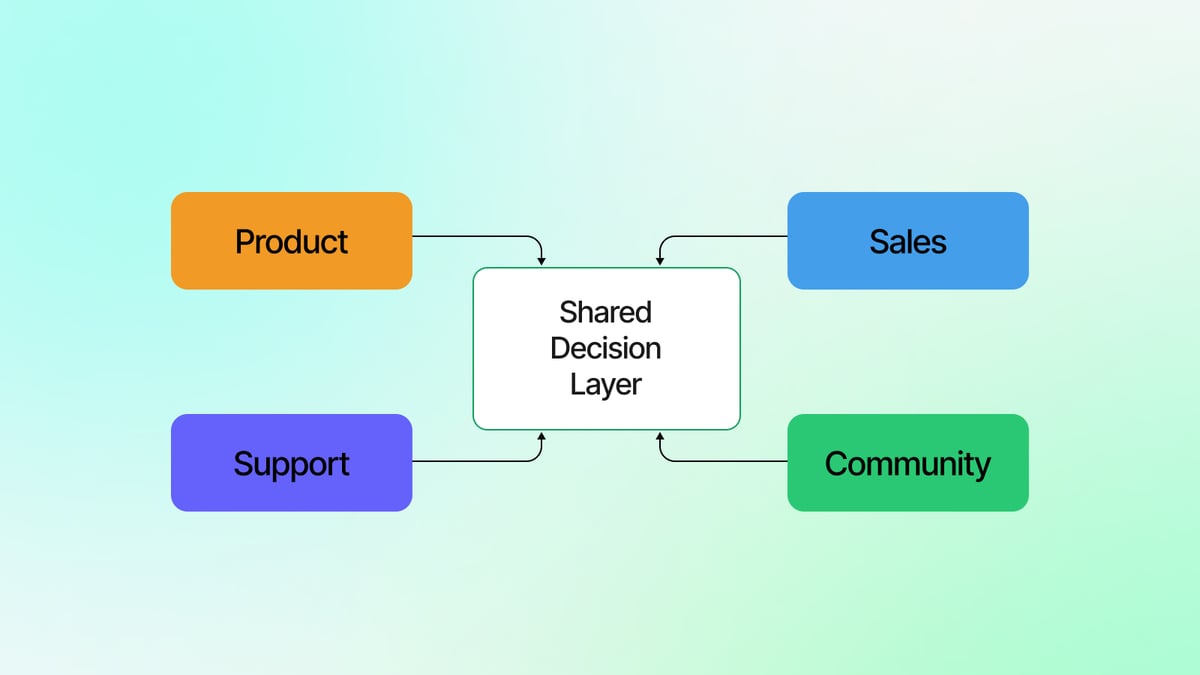
Consistency alone is helpful, but convergence is even more powerful. Signals become more credible when they appear across different functions inside the organization.
A customer concern raised during a sales conversation may gain importance if the product team is seeing the same issue reflected in usage data. Community discussions may reveal themes that later appear in support conversations or onboarding calls.
When signals surface across multiple channels, they form a stronger narrative about the customer experience.
  • Cross-functional convergence often looks like this:
  • Sales hears a recurring objection during late-stage conversations
  • Customer success notices related friction during onboarding
  • Product analytics reveals unusual behavior around the same feature
  • Marketing observes prospects describing the same challenge
Individually, each signal might appear modest. Together, they reveal a deeper pattern.
Organizations that create space for cross-functional signal sharing tend to identify strategic signals earlier because they connect insights that would otherwise remain isolated.

Context determines signal importance

Even strong signals require context. Not every pattern deserves a strategic response.
A signal becomes strategically meaningful when it connects to broader questions about customer outcomes, product direction, or market positioning. Leadership teams often evaluate signals through the lens of impact.
Useful questions include:
  • Does this signal reflect a widespread customer challenge?
  • Could this pattern influence retention, expansion, or acquisition?
  • Does the signal point to a shift in how customers use the product?
  • Could responding to this signal create a competitive advantage?
Signals that align with meaningful business outcomes are more likely to influence strategic decisions.

Build shared signal interpretation

One of the most overlooked aspects of signal identification is interpretation. Data rarely explains itself. Signals gain meaning when teams interpret them together.
Organizations that consistently translate signals into decisions often create simple rituals where cross-functional leaders compare what they are seeing. These discussions allow teams to place signals into a broader customer narrative.
Shared signal interpretation typically involves:
  • Bringing signals from multiple functions into the same conversation
  • Comparing patterns rather than isolated anecdotes
  • Connecting signals to real customer workflows and outcomes
  • Discussing potential implications for roadmap or GTM strategy
When teams interpret signals collectively, they develop a shared understanding of which signals matter most.

Key takeaways

  • Strategic signals rarely stand out immediately. They emerge through patterns, convergence, and shared interpretation.
  • Consistent signals across customers often reveal meaningful patterns
  • Signals gain credibility when they appear across multiple teams
  • Context determines whether a signal deserves strategic attention
  • Cross-functional conversations improve signal interpretation
  • Shared understanding helps leadership teams respond confidently

FAQ

What is a customer signal? A customer signal is any observable behavior, feedback, or engagement pattern that reveals how customers experience a product or service.
Why do many signals never influence strategy? Signals often remain within the teams that collect them. Without cross-functional interpretation, they rarely reach leadership discussions.
What makes a signal credible? Signals become credible when they appear consistently across customers and converge across multiple channels or teams.
How can organizations identify strategic signals earlier? By creating regular cross-functional conversations where teams compare what they are seeing across product, sales, marketing, and customer success.
Comments (0)
Popular
avatar

Table Of Contents
Dive in

Related

Resource
The Context First Framework: Turning Customer Signals Into Strategy
By Joshua Zerkel • Apr 16th, 2026 Views 12
Resource
Playbook: Building a Reddit Engagement System That Creates Shared Customer Context
By Jeremie Gluckman • Mar 12th, 2026 Views 32
Resource
Playbook: Designing Peer Moments That Actually Move Work Forward
By Joshua Zerkel • Feb 11th, 2026 Views 38
Resource
Playbook: How to Build a Focused Community Strategy That Delivers Impact
By Bill Johnston • Dec 5th, 2025 Views 14
Resource
The Context First Framework: Turning Customer Signals Into Strategy
By Joshua Zerkel • Apr 16th, 2026 Views 12
Resource
Playbook: Designing Peer Moments That Actually Move Work Forward
By Joshua Zerkel • Feb 11th, 2026 Views 38
Resource
Playbook: How to Build a Focused Community Strategy That Delivers Impact
By Bill Johnston • Dec 5th, 2025 Views 14
Resource
Playbook: Building a Reddit Engagement System That Creates Shared Customer Context
By Jeremie Gluckman • Mar 12th, 2026 Views 32
© 2026 Gradual Community
Privacy Policy