
Playbook: Marketing Your Community Is Part of Building It
# Community
# Format: Playbooks
Communities grow when positioning, distribution, onboarding, and engagement are treated as part of the community strategy from the beginning.
July 9, 2026 · Last updated on June 29, 2026
Joshua Zerkel
Launching a community is often treated as a milestone. The platform goes live, members are invited, events are scheduled, and resources are published. After months of planning, there is a natural sense that the hard part is behind you.
In reality, launch is usually the point where a different kind of work begins.
Building the community creates the environment where participation can happen. Growing the community requires helping people discover it, understand its value, experience that value for themselves, and develop habits that bring them back over time. Those activities are closely connected, but they solve different problems.
This distinction matters because community adoption rarely happens automatically. People are already balancing competing priorities, overflowing inboxes, and more information than they can reasonably consume. Even a thoughtfully designed community has to earn attention and demonstrate relevance before participation becomes part of someone's routine.
When community growth feels slower than expected, the issue is often not the quality of the community itself. More often, there are gaps between the value being created and the ways people encounter, understand, and experience that value. Addressing those gaps requires thinking about marketing as part of the community-building process rather than an activity that happens before or after it.
The strongest communities invest not only in creating valuable experiences, but also in creating clear pathways that help people discover and participate in those experiences. That work begins long before launch and continues long after the initial excitement fades.
Start with a clear community promise
Before someone joins a community, they are making a decision about whether participation will be worth their time.
That decision is rarely based on the platform, the technology, or even the features available inside the community. It is usually based on a much simpler question: what will this help me accomplish?
Communities can struggle with adoption when their value proposition is framed around the existence of the community itself rather than the outcomes members can achieve by participating. Networking, collaboration, discussion, and engagement all sound positive, but they are broad concepts that leave a lot of room for interpretation.
People are usually looking for something more concrete. They want to learn from peers facing similar challenges. They want practical guidance they can apply in their work. They want access to perspectives and experiences that help them make better decisions. They want to feel connected to people who understand the context in which they operate.
A strong community promise makes those outcomes visible.
Questions worth answering include:
- Who is this community designed for?
- What challenges does it help members navigate?
- What kinds of conversations happen here?
- What can members learn from one another?
- Why is this worth returning to over time?
The goal isn’t to create a clever positioning statement, but to help potential members quickly recognize themselves in the community and understand why participation may be valuable.
That clarity becomes especially important once the community begins reaching a broader audience. Distribution becomes significantly easier when people immediately understand who the community is for, what role it can play in their work, and how participation supports their goals.
Distribution is part of the community experience
Community leaders sometimes think about distribution as something that happens outside the community.
The community team builds the destination. Marketing helps people find it. Customer success mentions it to customers. Product teams may reference it during onboarding or education. Each group contributes in different ways, creating the impression that distribution sits adjacent to the community experience itself.
In practice, the two are closely connected.
Every interaction someone has before joining helps shape their expectations about what the community is and why it matters. The invitation they receive, the event that introduces them to the community, the recommendation from a customer success manager, or the discussion that surfaces during onboarding all influence how they understand the value of participating.
This is why distribution deserves as much intentionality as the spaces, events, and programs that exist inside the community.
Useful distribution channels often include:
- Customer onboarding
- Events and webinars
- Resource centers
- Newsletters
- Customer success conversations
- Product education experiences
- Partner ecosystems
- Sales conversations
It’s not just to increase visibility; visibility alone won’t create participation. What matters is helping people encounter the community in moments where its value feels immediately relevant to a challenge they are already trying to solve.
A customer attending an educational webinar may want to continue the conversation with peers. Someone navigating a new responsibility may benefit from hearing how others approached a similar challenge. A new customer may appreciate access to people who recently completed the same journey.
When community appears in those moments, it feels useful rather than promotional. The invitation arrives with context, and the value is easier to understand because it is connected to something that already matters to the member.
Build community into the customer journey
One challenge with community adoption is that it often relies on memory.
Someone receives an invitation, joins the platform, and then returns to the rest of their work. Days or weeks later, they vaguely remember that the community exists but have little reason to revisit it. Nothing is necessarily wrong with the community. It simply has not become part of the member's existing workflow or habits.
This is one reason standalone communities can struggle to maintain participation.
A stronger approach is to integrate community into the broader customer journey. Customers already engage with an organization through onboarding programs, educational content, events, product experiences, customer success interactions, and support resources. Each of these moments creates an opportunity to introduce community experiences that feel immediately relevant.
Examples include:
- Extending event conversations into community discussions
- Connecting educational content to peer learning opportunities
- Introducing new customers to experienced members
- Surfacing community resources during onboarding
- Recommending discussions tied to customer goals or interests
This approach changes the role community plays within the customer experience.
Instead of asking members to remember another destination, community shows up naturally within experiences they’re already having. Participation becomes easier because discovery happens in context, and members can immediately see how the community connects to the challenges they are trying to solve.
The benefits extend beyond the community team. Marketing gains a deeper engagement channel. Customer success gains opportunities for peer learning. Product teams gain richer customer context. Members gain relationships and perspectives that extend beyond their direct interactions with the company.
Over time, community becomes less of a destination and more of a connective layer that strengthens the broader customer ecosystem.
Treat participation as an onboarding challenge
Awareness is only the beginning of adoption.
A person can join a community with every intention of participating and still never return. This often happens because joining feels clear while participating feels ambiguous. The member arrives, explores a few spaces, reads a discussion or two, and then leaves without experiencing meaningful value.
The challenge is awareness followed by activation.
Strong communities recognize that participation is a learned behavior. New members need help understanding where to begin, how to navigate the space, and what actions are most likely to lead to a valuable experience. Without that guidance, even highly engaged members can struggle to find their footing.
Helpful onboarding experiences often include:
- Welcome journeys
- Recommended first actions
- Curated resource collections
- Introductions to key discussions
- Event recommendations
- Peer connections
Each of these elements serves the same purpose: reducing friction between joining and experiencing value.
The goal is to help members achieve something meaningful as quickly as possible. That outcome may be finding a useful resource, meeting a peer, attending an event, or discovering an answer to a pressing question.
When people experience value early, they develop confidence that the community is worth returning to. That confidence becomes the foundation for deeper participation over time.
Keep creating reasons to return
Joining is a moment. Community growth happens through repetition.
Members return because they continue finding value in the experience. They discover useful conversations, attend events that help them learn, build relationships with peers, and encounter new ideas they can apply in their work. Each interaction reinforces the decision to participate again.
This is why recurring experiences play such an important role in community growth.
Consistent programming creates opportunities for members to reconnect with both the community and the people within it. Familiar names become familiar people. Individual conversations become ongoing relationships. The community gradually becomes part of a member's professional routine rather than something they occasionally remember exists.
Communities often create this rhythm through:
- Recurring events
- Community newsletters
- Peer roundtables
- Expert sessions
- Resource releases
- Member spotlights
The specific format matters less than the consistency.
People develop habits when they know what to expect. They build trust when experiences repeatedly deliver value. They build relationships when they encounter the same people over time.
From the outside, this growth can appear gradual. Inside the community, however, those repeated interactions are steadily creating the connections and trust that make long-term participation possible.
Community growth is a shared responsibility
Community growth is sometimes viewed as the responsibility of the community team alone. While community teams play an important role, adoption is influenced by nearly every function that interacts with customers.
Marketing creates awareness. Customer success builds relationships. Product teams contribute expertise and education. Sales helps prospects understand the ecosystem surrounding a company. Support teams encounter the challenges that frequently bring people into community spaces.
Each team has opportunities to connect people with relevant community experiences.
Supporting this effort doesn’t require complicated processes. In many cases, simple enablement materials can make a significant difference:
- Consistent positioning language
- Recommended introduction points
- Links to relevant events and discussions
- Community success stories
- Internal enablement resources
These tools help teams understand how community creates value and when it makes sense to introduce it as part of the customer journey.
Over time, community growth becomes less dependent on launch campaigns and more dependent on a network of people helping others discover useful experiences. Awareness increases because more teams understand the role community plays. Participation increases because members encounter community in relevant contexts. Value becomes easier to communicate because more people have seen it firsthand.
That shift is often what distinguishes communities that remain peripheral from communities that become an important part of how people learn, connect, and succeed.
Key takeaways
- Building a community and growing a community are separate challenges.
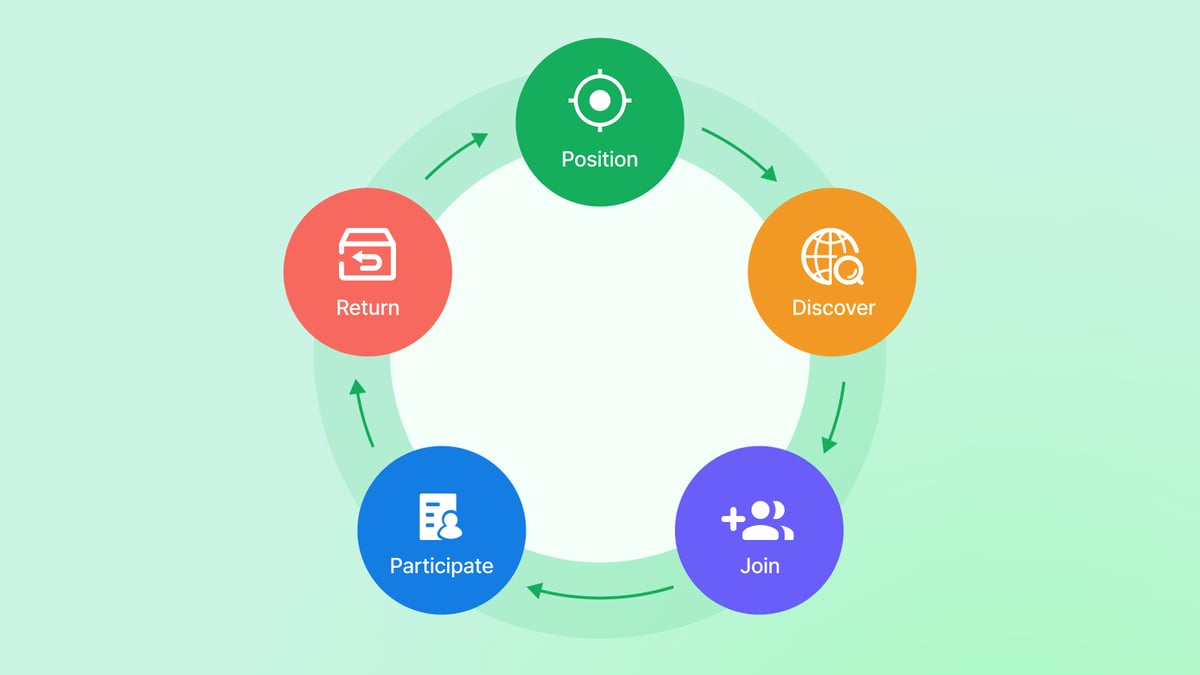
- Community adoption depends on positioning, distribution, onboarding, and ongoing engagement.
- Distribution should be designed into the community experience from the beginning.
- Participation increases when community is integrated into existing customer journeys.
- Sustainable growth comes from creating recurring opportunities for members to experience value.
FAQ
Why isn't launching a community enough to drive growth?
A launch creates awareness, but awareness alone rarely creates participation. People need clear reasons to join, engage, and return before community growth becomes sustainable.
What role does marketing play in community growth?
Marketing helps people discover the community and understand its value. Effective community growth combines positioning, distribution, onboarding, and ongoing engagement.
How can organizations increase community participation?
Participation improves when members can quickly experience value. Strong onboarding, relevant programming, peer connections, and recurring engagement opportunities all contribute to adoption.
Who should be responsible for community growth?
Community growth works best as a shared effort across marketing, customer success, product, sales, support, and community teams. Each function creates opportunities to connect people with valuable community experiences.
Like
Comments (0)
Popular

Dive in
Related
Resource
Playbook: Building Internal Champions for Community Work
By Holly Firestone • Mar 4th, 2026 • Views 29
Resource
Playbook: Preparing Your Community For A Migration
By Ryan Paredez • Feb 24th, 2026 • Views 25
Resource
Community Engagement Playbook: Building (and Rebuilding) Participation
By Joshua Zerkel • Dec 4th, 2025 • Views 49
Resource
The Engagement Marketing Playbook: Combining Education, Lifecycle, and Community
By Joshua Zerkel • Sep 22nd, 2025 • Views 31
Resource
Playbook: Building Internal Champions for Community Work
By Holly Firestone • Mar 4th, 2026 • Views 29
Resource
Community Engagement Playbook: Building (and Rebuilding) Participation
By Joshua Zerkel • Dec 4th, 2025 • Views 49
Resource
The Engagement Marketing Playbook: Combining Education, Lifecycle, and Community
By Joshua Zerkel • Sep 22nd, 2025 • Views 31
Resource
Playbook: Preparing Your Community For A Migration
By Ryan Paredez • Feb 24th, 2026 • Views 25