
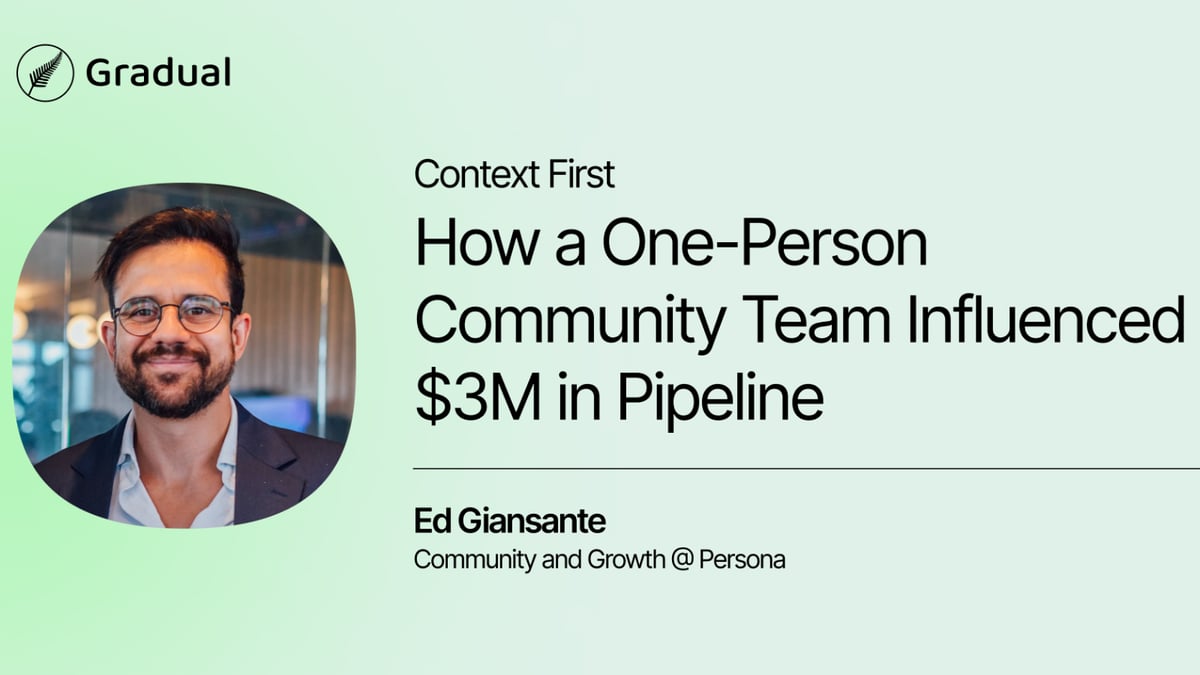
Event Recap: How Ed Giansante Built a One-Person Community Team That Influenced $3M in Pipeline
# Format: Event Recaps
# Community
# GTM Strategy
Ed Giansante shares how a one-person community team at Persona influenced more than $3M in pipeline through events, AI, tracking, and sales partnership.
July 9, 2026
Joshua Zerkel

Ed Giansante
One thing I've seen over and over again in community work is that the value is usually real long before it's legible.
People are building relationships. Customers are learning from each other. Prospects are finding peers who are wrestling with the same problems. Product teams are hearing feedback they wouldn't have uncovered through a survey. Sales teams are picking up context that never would have shown up in a CRM.
Eventually, someone asks the question every community leader hears.
"How does this contribute to the business?"
I've never thought that's an unreasonable question. If community is going to be treated as a strategic function, it has to participate in strategic conversations. That means connecting community work to outcomes the rest of the business already understands.
That's why I was excited to host Ed Giansante for Context First. Ed leads Community at Persona , and over the past two years built a program that influenced more than $3M in pipeline on roughly $56K in annual spend. He did it as a team of one.
The pipeline number is what gets attention. The operating model behind it is what makes the story useful.
Throughout our conversation, Ed kept coming back to four ideas: AI-powered operations, VIP experience design, disciplined measurement, and close partnership with sales. None of them were particularly flashy. Together, they created a system that scaled far beyond what most people would expect from one person.
The program started before it was polished
One part of Ed's story that stuck with me had nothing to do with pipeline.
When he moved to San Francisco, he didn't know many people. So he started inviting people to get together. There wasn't a grand strategy behind those first events. They were opportunities to meet people, build relationships, and see what happened next.
I've seen that pattern before. A lot of community leaders assume they need the perfect strategy before they invite the first people into a room. In practice, most of the useful learning happens after people start showing up.
Every event teaches you something.
- Who accepted the invitation?
- Who brought a colleague?
- Who stayed after everyone else had left?
- Who introduced two people that should have known each other already?
Programs mature because leaders notice those patterns and make small adjustments over time.
By the time Ed's events evolved into curated executive dinners, he had already spent months learning what kinds of conversations created the most value for participants. That experience became the foundation for everything that followed.
AI created leverage, not the experience
Whenever AI comes up in community conversations, I think it's worth separating where it helps from where it doesn't.
People don't join communities because they're hoping to spend more time talking to AI. They join because they're looking for other people. I've said before that AI may be the vehicle for connection, but humans are still the reason people show up. Ed's approach reflected that same mindset.
Running dozens of events each year means the operational work starts to pile up quickly. Researching attendees. Preparing introductions. Sending invitations. Following up afterward. Looking for patterns. Connecting activity back to accounts.
Early on, Ed handled much of that work manually. Once those workflows became predictable, AI helped reduce the operational burden. That's an important distinction. AI didn't replace the judgment, it created more room for it. The conversations, relationships, and decisions still belonged to the human running the program.
The room matters more than the restaurant
I've hosted enough dinners over the years to know that people rarely remember the menu. They remember who they met.
Ed spent a lot of time talking about experience design, and I appreciated that he broadened the definition beyond food, venues, or logistics. The experience starts long before someone sits down.
- Who's invited?
- Why are they there?
- Will they meet people they wouldn't normally have access to?
- Will the conversation justify giving up an evening away from family or work?
Those questions matter much more than finding the perfect restaurant.
One point Ed made that I immediately wrote down was the idea that every host should have an internal agenda. Guests shouldn't feel like they're attending a sales meeting. The host, however, should know exactly why the room exists.
- What relationships are you hoping to strengthen?
- What questions are worth asking?
- What would success look like by the end of the evening?
That preparation creates structure without making the experience feel structured.
Tracking makes community easier to understand
Community teams often know they're creating value. Explaining that value is another challenge entirely.
Ed was refreshingly practical about measurement. Executives already have a language they use to make decisions. Pipeline. Retention. Expansion. Revenue. Cost savings. Risk reduction.
Community doesn't need to abandon its own metrics. Participation still matters. Relationships still matter. Trust still matters.
Eventually, though, someone has to connect those signals to outcomes the rest of the company already understands. I've always thought of that as translation more than attribution. Community leaders spend a lot of time collecting context. The work becomes much more influential when that context can travel into sales, product, customer success, and leadership without losing its meaning along the way.
Sales partnership protects the relationship
One idea Ed returned to several times was that community isn't there to replace sales. It's there to make sales smarter.
I've seen companies unintentionally undermine great community experiences by treating the event itself as the sales opportunity. Someone spends two hours in a thoughtful dinner with peers. The next morning they receive a generic sales email. That disconnect is hard to recover from.
The better handoff is built around context. Sales should understand who attended, what conversations happened, what challenges surfaced, and whether follow-up even makes sense yet. Relationships move at different speeds. Community helps create trust. Sales helps build on that trust when the timing is right.
Those aren't competing motions. They're complementary ones.
Start smaller than you think
Toward the end of our conversation, I asked Ed what advice he'd give someone who wanted to start doing this themselves. His answer surprised me in its simplicity.
- Book a table.
- Invite six or eight people.
- Ask your sales or customer success team who should be there.
- See what happens.
I like advice like that because it's immediately actionable. Too many community strategies begin with scaling. Very few begin with learning. Small groups create tighter feedback loops.
- They're easier to facilitate.
- They're easier to follow up with.
- They're easier to improve.
Looking back at our conversation, I don't think the headline is really about influencing $3M in pipeline. It's about building enough repeatable systems that one person can consistently create meaningful customer experiences, preserve the context that comes out of them, and help the rest of the business make better decisions.
The revenue followed because the system worked.
Key takeaways
- Community becomes more strategic when its value can be translated into business outcomes.
- AI creates leverage by reducing repetitive operational work, not by replacing human relationships.
- Curated experiences begin with thoughtful guest lists, not expensive venues.
- Customer context becomes more valuable when it's preserved and shared across teams.
- Small, repeatable systems often outperform ambitious programs that never get off the ground.
FAQ
How did Ed Giansante influence $3M in pipeline?
He built a repeatable community operating model centered on curated events, AI-supported operations, disciplined measurement, and close partnership with sales.
Why are curated dinners effective community events?
Small, thoughtfully curated groups create stronger conversations, better peer connections, and richer customer context than many larger networking events.
What role should AI play in community management?
AI is most valuable for repetitive operational work like research, preparation, follow-up, and synthesis, giving community teams more time for relationship building.
What's the best way to get started with executive community events?
Start with a small dinner of six to eight carefully selected participants, learn from the experience, and improve the system before expanding.
Like
Comments (0)
Popular

Dive in
Related
29:25
Video
Event Replay: Context First: How a One-Person Community Team Influenced $3M in Pipeline
By Ed Giansante • Jul 9th, 2026 • Views 40
28:19
Video
Event Replay: Four Places to Look When Engagement Starts to Slip
By Helen Miller • Oct 23rd, 2026 • Views 6
29:44
Video
Event Replay: From Attendee to Advocate: How Product-Led Events Drive Feedback, Early Access, and Loyalty
By Hillarie Ralston • Oct 21st, 2026 • Views 43
29:25
Video
Event Replay: Context First: How a One-Person Community Team Influenced $3M in Pipeline
By Ed Giansante • Jul 9th, 2026 • Views 40
28:19
Video
Event Replay: Four Places to Look When Engagement Starts to Slip
By Helen Miller • Oct 23rd, 2026 • Views 6
29:44
Video
Event Replay: From Attendee to Advocate: How Product-Led Events Drive Feedback, Early Access, and Loyalty
By Hillarie Ralston • Oct 21st, 2026 • Views 43