
Gradual Community
Ask

How Community Adds Value Across GTM
How Community Adds Value Across GTM
# Community
# GTM Strategy

Why community gives marketing, sales, brand, product, and customer teams better context for the conversations they already need to have.

June 8, 2026
Joshua Zerkel
Joshua Zerkel
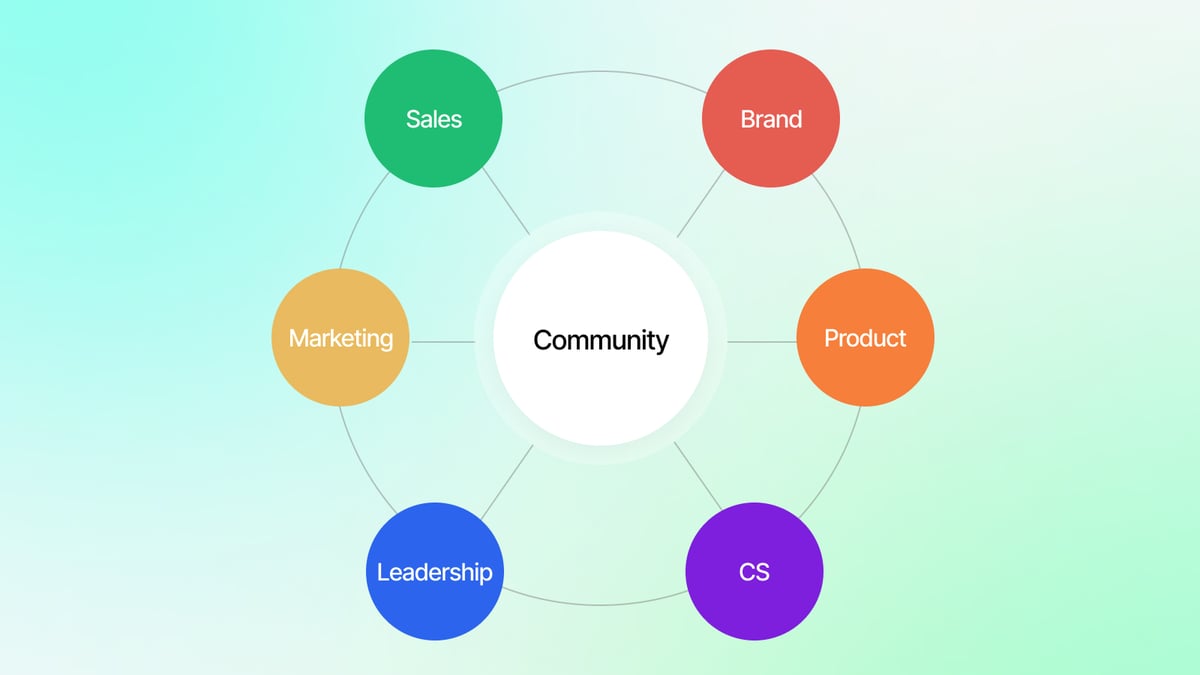
How Community Adds Value Across GTM
Most companies already have plenty of GTM activity.
There are campaigns, sales plays, product launches, lifecycle emails, customer programs, executive events, advisory boards, support motions, and content calendars. The work usually isn’t missing effort. What’s often missing is a clearer connection between what teams are doing and what customers are actually experiencing.
That’s where community can add real value.
Community doesn’t need to be positioned as a separate motion or another program competing for attention. It works best when it helps the GTM functions a company already has become more informed, more connected, and more useful to customers.
A strong community creates a place where customers, prospects, and peers can ask questions, compare notes, share what’s working, and talk about the problems they’re trying to solve. Over time, those conversations create context.
When that context gets translated back into the business, community becomes much more than a place where engagement happens. It becomes a way for GTM teams to understand customers more clearly.

Community helps teams understand customer context

Every GTM team is trying to understand the customer, but each team usually sees a different part of the story. Marketing sees topic performance. Sales hears objections. Customer success sees risk and adoption patterns. Product receives requests. Brand looks for the ideas the company should be known for.
Community can help connect those pieces because it gives people a shared place to talk through what they’re learning, trying, questioning, and solving. The value isn’t just that those conversations happen. The value is that they reveal how customers are making sense of their work in real time.
Community can help surface:
  • Questions customers are asking before they’re ready for a formal conversation
  • Language people use when they describe problems in their own words
  • Peer advice that shows what customers trust
  • Repeated themes that may point to broader market movement
  • Gaps between what the company explains and what customers understand

Community helps marketing, sales, and brand have better conversations

Marketing, sales, and brand teams all need relevance, though they often get there in different ways. Marketing needs language and themes that resonate. Sales needs useful reasons to engage. Brand needs a broader idea people can trust and associate with the company over time.
Community gives these teams more context for the conversations they already need to have. It can show which topics are gaining energy, which questions come up before a buying conversation, and how people describe value when they’re talking with peers instead of responding to a company prompt.
Community can help these teams by providing:
  • Customer language for sharper messaging and content
  • Market topics that create real discussion
  • Peer examples that can support more relevant sales conversations
  • Broader ideas that help the brand earn trust
  • Early signals about what customers are trying to understand

Community helps product and customer teams see patterns earlier

Product, customer success, support, and education teams need to understand where customers are getting value and where they’re getting stuck. Formal data is useful, though it often shows an issue after the pattern has already become visible somewhere else.
Community can reveal the pattern earlier. A customer may share a workaround before it becomes a ticket. Several members may ask similar questions before the onboarding gap gets named. A peer answer may show a clearer way to explain something than the company’s existing documentation.
Community can help product and customer teams understand:
  • What problem sits underneath a feature request
  • Where customers are confused after onboarding or training
  • Which workflows are creating friction
  • How customers are learning from each other
  • Where support, education, or success programs may need reinforcement

Community helps leadership understand what the business is learning

For executives and boards, the most useful framing usually isn’t community activity. It’s business learning. Community can help leadership understand what customers are trying to figure out, which topics are gaining urgency, and where the market may be moving.
Leadership doesn’t need every detail from every thread or event. It needs translation. The question is what the company is learning through community that would be harder to see through internal systems alone.
Community can help leadership answer:
  • What are customers trying to understand right now?
  • Which conversations are becoming more important over time?
  • Where is the company earning trust?
  • What customer language should inform strategy?
  • Which decisions could be improved with more context?

Key takeaways

  • Community adds value across GTM by creating shared customer context.
  • It helps teams understand customer language, peer learning, emerging patterns, and unmet needs.
  • Community works best when it strengthens existing GTM functions rather than competing with them.
  • The business value comes from translating community signals into decisions teams can use.

FAQ

How does community support GTM teams?
Community supports GTM teams by giving them better context for customer conversations. It helps marketing, sales, brand, product, customer success, and leadership understand what customers are asking, learning, and experiencing over time.
Is community a separate GTM motion?
Community doesn’t need to be treated as a separate GTM motion. It’s often more useful as a connected layer that helps existing GTM functions become more informed, relevant, and trusted.
How can community help sales and marketing?
Community helps marketing by surfacing customer language, emerging topics, and useful stories. It helps sales by creating more context for value-added conversations before, during, and after formal buying conversations.
How should leaders explain the business value of community?
Leaders can explain community value by connecting it to business learning. Community helps the company understand customer needs, market shifts, product gaps, education opportunities, and trust-building moments that can inform decisions across GTM.
Comments (0)
Popular
avatar

Table Of Contents
Dive in

Related

Resource
The GTM Experimentation Playbook: How to Test, Learn, and Scale Across Functions
By Joshua Zerkel • Dec 4th, 2025 Views 27
Resource
Playbook: How Executives Can Build Strategic Value Through Community
By Brian Oblinger • Dec 5th, 2025 Views 23
Resource
How Newsletters Can Drive Community Engagement and Strengthen GTM Alignment
By Joshua Zerkel • Dec 4th, 2025 Views 14
Resource
The Community-Led GTM Flywheel: How to Put Community at the Center of Growth
By Joshua Zerkel • Nov 3rd, 2025 Views 48
Resource
The GTM Experimentation Playbook: How to Test, Learn, and Scale Across Functions
By Joshua Zerkel • Dec 4th, 2025 Views 27
Resource
How Newsletters Can Drive Community Engagement and Strengthen GTM Alignment
By Joshua Zerkel • Dec 4th, 2025 Views 14
Resource
The Community-Led GTM Flywheel: How to Put Community at the Center of Growth
By Joshua Zerkel • Nov 3rd, 2025 Views 48
Resource
Playbook: How Executives Can Build Strategic Value Through Community
By Brian Oblinger • Dec 5th, 2025 Views 23
© 2026 Gradual Community
Privacy Policy
Your Privacy Choices