
Gradual Community

Playbook: How To Build A Community Function That Supports Multiple Business Goals
Playbook: How To Build A Community Function That Supports Multiple Business Goals
# Community
# GTM Strategy
# Format: Playbooks
# Format: Thought Leadership

How to design community as durable infrastructure instead of a one-team program with a short shelf life.

May 12, 2026 · Last updated on May 6, 2026
Ashley Williams
Ashley Williams
Joshua Zerkel
Joshua Zerkel
Playbook: How To Build A Community Function That Supports Multiple Business Goals
Community teams often get launched in response to one urgent business need. Support reduction, customer advocacy, product feedback, adoption, and word of mouth are all common starting points. That focus can be useful early on, but it becomes limiting when the function is designed too narrowly from the start.
A durable community strategy works more like shared infrastructure. It creates a foundation that can support multiple business goals over time.

Define community as a system, not a campaign

A campaign is built to achieve one defined outcome within a fixed frame. A community system is different. It creates ongoing relationships, repeated participation, and a structure that other parts of the business can learn from and work through.
This distinction matters because it affects the decisions made at every level. If the team is optimizing for one short-term goal only, it may overbuild for that use case and make future adaptation harder. If the team is building a flexible system, it can serve one near-term priority while still creating room for future needs.
A flexible system usually includes:
  • A clear member promise
  • Repeatable ways for members to connect with one another
  • Ongoing listening loops
  • Shared spaces or rituals that can support different types of engagement
  • A strategy that explains why these elements matter to the company
This is the “platform” idea Ashley described. Community becomes something the business can work through, not just something it observes from the side.

Anchor the strategy in a core human need

Even when community serves multiple business outcomes, it still needs a coherent center. That center is not the org chart. It is the human value being created for members.
Ashley described this as building the atomic unit of human connection. In practice, that means asking what kind of connection, learning, support, or shared experience the community is meant to make possible. Once that core is clear, the business applications become easier to extend without making the community feel random or overengineered.
For example, a community built around peer learning and customer connection may support:
  • Product feedback
  • Adoption and education
  • Customer retention
  • Advocacy and referrals
  • Qualitative insight across teams
The common thread is not that every business goal is pursued at once. It is that the core member experience can support several of them over time.

Build with the next shift in mind

One of the strongest lessons from Ashley’s Wix example is that company priorities move. A community strategy that makes perfect sense in one phase may feel incomplete in the next.
That does not mean the original strategy was wrong. It means the function needs to be designed with enough flexibility to evolve.
To do that well:
  • Stay informed about company-wide priorities
  • Track which teams are under new pressure
  • Notice where current community assets could create value in a different way
  • Be willing to propose a shift before the business asks for one
This is easier when the community has not been too tightly constrained by a single use case. A function built only for support will struggle to pivot toward adoption. A function built only for events will struggle to become a strong feedback engine. A more flexible foundation makes those moves more possible.

Translate community into business language without shrinking it

One risk in multi-goal community design is becoming too vague. If the strategy tries to be useful to everyone without being specific about anything, internal trust erodes. That is why the community team needs to explain its value in business language while still protecting the integrity of the member experience.
This means being able to describe how the same foundational system can create different kinds of value for different teams.
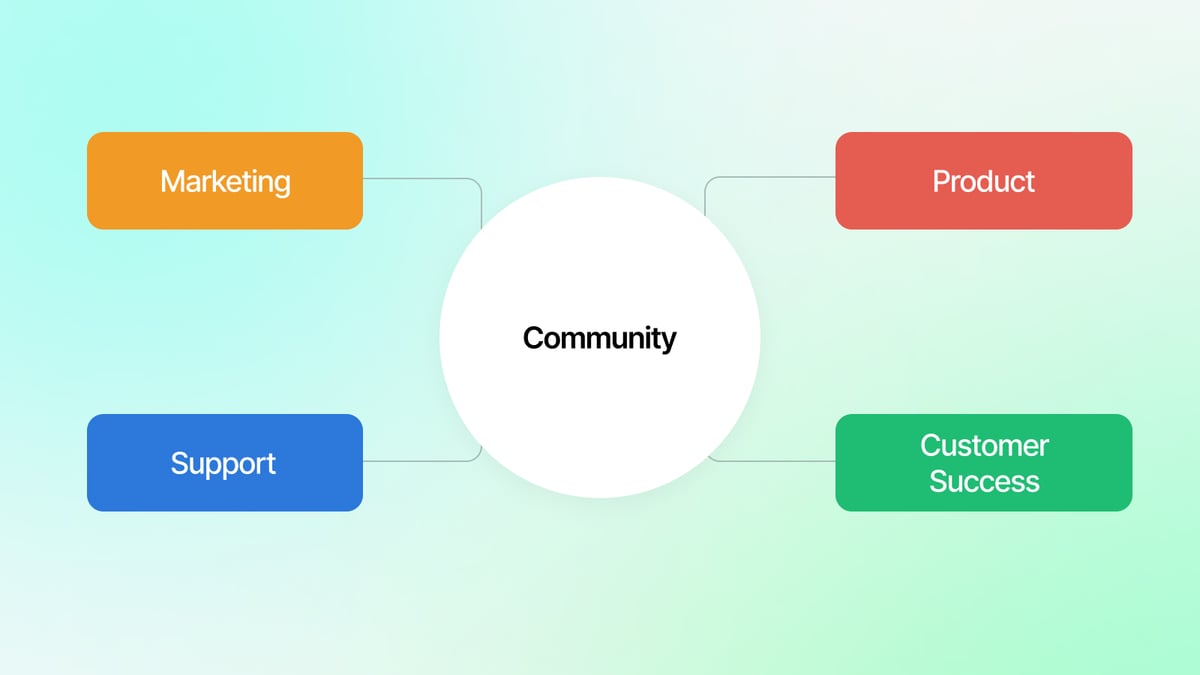
Marketing may care about advocacy and referrals. Product may care about feedback and early signal. Customer success may care about adoption and peer support. Leadership may care about alignment, trust, and better qualitative context.
The job is not to force every team into the same story. It is to show how the same underlying system can support several legitimate goals in ways that remain connected.

Use pilots to prove adjacent value

When a community team wants to expand beyond its original remit, a pilot can be one of the most effective tools available. Pilots lower the stakes, create real examples, and generate the evidence needed for broader buy-in.
A useful pilot has a few qualities:
  • It is tied to a real business need
  • It has a clear internal partner
  • It produces something observable
  • It can be explained simply afterward
For example, a team that started with advocacy work might run a structured listening pilot with product. A community centered on peer engagement might partner with customer success around onboarding or adoption. The point is to show adjacent value without forcing a full strategic rewrite all at once.

Protect the member experience while expanding relevance

The risk of serving multiple business goals is that the community starts to feel instrumentalized. Members can tell when a space exists mainly to extract value from them. That weakens trust and reduces the very signal the business hopes to gain.
A healthy multi-goal strategy keeps the member experience central. It asks whether each new business use case still creates something meaningful for participants.
That is what makes the system durable. It is useful to the business because it remains useful to the people in it.

Key takeaways

  • A durable community function acts like infrastructure, not a narrow campaign.
  • The strongest multi-goal strategies are anchored in a clear member promise.
  • Community should be built with future company shifts in mind.
  • Different teams can benefit from the same community system in different ways.
  • Pilots can help prove adjacent value without overcommitting too early.

FAQ

What does it mean to treat community as a platform?

It means designing community as flexible infrastructure that supports different goals over time, rather than building it too narrowly around one immediate need.

Can one community really support multiple business goals?

Yes, when the underlying member experience is coherent and the team can clearly explain how different functions benefit from the same foundation.

How do you keep community from becoming too vague?

Anchor it in a clear member value proposition and translate that into specific business relevance for different teams.

Why are pilots useful in community strategy?

They create low-risk proof that the community can support adjacent business goals, making broader strategic shifts easier to support.
Comments (0)
Popular
avatar

Table Of Contents
Dive in

Related

Resource
Playbook: Positioning Community as a Business Function
By Dani Weinstein • Feb 18th, 2026 Views 29
Resource
Playbook: Turning Community Insights into Business Impact
By Brian Oblinger • Dec 5th, 2025 Views 24
Resource
Playbook: How to Build a Focused Community Strategy That Delivers Impact
By Bill Johnston • Dec 5th, 2025 Views 14
Resource
Playbook: How Executives Can Build Strategic Value Through Community
By Brian Oblinger • Dec 5th, 2025 Views 23
Resource
Playbook: Positioning Community as a Business Function
By Dani Weinstein • Feb 18th, 2026 Views 29
Resource
Playbook: How to Build a Focused Community Strategy That Delivers Impact
By Bill Johnston • Dec 5th, 2025 Views 14
Resource
Playbook: How Executives Can Build Strategic Value Through Community
By Brian Oblinger • Dec 5th, 2025 Views 23
Resource
Playbook: Turning Community Insights into Business Impact
By Brian Oblinger • Dec 5th, 2025 Views 24
© 2026 Gradual Community
Privacy Policy