
Playbook: Mapping and Managing Your Community Ecosystem
# Community
# GTM Strategy
# Format: Playbooks
A guide to understanding where your members gather, how value flows across your ecosystem, and where to focus your investment.
December 5, 2025 · Last updated on March 3, 2026
Bill Johnston

Joshua Zerkel
Many community teams begin with the assumption that everything should happen in one place. The instinct is understandable. A single platform seems easier to manage, easier to scale, and easier to measure. Yet real communities rarely behave this way. They grow across networks of touchpoints, conversations, relationships, and informal spaces that are often outside the company’s control.
This is why community strategist Bill Johnston encourages leaders to shift from a destination mindset to an ecosystem mindset. An ecosystem approach recognizes that members gather in many places and that each of these spaces plays a distinct role. Instead of trying to own every interaction, teams learn to understand where value is already happening and how to support it with intention.
This playbook translates Bill’s ecosystem framework into a practical guide you can use to map your landscape, identify essential areas of investment, and design a strategy that reflects how members actually behave.
Understand the full landscape of community touchpoints
Every community exists across a wider ecosystem. Some parts are visible. Others operate quietly in the background. The first step is developing a clear picture of every place where members learn, connect, or share insight. This usually includes:
- Your on-domain community platform
- Events and experiences hosted by your team
- Regional user groups
- Creator channels and expert blogs
- Product or industry forums
- Partner communities
- Social groups and private peer circles
- Developer spaces or technical resource hubs
- Slack or Discord spaces created by customers
- Independent fan or enthusiast sites
Bill described this network as a set of relationships and gathering places that already exist whether the company acknowledges them or not. Your role is to understand the purpose of each space and the energy that already flows through it.
Identify where value already happens
Once you have a view of the full landscape, study how members use each space. Look for signals of authentic value. These may show up as:
- High quality discussion
- Meaningful peer support
- Reliable knowledge sharing
- Product insight or feedback
- Strong creator influence
- Healthy rituals or norms
- Trust and belonging among members
- Expertise that would not surface elsewhere
Communities are strongest where members already invest their time. Bill noted that companies often underestimate the value of these existing relationships. By understanding where depth already exists, you can prioritize efforts that support the most engaged groups and conversations.
Determine what you will host, support, or connect
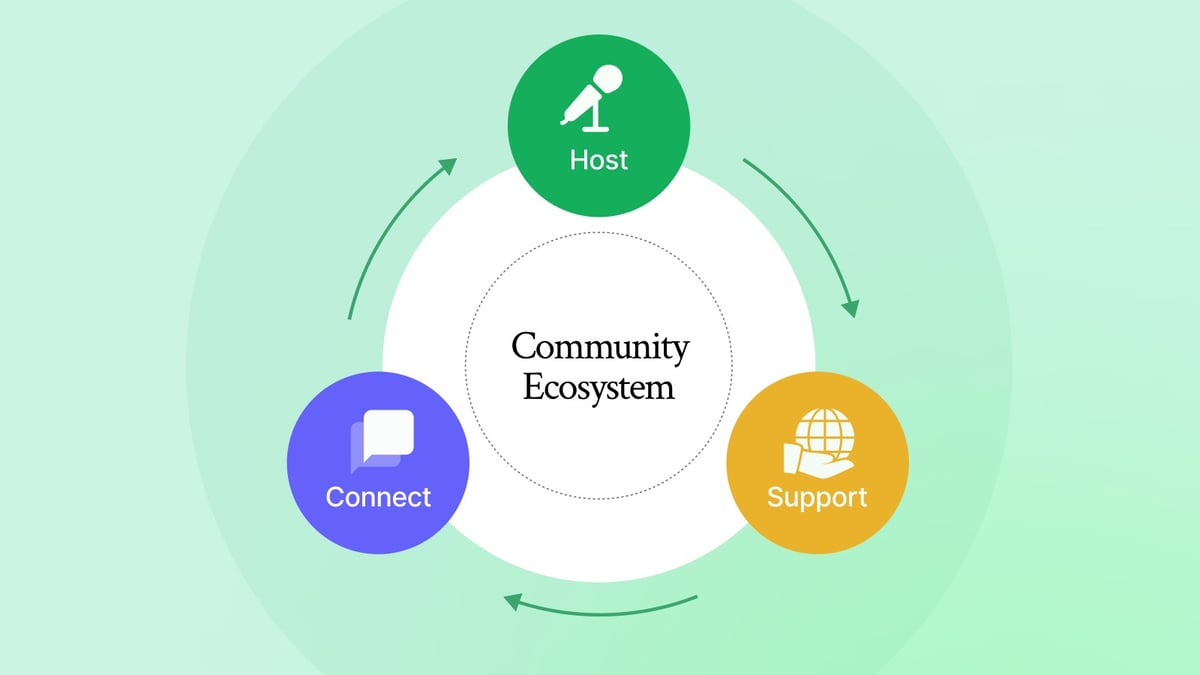
An ecosystem strategy does not require you to manage every space. It requires you to choose your role in each part of the landscape. Bill recommends grouping touchpoints into three categories:
Host
Spaces your team owns and actively manages. These usually include:
- Your core community platform
- Official events or office hours
- Structured peer groups
- Advocate or ambassador programs
Choose to host elements that directly support your North Star and require consistent quality or moderation.
Support
Spaces your community influences but does not fully control. Examples include:
- Independent user groups
- Third-party forums
- Volunteer-led meetups
- Creator ecosystems or influencer channels
Support can look like resource sharing, sending speakers, highlighting relevant posts, or offering early access to product developments.
Connect
Spaces that exist in the broader environment and play an important role even though your team is not involved. These might be:
- Popular industry forums
- Professional associations
- Social media groups
- Developer networks or open-source spaces
Your job is to understand their importance and help members navigate between them and the spaces you host.
This simple framework helps teams focus on areas of highest strategic value without spreading themselves thin.
Clarify the purpose of each part of the ecosystem
Each touchpoint serves a different purpose. When teams define that purpose clearly, members have an easier time knowing where to go and why. Consider the following categories:
- Learning and education
- Troubleshooting and support
- Product feedback and insight
- Co-creation and ideation
- Networking and relationship building
- Career development
- Advocacy and leadership opportunities
- Innovation and future planning
Place each touchpoint into a category to understand where each one fits within the larger picture. This clarity reduces duplication, strengthens focus, and makes it easier to explain your ecosystem to internal stakeholders.
Look for gaps and duplication
After mapping touchpoints and defining their purpose, identify areas of overlap or absence. Common patterns include:
- Two spaces serving the same function and splitting attention
- Valuable conversations happening in a space you do not yet support
- A key audience that lacks connection or representation
- External groups that could be elevated with partnerships
- Channels that require more moderation or structure
- A missing bridge between content and discussion
Gaps and duplication reveal where strategic adjustments can create more cohesion and value.
Strengthen the core without overextending
An ecosystem mindset does not mean abandoning your primary community platform. It means designing the platform with a clear purpose and strengthening it as a central anchor. The core space should excel at what matters most for your strategy.
For example:
- If your focus is peer learning, prioritize discussion quality and content clarity.
- If your focus is product adoption, highlight resources and onboarding experiences.
- If your focus is leadership or executive engagement, invest in events and thoughtful conversation.
Supporting the wider ecosystem always begins with having a strong and intentional home base.
Build partnerships that create mutual benefit
Community value expands when you partner with groups that already serve your audience well. This is especially helpful for:
- User groups
- Creators or influencers
- Professional associations
- Technical experts
- Mentorship circles
- Local meetups
Partnerships should be light and sustainable. Offer value without adding heavy operational requirements. You may share resources, amplify member stories, or collaborate on small projects that benefit both communities.
Use insight from the ecosystem to guide strategy
Each part of the ecosystem produces a different type of insight. On-domain spaces often reveal structured learning and engagement patterns. External spaces may reveal emerging trends or early product issues.
Collect signals such as:
- Frequently asked questions
- Recurring pain points
- Unmet needs
- Emerging themes
- Trusted voices
- Areas where members support one another organically
These signals guide your roadmap, influence leadership conversations, and help the business better understand its customers.
Adapt your ecosystem as needs evolve
Community ecosystems are dynamic. Member behavior, product direction, team resources, and industry trends influence how and where people gather. Review your ecosystem several times a year. Notice where energy is shifting. Be prepared to evolve your role in different spaces.
Bill emphasized that this work is ongoing. Understanding the ecosystem and adapting with care creates long-term cohesion and strategic alignment.
Key takeaways
- Communities grow across networks of spaces, not only on a single platform.
- Mapping your ecosystem helps you focus where value is strongest.
- Decide which touchpoints to host, support, or simply connect.
- Clarify the purpose of each space so members know where to go.
- Identify gaps and duplication to strengthen alignment.
- Keep the core community strong while supporting external spaces lightly.
- Use insight from across the ecosystem to shape strategy and decisions.
Frequently asked questions
What is a community ecosystem?
It is the full set of spaces where members learn, connect, and share value inside and outside the official community.
Do we need to manage everything we map?
No. The value of mapping is to understand where energy already exists so you can invest with intention.
How often should we review the ecosystem?
A quarterly or semiannual review is usually enough to understand where behavior is changing and where new opportunities appear.
- ▶️ Watch the full replay from our Executive Insights webinar
- Learn more and get in touch with Bill at his Substack
Like
Comments (0)
Popular

Dive in
Related
Resource
Mapping and Managing Your Community Ecosystem for Clarity and Impact
By Joshua Zerkel • Dec 3rd, 2025 • Views 59
Resource
Community Engagement Playbook: Building (and Rebuilding) Participation
By Joshua Zerkel • Dec 4th, 2025 • Views 206
Resource
Playbook: Measuring and Operationalizing Community Value
By Dani Weinstein • Feb 19th, 2026 • Views 80
Resource
Playbook: Preparing Your Community For A Migration
By Ryan Paredez • Feb 24th, 2026 • Views 40
Resource
Mapping and Managing Your Community Ecosystem for Clarity and Impact
By Joshua Zerkel • Dec 3rd, 2025 • Views 59
Resource
Playbook: Measuring and Operationalizing Community Value
By Dani Weinstein • Feb 19th, 2026 • Views 80
Resource
Playbook: Preparing Your Community For A Migration
By Ryan Paredez • Feb 24th, 2026 • Views 40
Resource
Community Engagement Playbook: Building (and Rebuilding) Participation
By Joshua Zerkel • Dec 4th, 2025 • Views 206