
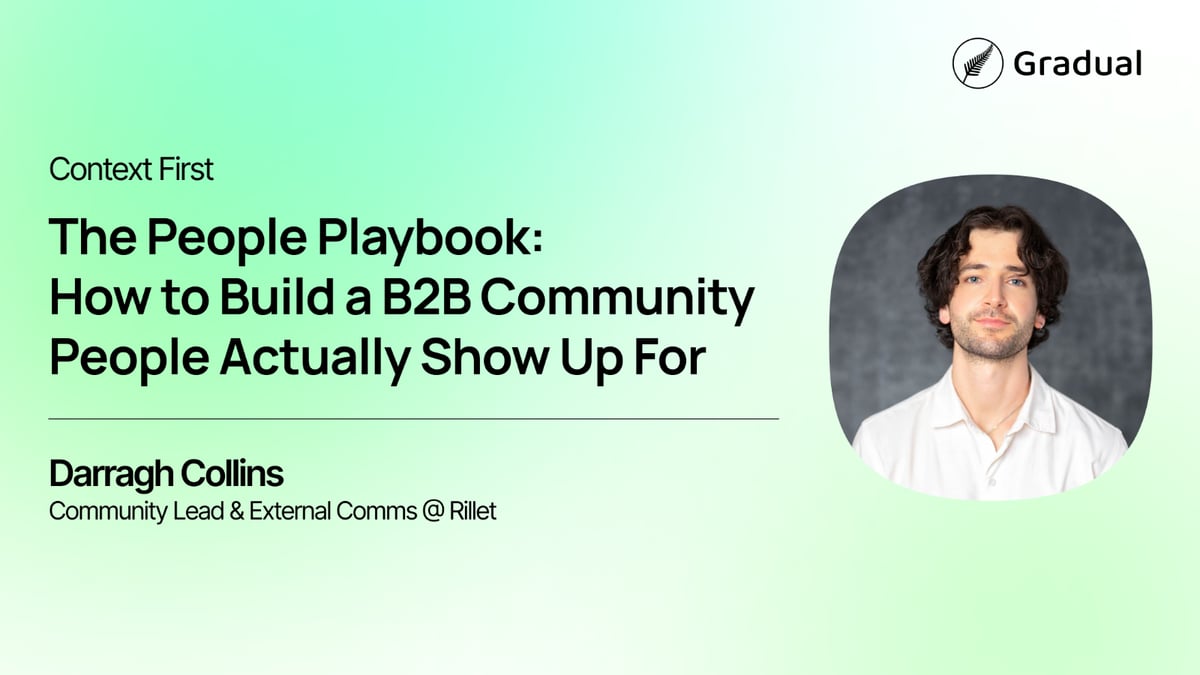
Darragh Collins On Building A B2B Community People Actually Show Up For
# Community
# GTM Strategy
# Format: Event Recaps
# Customer Success & Support
# Marketing & Growth
A practical conversation about founding members, curation, personal attention, and the people work behind stronger B2B communities.
May 7, 2026
Joshua Zerkel

Darragh Collins
I was looking forward to this conversation with Darragh Collins because the topic felt immediately familiar.
If you’ve built community in B2B, you’ve probably heard some version of the same concern: “Our audience is too busy,” “B2B is too boring,” or “People don’t really want to join another professional community.”
I understand where that comes from. People are busy. Most of us already belong to more spaces than we can reasonably keep up with. A new Slack group, forum, or event series has to earn its place in someone’s routine.
But I don’t think the problem is that B2B people don’t want community. They want to meet people who understand their work. They want help with real problems. They want access to peers who have already figured out something they’re still working through.
The issue is that many communities don’t feel personal, relevant, or useful enough to become part of someone’s day.
That’s why Darragh was such a good person for this conversation. He leads Community and External Communications at Rillet, and he’s built several B2B fintech communities from the ground up, including Off the Ledger at Airbase, the Zip community for procurement leaders, and Close Club at Rillet.
He brought the perspective of someone who has had to get people to show up in real life, not just register, join a platform, or nod along to the idea of community.
What came through clearly was this: the people work is the strategy.
Start with the customers who already care
When I asked Darragh how he thinks about getting a community from zero to one, he didn’t start with channels, content calendars, or event programming.
He started with customers.
His advice was to talk to customer success and identify the people who already love the company. The customers who show up. The ones who do references, join case studies, give thoughtful feedback, and already act like members before the community formally exists.
Then reach out personally.
Not with a polished launch message. Just a real ask: “I’m building a community and would love to understand what would make it useful for you.”
That part matters. It’s very easy, especially inside a company, to start building around internal assumptions. The business wants customer engagement. Product wants feedback. Sales wants influence. Marketing wants stories. All of those things can be valid, but they don’t matter if the community isn’t valuable to the people being invited into it.
Darragh described his role in those early conversations almost like Santa Claus: ask people what they want, then give it to them.
I liked that because there’s a generosity to it, but also a discipline. You’re not guessing. You’re asking the people you hope will participate what would make the community worth their time, then building as much of the early experience around those answers as you reasonably can.
That’s the point of a founding member group. It gives people a voice before the structure is fixed.
Make people feel personally addressed
One of the strongest threads in the conversation was Darragh’s focus on making members feel personally addressed.
He talked about joining around 50 communities before starting one of his roles, just to see what was already out there. What stood out to him was how little attachment he felt to most of them. He joined, looked around, and didn’t feel like anyone had really noticed him or cared why he was there.
That’s a common experience. And it’s one reason so many communities quietly stall after launch.
People join because something sounds relevant. They stay when they feel seen, connected, and helped.
Darragh’s approach is very hands-on. When someone joins Close Club and they’re in New York, he’ll often message them and ask to meet for coffee. Not to sell Rillet. Just to understand what they’re looking for from the community and what would make it more useful.
That level of attention isn’t always scalable in the same way a welcome email is scalable, but it teaches the right lesson. The first member experience should feel like someone is paying attention.
It can be a coffee. It can be a thoughtful DM. It can be a targeted introduction. It can be a personal reply to an onboarding answer. The format matters less than the signal: you’re not just another name in the member list.
Darragh put it well: “You have to show up for your community before they’re going to show up for you.”
Curation helps people trust the room
Darragh has built intentionally curated communities, including application-only spaces like Close Club. That came up several times, and I think it’s worth paying attention to.
There’s often pressure in community work to grow as quickly as possible. More members, more registrants, more reach. I get that pressure. But growth without relevance usually creates weaker engagement.
People show up when they believe the room has been thoughtfully put together.
That’s especially true in B2B. If you’re asking a CFO, controller, procurement leader, marketer, or community builder to spend time in a room, online or in person, they need to believe the other people there are worth meeting.
Darragh mentioned something I’ve also seen work well: sharing the guest list ahead of in-person events. It gives people a sense of the room before they walk into it. They can see who they might meet and identify peers, customers, prospects, or people from companies they respect.
That kind of clarity reduces uncertainty, and uncertainty is one of the reasons people bail.
Curation also protects quality as the community grows. At Airbase, Darragh described Off the Ledger as a strictly no-sales space. If someone came in trying to pitch, the team redirected them. That boundary helped the community become a place where finance professionals could ask questions, share openly, and learn from one another.
Boundaries are part of hospitality. They help the right people feel safer participating.
B2B communities can still feel human
One of my favorite parts of the conversation was when we talked about the strange assumption that people become less human when they go to work.
Darragh said it plainly: CFOs and controllers are humans too.
They still want connection. They still want useful conversations. They still want to enjoy themselves. They still use social platforms. They still want to meet people who understand what their day-to-day work actually feels like.
That may sound basic, but a lot of B2B community experiences are designed as if the audience only wants formal content and polished panels. The result is often technically professional, but not especially compelling.
Darragh’s work in finance communities is a useful reminder that even highly specific professional audiences need spaces that feel real. At Airbase, Off the Ledger grew during COVID, when many finance professionals were suddenly more isolated and working from home. People needed mentorship, peer access, and a place to ask questions that weren’t easy to ask inside their own company.
That need hasn’t gone away.
A good community can give people a room full of peers who are working through similar problems. That’s valuable in a very practical way.
Community earns business value through trust
We also talked about how community connects to the rest of the business.
I’m always interested in this because community can create real value across sales, product, customer success, and marketing. But it has to be handled carefully. If members feel like the community only exists to extract value from them, the trust disappears.
Darragh shared a great example from Rillet. A prospect had been part of the community, attended sessions, and built familiarity with the company over time. Then he changed jobs. At the new company, he reached out and asked to speak with the best sales rep because he was ready to evaluate the product.
That’s community creating business impact.
But the important part is how it happened. It didn’t come from badgering him every week to book a demo. It came from being present in a useful community, hearing from customers organically, and building trust before there was a buying moment.
Darragh also shared how he uses product update spaces. At Rillet, product ships quickly, so they share frequent updates in a dedicated channel. At Zip, a monthly rhythm made more sense. The idea is to give customers a clear place to see what’s changing without turning the whole community into a product broadcast.
That’s how community becomes a source of context for the business. It captures what people are asking, how they talk about their problems, what they need next, and where there’s energy.
What Darragh’s approach makes clear
The thing I appreciated most about Darragh’s approach is that none of it depends on pretending community is mysterious.
It’s thoughtful work, done consistently.
Talk to the people who already care. Ask what they want. Build with them. Make the room relevant. Welcome people personally. Protect the experience. Create clear ways for members to shape what happens next. Share what you’re hearing with the business. Keep giving members reasons to trust the space.
People don’t show up because a company launched a community. They show up because the community helps them feel smarter, more connected, more supported, and more confident in the work they’re already trying to do.
That starts with getting really good at people.
Key takeaways
- A strong B2B community starts with the customers and practitioners who already show signs of trust and engagement.
- Founding members help shape the community before the structure is locked in.
- Personal attention early in the member journey creates stronger participation later.
- Curation helps members trust that the room is relevant and worth their time.
- B2B audiences still want community experiences that feel human, useful, and relationship-driven.
- Community can support business outcomes when it earns trust before asking for action.
FAQ
What makes a B2B community successful?
A successful B2B community gives members access to relevant peers, useful conversations, practical learning, and a sense that their participation matters.
How do you get people to participate in a B2B community?
Start by personally welcoming members, asking why they joined, connecting them to relevant people or conversations, and creating value before asking them to contribute.
Why are founding members important in community building?
Founding members help shape the community early. They provide feedback, model participation, and create the first layer of trust before the community grows more broadly.
How can community create business value?
Community creates business value by building trust, surfacing customer context, supporting product feedback, deepening relationships, and keeping customers and prospects connected before a buying or expansion moment.
Like
Comments (0)
Popular

Dive in
Related
30:14
Video
Event Replay: Context First: The People Playbook: How to Build a B2B Community People Actually Show Up For with Darragh Collins
By Darragh Collins • May 7th, 2026 • Views 102
Resource
Building a Smarter Community Operating Model for the Year Ahead
By Joshua Zerkel • Jan 27th, 2026 • Views 22
Resource
Playbook: How to Design Community Experiences People Actually Want to Return To
By Leslie Barber • Jun 15th, 2026 • Views 23
Resource
Playbook: Building Internal Champions for Community Work
By Holly Firestone • Mar 4th, 2026 • Views 30
30:14
Video
Event Replay: Context First: The People Playbook: How to Build a B2B Community People Actually Show Up For with Darragh Collins
By Darragh Collins • May 7th, 2026 • Views 102
Resource
Playbook: How to Design Community Experiences People Actually Want to Return To
By Leslie Barber • Jun 15th, 2026 • Views 23
Resource
Playbook: Building Internal Champions for Community Work
By Holly Firestone • Mar 4th, 2026 • Views 30
Resource
Building a Smarter Community Operating Model for the Year Ahead
By Joshua Zerkel • Jan 27th, 2026 • Views 22