
Event Recap: Community Measurement Your CFO Will Trust: Mark Birch On Making Impact Defensible with Mark Birch
# Community
# GTM Strategy
# Format: Event Recaps
Most community leaders know their work creates value. The harder part is proving it in a way the business can understand, trust, and invest in.
June 25, 2026
Joshua Zerkel

Mark Birch
Community measurement has always been one of the more uncomfortable conversations in our field, mostly because the value is often visible long before it is measurable in the ways a business expects. Community leaders see customers answering one another’s questions, relationships forming across accounts, product feedback surfacing in real time, members showing up repeatedly, and trust building in ways that are hard to manufacture through other channels. The challenge is that those signals rarely move cleanly into the systems where the business measures performance.
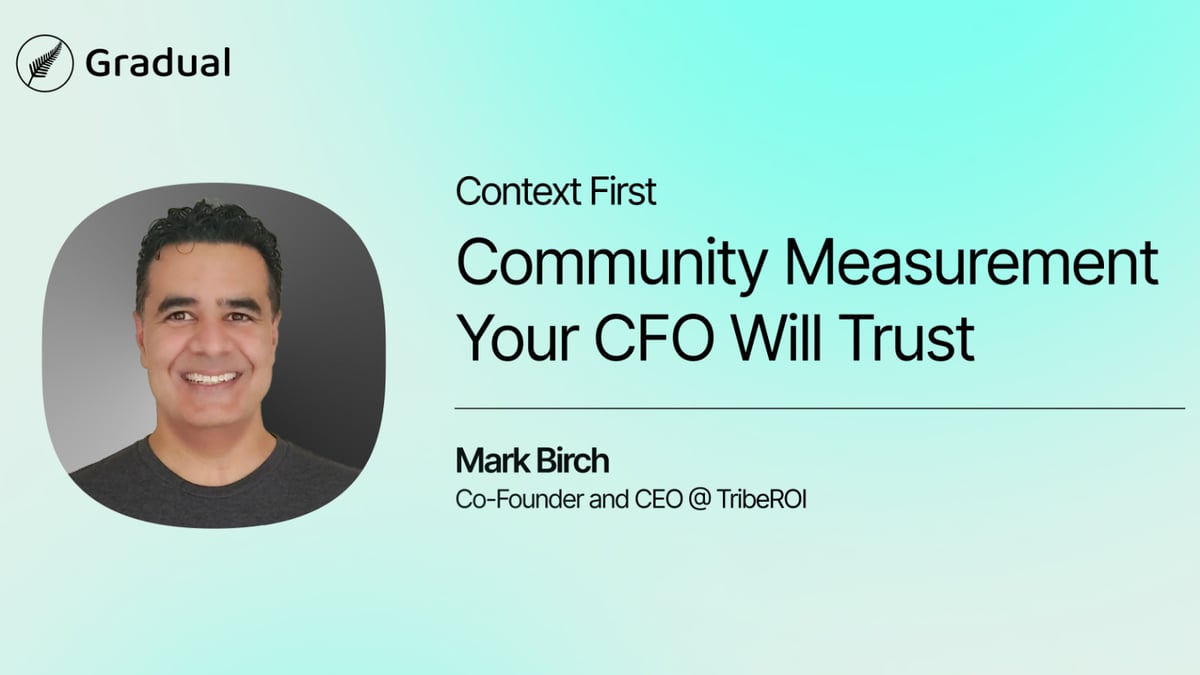
That tension was at the center of my conversation with Mark Birch , Founder and CEO of TribeROI . Mark has spent years building and scaling communities across Enterprise Sales Forum, Stack Overflow, and AWS, and he’s now focused on helping community leaders connect their work to revenue, retention, and innovation. What I appreciated about the conversation is that Mark didn’t treat measurement as a side project or a reporting exercise. He talked about it as something that becomes more important once a community starts to matter to more than just its members.
Measurement becomes part of the work as the community grows
When Mark started Enterprise Sales Forum, his first focus was creating a meaningful experience for members. That’s where a lot of community work begins. You’re thinking about the people in the room, the topics they care about, the formats that will help them connect, and the reasons they’ll keep coming back.
As Enterprise Sales Forum expanded, eventually reaching 30,000 members across 24 cities, Mark found himself serving more than one audience. Members wanted valuable experiences. Volunteers were contributing their time and energy. Sponsors were investing real money and wanted to understand what they were getting back. The question gradually became less about whether the community was valuable and more about how to explain that value clearly enough that people understood why they should continue investing.
Community leaders often think measurement starts when an executive asks for a dashboard, but in practice it tends to start earlier. It starts when a community becomes connected to other people’s time, budget, priorities, or goals. Once others depend on the community, the leader has to explain what happened, why it mattered, and what the work might make possible next.
Community is still building its measurement discipline
One of Mark’s clearest points was that community has not had the same institutional maturity as other business functions. Sales, marketing, customer success, product, and engineering all have established operating models. They have known metrics, standard dashboards, common vocabulary, and decades of practice behind them. People study those disciplines, build careers inside them, and inherit systems that already tell them what to measure.
Community is still developing many of those shared methods. That does not mean community lacks rigor. It means the profession has not yet had the same infrastructure around it that other functions often take for granted.
This shows up in very practical ways. Community teams are often asked to prove impact without the analysts, data infrastructure, or executive authority needed to do that work well. During the conversation, I shared that in one previous role I was fortunate to have an analyst dedicated to my team. That made it possible to build models and dashboards that connected community work to outcomes across the business. Most community teams don’t have that kind of support, even though they’re often asked to answer questions that require exactly that kind of support.
The result is a familiar gap. The organization wants proof, but the community team may not have the tools, data access, or resourcing needed to produce proof in a way that will hold up. That’s one of the reasons this conversation can feel so frustrating. Community leaders are not simply being asked to report on their work. They’re being asked to build a measurement practice around work that is distributed, relational, and often long-term in nature.
Community data rarely lives in one place
A modern community program usually leaves signals across many systems. Some activity may live in a community platform. Some may happen in events, Slack, Discord, Discourse, GitHub, LinkedIn, the CRM, the support system, or the marketing automation platform. A customer’s experience with the community may move across several of those places before it ever shows up in a business system.
That fragmentation is one of the reasons community does not fit neatly into attribution models built for other functions. A member may attend an event, ask a question, help another customer, join a group, share product feedback, engage with content, and later renew or expand their account. Each of those moments may help explain the relationship between community and business outcomes, but they’re difficult to connect when they sit in disconnected systems.
Community also does not behave like a campaign. It does not always create value in a straight line. It often works over longer periods of time, through relationships, repeated participation, and a small number of high-value contributions that influence many others. When organizations try to measure community only through short-term engagement windows, they miss much of what makes community valuable in the first place.
Signals need to connect to outcomes the business already cares about
A major theme in the conversation was the difference between community signals and business outcomes. Community teams are usually comfortable talking about activity: attendance, participation, posts, replies, content engagement, and member growth. Those signals help explain what is happening inside the community, but they are rarely enough on their own.
Executives are usually trying to understand how community contributes to revenue, retention, customer satisfaction, support efficiency, product innovation, or growth. They want to know whether the work is helping the business make progress against goals it already cares about.
Mark described this as a bridge between what happens in the community and what matters to the company. A community leader may know that members who participate more deeply are more likely to renew. They may see that product feedback from community members helps teams understand customer needs sooner. They may recognize that peer-to-peer support reduces repetitive support burden. But recognizing those patterns and proving them through data are different things.
The goal is not to reduce community to a spreadsheet. The goal is to help the business understand the relationship between community participation and the outcomes it already values. That kind of measurement helps community leaders move from describing activity to explaining impact.
Executives need different parts of the story
One of the most practical parts of the discussion was Mark’s advice on executive communication. A CFO, CMO, Chief Product Officer, and Customer Success leader may all ask about the ROI of community, but they are usually not asking the same question. Each leader has different responsibilities, different metrics, and a different lens for evaluating whether something is working.
For finance, the conversation may need to connect to revenue, cost savings, efficiency, or risk. For product, it may need to connect to feedback loops, innovation, adoption, or roadmap confidence. For customer success, it may need to connect to retention, expansion, education, or support deflection.
This does not mean reshaping the community around every stakeholder’s preference. It means understanding how community contributes to each stakeholder’s goals and learning how to explain that contribution in language they can use. Mark compared it to learning the language of the person you’re trying to reach. If community leaders bring engagement language into every executive conversation, they may be answering a question nobody in the room is actually asking.
Engagement matters. Member experience matters. Trust matters. In a budget conversation, those ideas still need to connect to something the business can recognize and act on.
Baselines make the next conversation more grounded
Toward the end of the conversation, Mark shared a practical idea that can be easy to overlook. Before community leaders can make a stronger case for future investment, they need a baseline.
Without a starting point, the conversation stays vague. You can believe community is improving retention. You can sense that it is helping product teams learn faster. You can see that members are getting value. But if there is no baseline, it becomes difficult to show change over time or make a credible argument for what deeper investment could produce.
Many community leaders can begin this work even without sophisticated tooling. Start by identifying the outcomes the organization already cares about, then look at the community behaviors that may reasonably influence those outcomes. From there, compare customers who participate in the community with those who do not. Look for patterns tied to retention, expansion, support usage, product adoption, or feedback quality.
That work will not produce a perfect attribution model overnight, and it may not answer every question immediately. It does, however, give the team a more grounded place to start. Instead of saying, “We think community matters,” the team can begin saying, “Here’s what we’re observing, here’s the relationship we’re testing, and here’s what we want to understand next.”
Community measurement is becoming more mature
What I appreciated most about Mark’s perspective is that he treated the measurement gap as part of the profession’s maturation rather than as a failure of community teams.
Marketing had to build its attribution models over time. Sales had to develop pipeline discipline. Customer success had to define and standardize its own metrics. Community is still working through a similar process, and that can be frustrating for leaders who are already being asked to justify investment with methods the profession is still developing.
At the same time, the work happening now matters beyond any single program. The more community teams learn how to connect signals to outcomes, the stronger the profession becomes. The more we learn to speak the language of the business while still protecting the member experience, the more credible community becomes as a long-term function.
Community measurement does not have to make the work feel less human. Done well, it helps organizations better understand the value of the human work already happening.
Key takeaways
Community measurement becomes more important as more people depend on the community for outcomes, investment, or support.
Community teams often have signals, but those signals need to be connected to business outcomes before they become useful in executive conversations.
The data needed to measure community often exists across many systems, which makes the work harder than reporting from a single platform.
Executives evaluate community through the lens of their own goals, so community leaders need to translate impact differently for different stakeholders.
A useful first step is to build a baseline, compare engaged and non-engaged cohorts, and look for patterns tied to business outcomes.
Community measurement is still maturing as a discipline, and today’s work is helping shape the standards future teams will use.
FAQ
Why is community impact hard to measure?
Community impact is hard to measure because community activity often happens across many systems and creates value over a longer period of time. A single member may engage through events, discussions, content, social channels, or product feedback before that activity connects to a business outcome.
What is a community signal?
A community signal is an observable action or behavior inside the community, such as attending an event, joining a discussion, answering a peer’s question, contributing feedback, or engaging with content. Signals become more useful when they are connected to business outcomes.
What outcomes should community teams connect to?
Community teams should connect their work to outcomes the business already tracks, such as retention, expansion, product adoption, support cost reduction, customer satisfaction, feedback quality, or revenue influence.
What is the first step toward better community measurement?
The first step is to identify the business outcomes that matter most, then look for community behaviors that may influence those outcomes. From there, teams can build a baseline and begin comparing patterns between engaged and non-engaged customers.
Like
Comments (0)
Popular

Dive in
Related
31:31
Video
Event Replay: Context First: Community Measurement Your CFO Will Trust
By Mark Birch • Jun 25th, 2026 • Views 19
28:13
Video
Event Replay: Context First: Making Community Impossible to Ignore: From Established Program to Strategic Function with Michelle Baltrusitis
By Michelle Baltrusitis • May 13th, 2026 • Views 19
30:13
Video
Event Replay: Executive Insights with Gradual: Making Community Matter Internally
By Holly Firestone • Feb 5th, 2026 • Views 32
30:54
Video
Event Replay: Executive Insights with Gradual: Essential Community Strategy for Focused Impact
By Bill Johnston • Nov 12th, 2025 • Views 49
31:31
Video
Event Replay: Context First: Community Measurement Your CFO Will Trust
By Mark Birch • Jun 25th, 2026 • Views 19
30:13
Video
Event Replay: Executive Insights with Gradual: Making Community Matter Internally
By Holly Firestone • Feb 5th, 2026 • Views 32
30:54
Video
Event Replay: Executive Insights with Gradual: Essential Community Strategy for Focused Impact
By Bill Johnston • Nov 12th, 2025 • Views 49
28:13
Video
Event Replay: Context First: Making Community Impossible to Ignore: From Established Program to Strategic Function with Michelle Baltrusitis
By Michelle Baltrusitis • May 13th, 2026 • Views 19