
Gradual Community

From Community Leadership to Business Impact: Executive Insights with Dani Weinstein
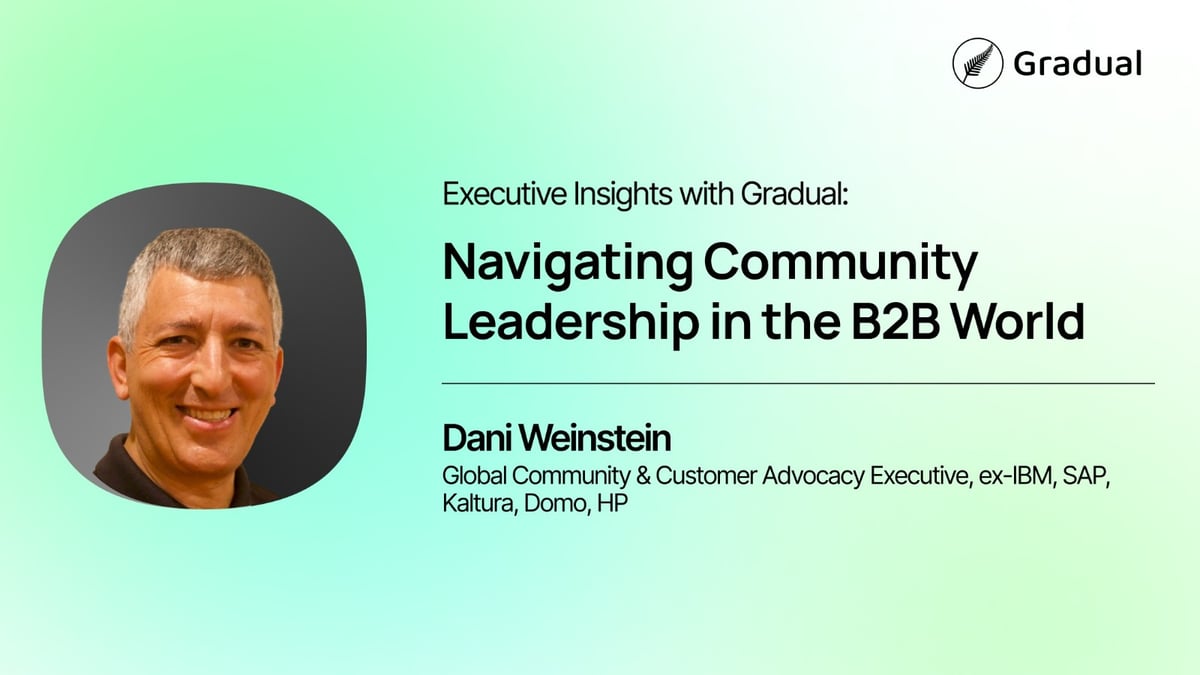
From Community Leadership to Business Impact: Executive Insights with Dani Weinstein
# Theme: Community Building & DevRel
# Theme: Leadership & Executive Perspectives
# Format: Event Recaps
# Format: Thought Leadership
# Role: Community/DevRel
# Challenge: Cross-Functional Alignment

What it actually takes to lead, measure, and sustain B2B communities that matter to the business.

January 29, 2026
Joshua Zerkel
Joshua Zerkel
From Community Leadership to Business Impact: Executive Insights with Dani Weinstein
Community leadership in B2B comes with a quiet tension. Most of the work happens close to customers and peers, but the questions that determine whether a program survives are usually coming from executives. Questions about value. About priorities. About what, exactly, the business is getting back.
That tension was at the center of my conversation with Dani Weinstein in our recent Executive Insights session. Dani has spent his career leading community programs inside large enterprises and high-growth companies, including IBM, SAP, HP, Domo, and Kaltura. He’s seen community succeed, stall, reset, and scale. And he’s done that work from inside marketing, sales, support, learning, and success organizations.
What emerged from the conversation wasn’t a set of tactics. It was a way of thinking about community leadership as a business responsibility, not a program function.

How Dani defines community in a B2B context

Early in the conversation, Dani paused on something that often gets skipped. Before talking about metrics or buy-in, you need a shared understanding of what community actually is.
In B2B, Dani frames community as a system for connecting customers, partners, developers, and employees to share knowledge. That knowledge sharing helps people use products and platforms more effectively. And when that happens, adoption improves, support load changes, customer confidence grows, and new ideas surface.
This definition matters because it immediately connects community to outcomes executives already care about. It’s not abstract. It’s operational.
Community, in this framing, is not about vibes or engagement for its own sake. It’s about enabling people to learn from one another in ways that change how they work.

“Who’s paying the bills?” is not a cynical question

One of Dani’s most direct points landed early and stayed with me. If you can’t tie community to the priorities of the executive organization you sit in, you’re going to struggle.
That’s not a criticism of community leaders. It’s a reality of how businesses operate.
Dani talked about the importance of understanding where community sits in the org and how success is defined there. A support leader wants to see deflection and efficiency. A marketing leader wants advocacy, stories, and influence. A success leader wants retention and expansion. An engineering leader wants better signal and fewer distractions.
The work of community leadership, then, is translation. You’re constantly bridging between what members value and what the business measures.
And that translation has to happen in the language of the person you’re speaking to. Dani was clear that generic community value stories don’t land. What lands is showing an executive how community makes their job easier or their decisions better.

Start where value is clearest, not where ambition is highest

Another theme that came up repeatedly was restraint.
Many community leaders see the full potential of what community could become. That vision is often right. But trying to deliver all of it at once is where programs stall.
Dani shared examples from earlier in his career where starting small made the difference. Instead of launching everything at once, he focused on a narrow problem that mattered to a specific executive. In one case, it was helping engineering teams reduce time spent chasing the same customer ideas across emails and meetings.
By showing that community could centralize ideas, surface which accounts cared most, and tie requests to real revenue impact, he was able to change how skeptical leaders viewed the work. It wasn’t theoretical anymore. It was useful.
High-quality signal before volume came up more than once. Early success wasn’t about how many people participated. It was about whether the right people could see clear value.

Community leadership is horizontal work

Once a community program starts delivering value to one part of the business, something else happens. Other teams notice.
Dani talked about community as a horizontal layer that cuts across functions. It touches marketing, support, product, success, and sales. But that only works if leaders actively build relationships across those teams.
This isn’t about roadshows or decks. It’s about conversations. Listening tours. Finding the next leader who’s open to experimenting together. Building alliances one relationship at a time.
Over time, this is what anchors community as part of how the business operates, not as a side initiative that needs constant justification.

Measuring what executives actually trust

Measurement was one of the most practical parts of the conversation.
Dani outlined four common areas where community value shows up most clearly in B2B organizations.
First, support deflection. Measuring whether people find answers in community instead of opening tickets is often the fastest way to demonstrate value.
Second, content creation. Accepted answers, validated solutions, and expert contributions compound over time. They reduce friction and increase confidence for future users.
Third, advocacy and account health. Dani shared examples where accounts with active community participation showed stronger retention signals than those without. Even directional models helped teams understand the difference.
Fourth, innovation. Community-driven ideas, when tied to real accounts and real revenue, give executives better inputs for product decisions.
What stood out wasn’t the specific metrics. It was the reminder that measurement only works when it aligns with how leaders already make decisions.

Why B2B community leadership feels different

We also spent time on why B2B community leadership often feels harder than B2C.
In B2B, people show up to learn and grow. They want to talk to peers who do the same job, face the same constraints, and make similar decisions. That makes trust and relevance critical.
Dani pointed out that B2B community works best when it respects members’ time and expertise. People don’t want to be marketed to. They want to compare notes.
That peer-to-peer learning is also what makes community so powerful when it’s done well. It surfaces insight long before it shows up in dashboards.

Looking ahead to 2026

Toward the end of the conversation, Dani reflected on what’s changing.
He described a shift toward a community-everywhere reality. Conversations now happen across platforms, channels, and in person. The job of community leadership is less about owning a destination and more about listening, connecting, and strengthening relationships wherever they form.
At the same time, he emphasized the renewed importance of in-person connection. Small dinners. User groups. Real conversations. Those moments create trust that no platform can replicate.
On AI, Dani was pragmatic. AI changes how content is created and consumed. It introduces noise. But it also reinforces the value of trusted peers and human judgment. The work is not to fight that shift, but to refocus community energy on what machines can’t replace.

My reflection from our discussion

What I appreciated most about this conversation was how grounded it was. There were no grand claims about what community should be. Just a steady perspective on how it actually works inside real organizations.
Community leadership in B2B is slow, relational, and often invisible when it’s done well. It requires patience, translation, and a willingness to start smaller than your vision.
But when it clicks, it doesn’t just create engagement. It creates shared understanding across teams.
Comments (0)
Popular
avatar

Dive in

Related

Blog
Webinar Recap: From Activity to Impact: Executive Insights with Bill Johnston
By Bill Johnston • Nov 13th, 2025 Views 24
Resource
Playbook: Turning Community Insights into Business Impact
By Brian Oblinger • Dec 5th, 2025 Views 11
Blog
Webinar Recap: From Connection to Impact: Executive Insights with Brian Oblinger
By Brian Oblinger • Oct 31st, 2025 Views 65
Blog
Webinar Recap: From Activity to Impact: Executive Insights with Bill Johnston
By Bill Johnston • Nov 13th, 2025 Views 24
Blog
Webinar Recap: From Connection to Impact: Executive Insights with Brian Oblinger
By Brian Oblinger • Oct 31st, 2025 Views 65
Resource
Playbook: Turning Community Insights into Business Impact
By Brian Oblinger • Dec 5th, 2025 Views 11
© 2026 Gradual Community
Privacy Policy