
Gradual Community

From Community Value to Internal Alignment: Executive Insights with Holly Firestone
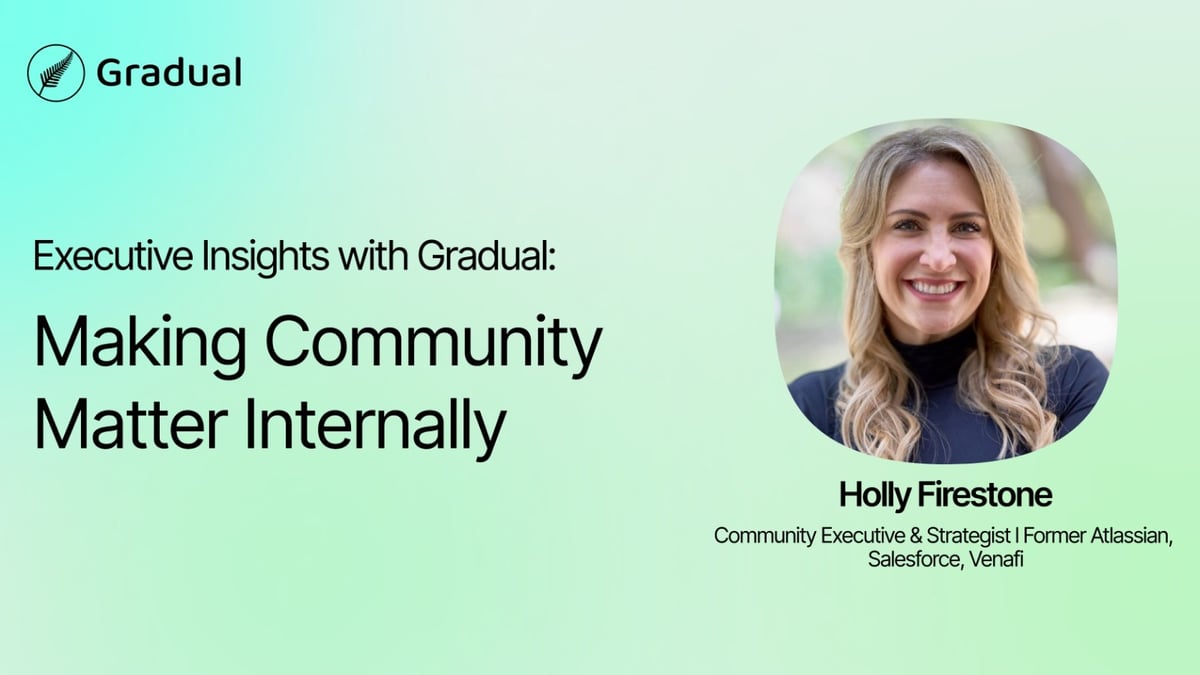
From Community Value to Internal Alignment: Executive Insights with Holly Firestone
# Theme: Community Building & DevRel
# Theme: Leadership & Executive Perspectives
# Challenge: Cross-Functional Alignment
# Format: Event Recaps

How community teams earn trust, clarity, and shared ownership across the organization

February 5, 2026
Holly Firestone
Holly Firestone
Joshua Zerkel
Joshua Zerkel
From Community Value to Internal Alignment: Executive Insights with Holly Firestone
Community teams rarely struggle to explain what they do. The harder part is helping the rest of the organization understand why it matters and how their work fits into it.
That was the core thread running through our recent Executive Insights conversation with Holly Firestone. Holly has built and led some of the largest enterprise community programs in the world, including Atlassian’s powerhouse user groups and Salesforce’s Trailblazer Community. She’s also spent years advising teams who know how to build community, but struggle to earn lasting internal alignment.
This session wasn’t about convincing people that community is important. It was about how alignment actually forms inside organizations, and why it almost always depends on translation, repetition, and shared context.

Community is a team sport

Early in the conversation, Holly explored an idea she’s known for: community as a team sport.
That framing matters because it pushes back on the idea that community lives on its own island. In practice, community touches product, marketing, support, sales, and leadership, whether those teams realize it or not. When community is treated as a standalone function, customers feel the seams immediately.
Customers don’t (and shouldn’t) know your org chart. They only experience the sum of how your teams show up.
Community leaders often feel protective of their members, which is understandable. But isolation makes alignment harder, not easier. Community only works when multiple teams understand their role in the system and why their participation matters.

Where alignment actually breaks down

One of the clearest insights from the session was that internal misalignment rarely comes from lack of interest. More often, it comes from lack of context.
Every team is operating under pressure, with their own goals and constraints. Asking them to “support community” without translating how it connects to their priorities is a nonstarter. As Holly put it, nobody is doing charity work inside a company. Teams need to understand what they’re getting back.
Alignment breaks down when community goals are presented as universal truths instead of tailored narratives. Product teams care about different outcomes than support teams. Executives need a different level of clarity than individual contributors. Using the same message everywhere is one of the fastest ways to lose buy-in.

Executive buy-in changes the equation

Holly shared how different alignment feels when community has executive sponsorship versus when it doesn’t. At Venafi, where she sat on the executive team, community priorities were visible early, discussed often, and reflected in how teams planned their work.
That level of access isn’t realistic for every community leader, especially in large organizations. But the principle still applies. Alignment forms faster when community goals are understood at the highest possible level, then reinforced through leadership conversations and team-level translation.
Support isn’t the same as understanding. Community leaders can’t assume that executive buy-in means executives can explain the work to others. Helping leaders understand the mechanics, not just the vision, is part of the job.

Translation is ongoing work, not a one-time pitch

A recurring theme in our conversation was repetition. Community leaders often hope for a single presentation or deck that will “make it click.” In reality, alignment forms over time through repeated, tailored communication.
Different teams speak different languages. Community leaders need to translate the same underlying value into terms that resonate with each audience. That means adjusting framing, examples, and outcomes without losing the core message.
Holly was clear that there are no shortcuts here. Alignment takes time, and community leaders should expect to explain what they do, how it works, and why it matters more than once.

Making community visible inside the organization

One of the most concrete examples Holly shared came from her time at Atlassian. During a company hackathon, she helped build an internal system that surfaced nearby user groups whenever employees booked travel. The goal was simple: help internal teams see and meet the people they were building for.
The impact was immediate. Employees who attended user group events came back energized, informed, and eager to share what they learned. Community stopped being abstract and became personal.
That kind of exposure creates internal advocates in a way slides never will. Seeing customers in context changes how teams think about their work, and it builds shared understanding faster than any report.

The real work behind the scenes

As the session wrapped, Holly acknowledged a hard truth. Community teams are already stretched thin. Spending time on internal education can feel like a distraction from building the community itself.
But without that work, community programs stall. Internal alignment isn’t overhead. It’s the work that makes everything else possible.
Community leaders are often builders and translators at the same time. The more clearly they can connect member value to business outcomes, the easier it becomes to earn trust, resources, and shared ownership.

Key takeaways

  • Alignment forms through shared context, not mandates
  • Community works best when multiple teams understand their role in the system
  • Translation and repetition are core community leadership skills
  • Executive support helps, but understanding matters more than approval
  • Internal exposure to customers builds trust faster than decks or dashboards

FAQ

Why is internal alignment so hard for community teams? Because most teams only see community through their own priorities. Without translation, value gets lost.
Does community need executive sponsorship to succeed? It helps, but what matters most is shared understanding across leadership and teams.
How can community leaders build internal champions? By making community visible, connecting teams directly to members, and tailoring messages to each audience.
Comments (0)
Popular
avatar

Dive in

Related

Blog
From Community Leadership to Business Impact: Executive Insights with Dani Weinstein
By Joshua Zerkel • Jan 29th, 2026 Views 22
Blog
Webinar Recap: From Connection to Impact: Executive Insights with Brian Oblinger
By Brian Oblinger • Oct 31st, 2025 Views 66
Blog
Webinar Recap: From Activity to Impact: Executive Insights with Bill Johnston
By Bill Johnston • Nov 13th, 2025 Views 25
© 2026 Gradual Community
Privacy Policy