
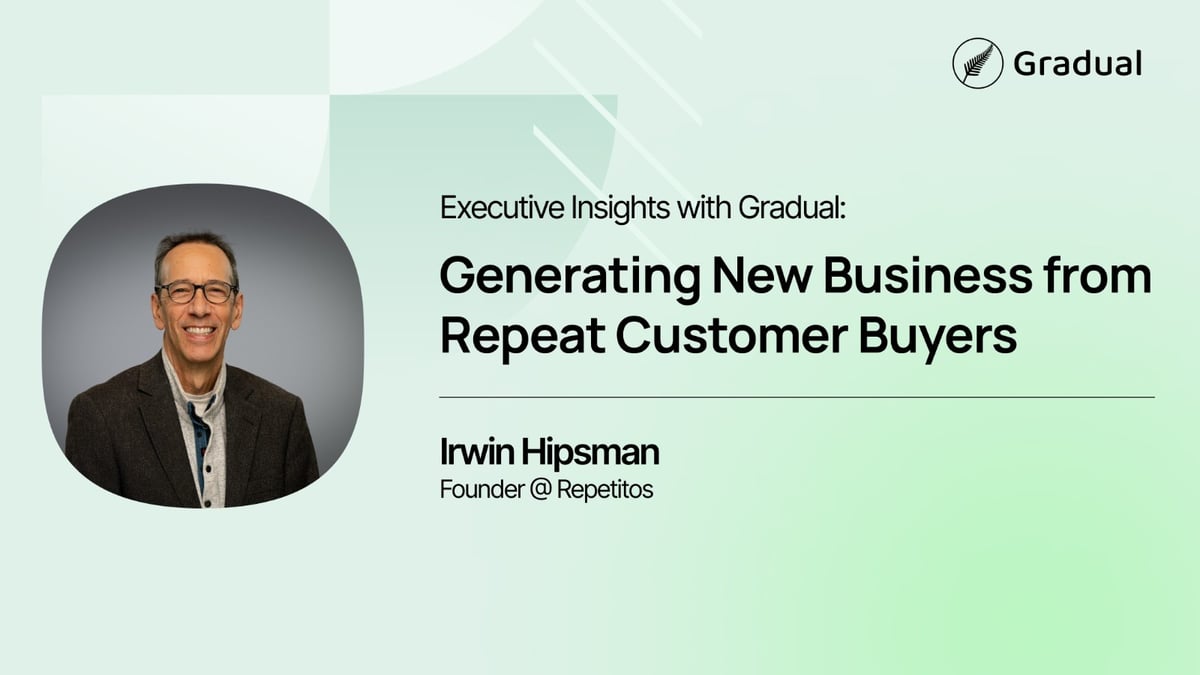
Webinar Recap: From Customer Context to Faster Revenue: Executive Insights with Irwin Hipsman
# GTM Strategy
# Format: Event Recaps
How repeat buyers reveal the value of clean customer data and shared understanding across go-to-market teams.
March 5, 2026
Irwin Hipsman

Joshua Zerkel
There are certain ideas that feel obvious once someone says them out loud.
That was the feeling during my recent conversation with Irwin Hipsman, founder of Repetitos and former Director of Customer Lifecycle Marketing at Forrester.
Most B2B companies spend enormous effort acquiring new customers. Entire teams focus on awareness, demand generation, lead qualification, and pipeline acceleration.
At the same time, a quieter opportunity sits inside nearly every CRM.
- People who already know your company.
- People who have already used your product.
- People who have already trusted your brand.
Many of those people eventually leave their company and land somewhere new. And when they do, they often become repeat buyers.
Yet most organizations don’t actively track them or nurture those relationships. They simply wait for those former customers to call back when they’re ready to buy again.
Irwin has spent years studying this pattern, and what he sees across companies is surprisingly consistent. Repeat buyers move faster, close at higher rates, and typically generate more long-term value than brand new prospects. But very few organizations run a structured program to identify and activate them.
As he put it during our conversation, companies spend a lot of time marketing to people who may never buy, while overlooking people who already know them.
What repeat buyers reveal about customer understanding
One of the most interesting parts of the discussion wasn’t just about repeat buyers themselves. It was about what they reveal about how organizations understand their customers.
Irwin’s work often starts with a simple question.
What shape is your customer contact database actually in?
When he ran a survey of B2B companies, the average score for database health landed around 47 percent. In practical terms, that means many organizations are operating with incomplete or outdated customer records.
That matters more than most teams realize.
Across companies he studies, the patterns are similar:
- Around 20 percent of contacts in most customer databases no longer work at the company listed.
- Around 30 percent have outdated job titles.
- Around 40 percent have incorrect or missing location data.
Those numbers tell a bigger story. When customer data isn’t maintained, it becomes almost impossible to understand how relationships evolve over time.
And that’s exactly where repeat buyer opportunities often appear.
A former champion changes jobs. A previous decision maker moves to a new company. A power user becomes a leader somewhere else.
Without clean data and visibility into those movements, those signals disappear.
Why repeat buyer programs rarely exist
During the conversation, I asked Irwin something that had been on my mind while preparing for the session.
Why don’t more companies do this?
After all, the logic is straightforward. Selling to someone who already knows your product should be easier than starting from scratch.
Irwin’s answer came down to three structural issues.
- First, systems rarely talk to each other. Signals that someone has left a company often live in separate tools or workflows that never reach the CRM.
- Second, organizational silos get in the way. A salesperson may notice a customer leaving an account, but if that customer lands in another territory or vertical, there’s little incentive to pass along the opportunity.
- Third, nobody formally owns the process.
When responsibility isn’t clear, repeat buyers simply become someone else’s problem.
That lack of ownership is why only about 12 percent of B2B companies run a formal repeat buyer program, according to the survey Irwin referenced.
The math behind repeat buyers
One of the most practical parts of the conversation was Irwin’s simple model for thinking about repeat buyer pipeline.
Imagine identifying 100 former customers who recently left their company.
About half of them will land at organizations that fit your ideal customer profile.
- From those 50 contacts:
- Roughly 25 leads may be accepted by sales.
- About 15 may turn into active opportunities.
- Around 5 may close.
Those numbers may seem modest until you compare them to traditional lead generation.
In many B2B programs, 100 top-of-funnel leads from content or webinars might generate only one closed deal.
Repeat buyers change the economics entirely.
They already know the product. They trust the brand. They often reach value faster once they adopt again.
That typically leads to larger contracts, faster sales cycles, and stronger lifetime value.
The real starting point: your database
Despite the upside, the first step in building a repeat buyer program isn’t marketing or outreach.
It’s data hygiene.
Irwin recommends starting with a small audit.
Select a random sample of about 200 contacts from your database and check a few basic signals:
- Are the job titles still accurate?
- Do you know the contact’s role with the product?
- Do you know where they’re currently located?
- Are they still working at the same company?
This quick review often reveals the underlying condition of the database.
From there, teams can start identifying the contacts who matter most for repeat buyer programs.
Not everyone qualifies.
The most promising repeat buyers usually come from specific roles:
- Primary champions or main points of contact
- Administrators who regularly used the product
- Advocates and active users
- Senior decision makers who approved the purchase
Those individuals tend to understand the brand, the solution, and the value it delivered. That shared experience becomes the foundation for future buying decisions.
Starting the repeat buyer relationship earlier
One of Irwin’s most interesting points was that repeat buyer programs shouldn’t begin when someone leaves.
They should start while the person is still a customer.
If organizations only communicate product updates to a small group of contacts, they limit who truly understands the value of the product.
Expanding that understanding across active users and leaders creates a broader base of future advocates.
In other words, repeat buyer programs begin with customer education.
The more people who understand the value of a product, the more potential champions exist when those individuals eventually move to new companies.
Staying visible after someone leaves
Once a former customer moves on, the goal isn’t aggressive selling.
It’s thoughtful relationship maintenance.
Irwin suggested a simple rule of thumb.
Wait about 30 days after someone changes jobs before reaching out. That gives them time to settle into their new role.
From there, the focus shifts to nurturing the relationship.
That might include:
- Offering useful content
- Inviting them to community discussions
- Sharing relevant research or resources
- Providing access to events or reports
The tone should acknowledge the existing relationship while recognizing that they’re no longer a current customer.
Done well, this keeps the company top of mind when a new buying cycle eventually begins.
A simple program with meaningful impact
The most surprising part of the conversation may have been how simple repeat buyer programs actually are.
They rarely require new technology.
Most companies already have the basic infrastructure in place through their CRM, marketing automation platform, and customer success workflows.
What’s missing is usually coordination.
Someone needs to own the program, track the signals, and keep the relationships alive.
When that happens, repeat buyers stop being a happy accident and become a reliable source of revenue.
And perhaps more importantly, they become a signal of something deeper.
An organization that truly understands its customers.
Key takeaways
- Repeat buyers often close faster and generate higher lifetime value than brand new prospects.
- Most companies overlook repeat buyers because their customer data is incomplete or outdated.
- Clean customer contact databases are essential for identifying repeat buyer opportunities.
- Repeat buyer programs should begin while customers are still active users.
- Ownership and cross-team coordination are critical for making these programs work.
FAQ
What is a repeat buyer program in B2B?
A repeat buyer program identifies former customers who move to new companies and nurtures those relationships so they can purchase again.
Why do repeat buyers convert faster?
They already understand the product, trust the brand, and know the value it provides.
What is the ideal percentage of revenue from repeat buyers?
Irwin suggested that healthy organizations often see around 10–20 percent of business come from repeat buyers.
What’s the first step to building a repeat buyer program?
Assess the health of the customer contact database and identify contacts who have left their company.
Like
Comments (0)
Popular

Dive in
Related
Blog
Webinar Recap: From Engagement to Revenue: Executive Insights with Anthony DeShazor
By Joshua Zerkel • Sep 24th, 2025 • Views 59
Blog
From Reddit Conversations to Shared Context: Executive Insights with Jeremie Gluckman and Anna Yuan
By Jeremie Gluckman • Feb 12th, 2026 • Views 48
Blog
Webinar Recap: From Activity to Impact: Executive Insights with Bill Johnston
By Bill Johnston • Nov 13th, 2025 • Views 50
Blog
Webinar Recap: From Connection to Impact: Executive Insights with Brian Oblinger
By Brian Oblinger • Oct 31st, 2025 • Views 94
Blog
Webinar Recap: From Engagement to Revenue: Executive Insights with Anthony DeShazor
By Joshua Zerkel • Sep 24th, 2025 • Views 59
Blog
Webinar Recap: From Activity to Impact: Executive Insights with Bill Johnston
By Bill Johnston • Nov 13th, 2025 • Views 50
Blog
Webinar Recap: From Connection to Impact: Executive Insights with Brian Oblinger
By Brian Oblinger • Oct 31st, 2025 • Views 94
Blog
From Reddit Conversations to Shared Context: Executive Insights with Jeremie Gluckman and Anna Yuan
By Jeremie Gluckman • Feb 12th, 2026 • Views 48