
Gradual Community

Webinar Recap: From Platform Change To Member Continuity: Community Tactics with Ryan Paredez
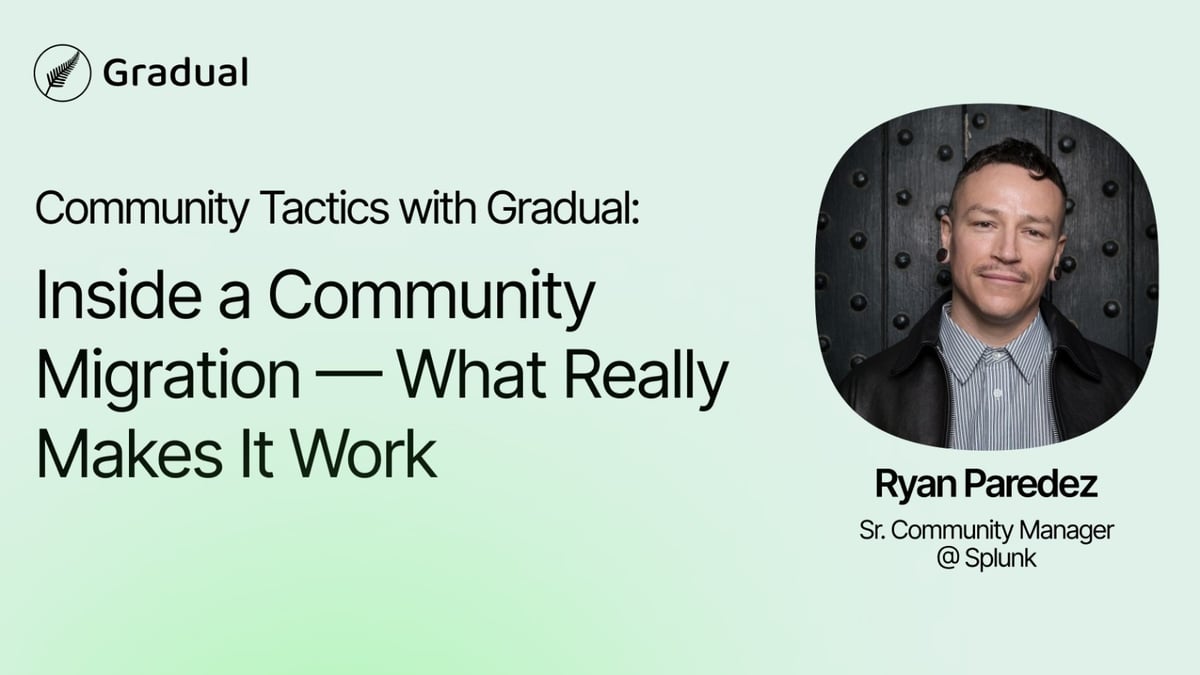
Webinar Recap: From Platform Change To Member Continuity: Community Tactics with Ryan Paredez
# Format: Event Recaps
# Challenge: Retention
# Role: Community/DevRel
# Theme: Community Building & DevRel

A close look at how one community team navigated a complex migration while keeping members informed, supported, and oriented.

January 16, 2026
Joshua Zerkel
Joshua Zerkel
Webinar Recap: From Platform Change To Member Continuity: Community Tactics with Ryan Paredez
Community migrations tend to be described as technical efforts. Platforms change, data moves, accounts transfer. What is easier to overlook is the experience members have while all of that is happening.
In this Community Tactics with Gradual session, I was joined by Ryan Paredez, Senior Community Manager at Splunk, to talk through the AppDynamics to Splunk community migration. Ryan shared the full arc of the work, including the preparation, the pivots, the communication decisions, and the outcomes that followed.
Ryan has spent more than a decade working across B2B and B2C communities, and his perspective throughout the session reflected that experience. Rather than focusing on an idealized end state, he walked through how the migration unfolded in real time, including moments of uncertainty and constraint.

Why the human side of migration matters

Early in the session, Ryan framed migrations as a form of disruption. Even when a change is necessary, members notice when familiar spaces, login flows, or URLs shift. Those changes can introduce confusion or hesitation, especially if members do not understand what is happening or why.
For Ryan, the focus was on communication that reduced uncertainty. That meant sharing information earlier than felt comfortable, acknowledging when details were still in flux, and keeping messages clear and direct. Members did not need every internal detail, but they did need to know what to expect and where to go.
This approach shaped how the team thought about preparation long before any data moved.

Cleaning up before moving

One of the first steps Ryan described was reviewing who and what would actually be migrated.
Over time, the AppDynamics community had accumulated a large number of accounts tied to people who had changed roles, left companies, or stopped using the product. Carrying all of those accounts into a new environment would have inflated numbers without improving participation.
The team reviewed account activity over several years and reached out to inactive members with a simple request. If they wanted to keep their account, they only needed to sign in. Two reminders were sent over a defined period. Accounts that remained inactive were removed before the migration.
The same thinking applied to content. Older posts with little recent activity were archived, and underused spaces were closed. The goal was not to erase history, but to reduce clutter and make the new environment easier to navigate.
Ryan described this phase as an opportunity to be more intentional about what the community was actually supporting.

Working through shifting plans

The original migration plan involved moving the AppDynamics community into Cisco’s ecosystem. That work included audits, customization reviews, and coordination across teams. Midway through, the project was paused. Later, after Splunk was acquired, the destination changed again.
From the outside, these shifts might look like standard corporate change. For the community team, they created long stretches where direction was unclear and communication had to be handled carefully.
Ryan shared that during these periods, he avoided launching new initiatives that might be disrupted later. Instead, he focused on readiness and documentation, knowing that much of the work could still be reused even if the destination changed.
When the move to Splunk became official, earlier preparation proved valuable. While the environment was different, the understanding of data, content, and member needs carried forward.

Communicating through the transition

Ryan outlined a clear communication sequence that supported members before, during, and after the migration.
Initial messages focused on awareness. Members were told that a migration was coming, even before exact dates were finalized. Later messages introduced specific actions, such as creating an account in the new environment ahead of time. Final reminders reinforced timelines and what would change at launch.
After the migration, Ryan shared a follow up message that oriented members to their new home. Familiar programs were mapped to new locations, and members were shown how to continue participating.
Just as important was internal communication. Ryan regularly updated marketing, product, and customer teams so they could accurately guide customers and avoid sharing outdated information.

What happened next

Post migration engagement was uneven. Fewer members signed in than Ryan initially expected, even after adjusting expectations based on the reduced member base. Incentives such as swag and gift cards had limited impact.
Ryan was clear that this outcome is common. Some members disengage during major transitions and do not return immediately, if at all. Over time, participation tends to stabilize among those who find value in the new environment.
Joining the broader Splunk community also created new opportunities. Stronger internal partnerships and a larger community team allowed Ryan to focus more on onboarding and helping members discover existing programs rather than rebuilding from scratch.
As the session wrapped, the conversation returned to what community teams can realistically control during a migration. Not every outcome will match expectations. Timelines shift. Participation fluctuates. Some members disengage despite careful planning.
What Ryan emphasized, through both his examples and his answers to questions, was the value of staying visible and consistent throughout the process. Reaching out to core members early. Keeping communication open even when details are incomplete. Making it easier for people to understand what changed and where to go next.
A migration does not end at launch. It continues in how members are welcomed, oriented, and supported afterward. The work Ryan shared offered a grounded view of what that looks like in practice, shaped by real constraints and tradeoffs rather than ideal scenarios.
Comments (0)
Popular
avatar

Dive in

Related

Blog
Webinar Recap: From Conversation to Collaboration: Community Tactics with Jenn Delconte
By Joshua Zerkel • Oct 21st, 2025 Views 32
Blog
Webinar Recap: From Activity to Impact: Executive Insights with Bill Johnston
By Bill Johnston • Nov 13th, 2025 Views 24
Blog
Webinar Recap: From Connection to Impact: Executive Insights with Brian Oblinger
By Brian Oblinger • Oct 31st, 2025 Views 64
© 2026 Gradual Community
Privacy Policy