
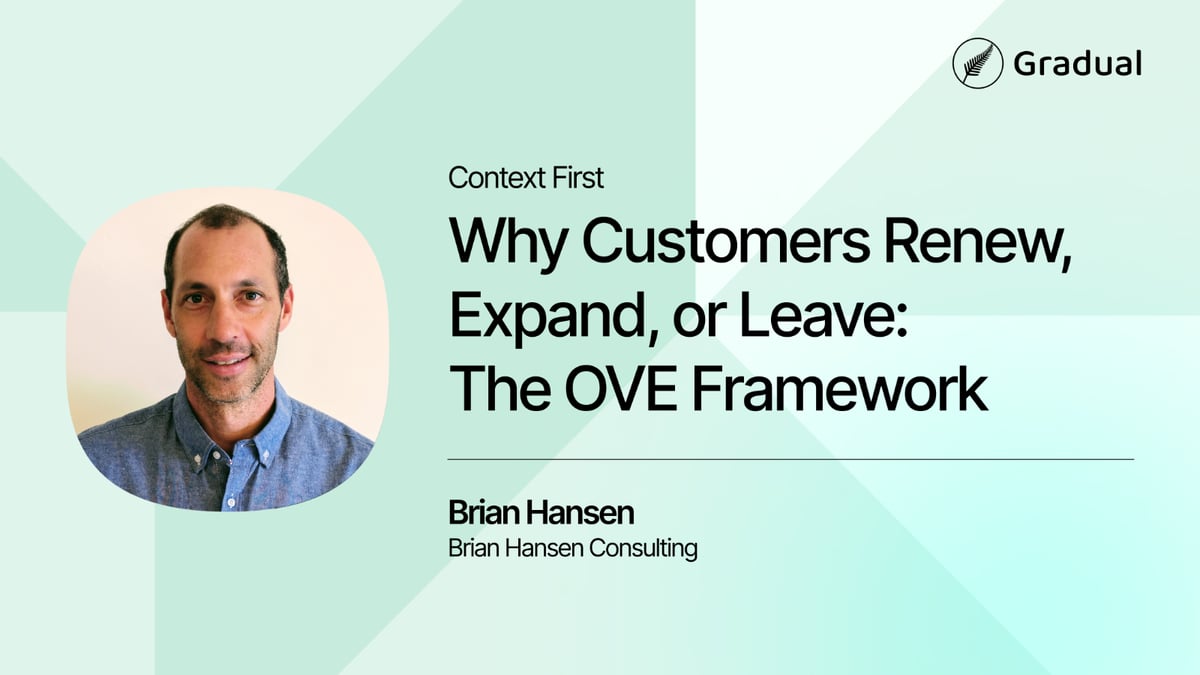
Why Customers Renew, Expand, or Leave: Brian Hansen on the OVE Framework
# Format: Event Recaps
# Sales & Revenue
# Community
A practical look at how outcomes, value, and expectations shape retention, expansion, and the way customer teams work.
July 31, 2026
Joshua Zerkel

Brian Hansen
One of the stranger patterns in customer work is how much energy companies put into winning customers, followed by how little attention those customers sometimes receive until something starts to go wrong.
I’ve seen versions of this throughout my career in community and customer programs. A company works hard to generate demand, close the deal, and get the customer through onboarding. Then everyone moves on to the next priority. The existing customer becomes visible again when usage drops, an escalation appears, or the renewal starts to look uncertain.
That was the starting point for my recent Context First conversation with Brian Hansen, a customer success consultant and advisor who has spent more than 15 years building and leading post-sale teams. Brian works primarily with Seed to Series B B2B SaaS companies, where the pressure to grow quickly can make it especially easy to focus on new revenue while treating retention as a problem for later.
Brian’s OVE Framework gives teams a simple way to understand what’s actually happening in the customer relationship. OVE stands for Outcomes, Value, and Expectations. These are three questions that sound basic, though many companies don’t ask them consistently:
- What is the customer trying to achieve?
- How does the customer measure value?
- Are we meeting the expectations of the people involved?
The usefulness of the framework comes from staying with those questions long enough to get real answers.
Outcomes provide the reason the customer bought
An outcome is the business result a customer hopes to achieve through the product or service.
Depending on the company, that may mean increasing revenue, reducing costs, improving efficiency, consolidating tools, or helping a team work more effectively. The specific answer matters because it creates the context for nearly everything that follows.
Customer teams often inherit a broad goal from the sales process and then move quickly into implementation tasks. The account gets configured. Users receive training. Meetings are scheduled. Those steps may all be necessary, though they don’t tell the team whether the original outcome is getting closer.
Brian encouraged teams to keep coming back to the reason the customer made the purchase. That may require confirming what sales heard, refining the outcome with new stakeholders, or recognizing that the customer’s priorities have shifted.
A clear outcome gives the relationship a shared direction. It also makes it easier to decide which activities deserve attention and which are simply creating motion.
Customers need to define value in their own terms
Many software companies use product adoption as a proxy for value. They look at logins, clicks, seats, feature usage, or time spent in the product.
Those signals are useful. They can help a team understand behavior and identify changes that deserve attention. Brian’s point was that they rarely provide a complete definition of value.
A customer can use a product regularly without getting the result they expected. Another customer may use only a small part of the product and still receive meaningful value from it. The best definition usually comes from asking the customer how they measure progress toward the outcome they care about.
When a company buys a product to increase revenue, value may be measured through pipeline, conversion, or revenue generated. When the goal is efficiency, value may show up through time saved, fewer manual steps, faster delivery, or lower operating costs.
This is where customer conversations need to move beyond reporting activity. The team has to understand what the customer considers evidence that the investment is working.
Expectations change faster than outcomes
Expectations are the most dynamic part of the framework.
A company’s desired business outcome may remain relatively stable for several quarters. Its definition of value may also remain consistent for a meaningful period of time. Individual expectations can change much faster.
A new executive arrives. A customer takes on a different role. The market shifts. A competitor introduces a new capability. AI changes what buyers assume should already be included. Pricing norms move from seat-based models toward consumption or outcomes.
Each of those changes can alter how a stakeholder evaluates the relationship.
This is also why one strong customer relationship may not be enough. Different people can hold different expectations at the same account. An executive may care about financial impact. An administrator may care about reliability and ease of management. A day-to-day user may care about whether the product makes their work easier. An operations leader may expect better data or stronger integration with existing systems.
Teams need a way to stay close to these perspectives over time. Expectations that were met six months ago may no longer reflect what matters today.
Better questions helped improve retention from 83% to 94%
Brian shared an example from a company where he began developing this approach.
The company had about $7 million in annual recurring revenue and gross revenue retention of 83%. That meant the business was losing a meaningful portion of its existing revenue each year and then working hard to replace it through new sales.
The product had room to improve, as most products do. The larger problem was that the company was highly focused on net-new growth and operating reactively after the sale. Customer work revolved around support tickets, complaints, escalations, and urgent situations.
Brian and the team began asking deeper questions. They documented what customers said about desired outcomes, value, and unmet needs. They shared those insights with product and adjusted both the product and the customer experience around what they were learning.
Over 12 months, gross revenue retention increased from 83% to 94%. Brian estimated that the improvement put roughly $770,000 back into the business.
That result came over multiple quarters. The team learned, adjusted, and became more effective as it went. They also reduced the amount of time founders and executives spent responding to customer fires, which created more room for strategic conversations and future growth.
Customer insight becomes more useful when it travels
One of the parts of the conversation I appreciated most was Brian’s emphasis on sharing what customer teams learn.
Post-sale teams often have access to some of the richest information in a company. They hear how customers describe their problems, what produces value, where expectations are changing, and which features matter in practice. That insight loses much of its potential when it stays inside account notes or individual calls.
Product teams can use it to understand which improvements are most connected to customer value. Marketing can use it to tell more credible stories and sharpen the way the company speaks to its audience. Sales can use it to show prospective customers how similar organizations moved from a starting point to a meaningful outcome.
Community can play an important role here as well. A community gives companies a place to ask questions at scale, invite customers to share how they’re experiencing value, and hear perspectives from people across roles and accounts.
As Brian put it, customers are people. They’re trying to do good work, meet their own goals, earn trust internally, and make choices that help them succeed. Community can create a more natural setting for those conversations than a formal account review alone.
The important part is closing the loop. When customers share information, they need to see that someone heard it, understood it, and used it.
The framework needs reinforcement to become a habit
OVE is simple enough to understand quickly. That simplicity can also make it easy for teams to agree with the idea and then return to their previous habits.
Brian identified incentives and measurement as common failure points. People tend to keep doing the work their managers inspect, praise, and reward. When customer curiosity is encouraged in theory but never reviewed, it gradually fades behind more visible priorities.
Teams can reinforce the behavior by reviewing call transcripts, looking at talk-to-listen ratios, and evaluating the quality of the questions being asked. A scorecard can help distinguish between surface-level check-ins and questions that reveal how the customer is thinking about outcomes, value, and expectations.
Recognition can matter too. The incentive doesn’t always need to be financial. Teams can celebrate people who uncover an important risk, identify an expansion opportunity, or bring customer insight back to the rest of the organization.
The goal is to make listening part of the operating rhythm rather than an occasional exercise.
Starting with OVE can be straightforward
A company doesn’t need to redesign its entire customer journey before using the framework. It can begin with three direct questions:
- What outcomes are you trying to achieve?
- How are you measuring value?
- Are we meeting your expectations?
Those questions can be used in one-to-one calls, account reviews, community discussions, support follow-ups, or short surveys. The answers should be documented in a consistent place and revisited over time.
In the first month, the most visible change may simply be more customer conversations. As teams improve their questions and listening, they can begin identifying risk earlier. Expansion opportunities become clearer as the company learns where customers are seeing value and what they need next. Over the following quarters, those changes can start to show up in retention and revenue.
The framework works because it brings teams back to the customer’s view of the relationship. That view is often more useful than the story a company tells itself based on activity alone.
Key takeaways
- Outcomes clarify the business result the customer is trying to achieve.
- Value should be defined by the customer and connected to evidence of progress.
- Expectations need regular attention because they can change across stakeholders and over time.
- Deeper customer questions can reveal retention risk and expansion opportunities earlier.
- Customer insight becomes more valuable when it reaches product, marketing, sales, and community teams.
- OVE becomes sustainable when leaders review, recognize, and reinforce the behavior behind it.
FAQ
What is the OVE Framework?
The OVE Framework is a customer success model based on Outcomes, Value, and Expectations. It helps teams understand what customers want to achieve, how they evaluate value, and whether the experience continues to meet their needs.
How does OVE improve customer retention?
OVE helps teams identify gaps before they become renewal problems. By discussing outcomes, value, and expectations regularly, teams can respond earlier and keep the relationship connected to meaningful customer results.
Is product usage the same as customer value?
Product usage can be a useful signal, though it doesn’t fully define value. Customer value is the customer’s assessment of whether the product is helping them achieve the outcome that motivated the purchase.
How can community support the OVE Framework?
Community can help companies ask questions at scale, hear how different stakeholders experience value, and create ongoing conversations about customer needs and expectations.
Like
Comments (0)
Popular

Dive in
Related
27:37
Video
Context First: Why Customers Renew, Expand, or Leave: The OVE Framework
By Brian Hansen • Jul 31st, 2026 • Views 4
Resource
Playbook: How to Speak The Language Of Executive Stakeholders
By Mark Birch • Jul 30th, 2026 • Views 6
27:37
Video
Context First: Why Customers Renew, Expand, or Leave: The OVE Framework
By Brian Hansen • Jul 31st, 2026 • Views 4
Resource
Playbook: How to Speak The Language Of Executive Stakeholders
By Mark Birch • Jul 30th, 2026 • Views 6