
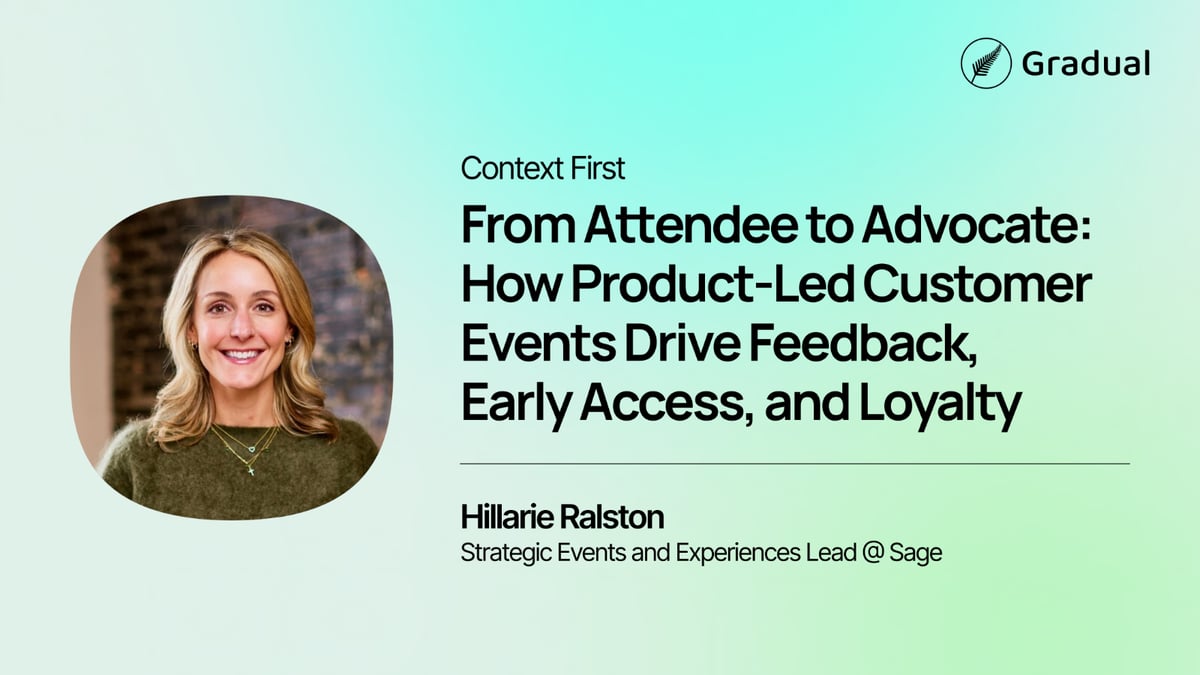
From Attendee to Advocate: How Hillarie Ralston Turns Customers Into Product Co-Creators
# Community
# Format: Event Recaps
A Context First event recap on how product-led customer events turn feedback into loyalty, and loyalty into advocacy.
August 12, 2026
Joshua Zerkel

Hillarie Ralston
We hosted Hillarie Ralston for Context First this week, and about two minutes into our conversation she said something that made me laugh: she felt like we were back on an Asana world tour together. We worked together years ago building customer events and community programs there, and catching up with her about what she's built since, at Ironclad and now at Sage, felt less like an interview and more like two colleagues comparing notes after some time apart.
Hillarie has spent over a decade in events and community, starting at Lululemon, one of the original architects of community-led brand building, before moving into B2B at Faire, Asana, Ironclad, and most recently Sage, a senior living nurse call management platform. Most of what she shared this week came from her years leading Ironclad Local, a customer roadshow series she inherited and then rebuilt around a simple, uncomfortable observation: the people building the product were never in the room with the people using it.
The best events leave people with a feeling, not just information
I asked Hillarie early on what separates a forgettable event from one that actually changes how someone feels about a company. Her answer had two parts. Most people who show up to a customer event are already bought into the product, so she sees her job as going a layer deeper into that relationship rather than reintroducing the pitch. The second part is more specific to how she works: she wants people to leave knowing their feedback mattered, that someone actually heard them and it's shaping what gets built next.
That second part is the thread that ran through the rest of our conversation, and it's the reason Ironclad Local looked so different by the time she left it than when she inherited it.
Ironclad Local started as an AMA for lawyers, and grew into a day of education
Hillarie inherited the program from Diane Warren, the events leader who originally built it as something closer to an informal AMA for procurement and legal teams. By the time Hillarie took it over, it had grown into a full day of programming held in cities like New York, Chicago, San Francisco, and Seattle, with 50 to 100 customers at each stop. Two education sessions went deeper into the product with the implementation team, and the day closed with a product keynote covering the roadmap, which she said was consistently the most exciting part of the day. People took pictures of the slides. They emailed afterward asking for a copy.
What the event didn't have, when Hillarie took it over, was anyone from product actually in the room.
The idea started at Faire, and she couldn't unsee it once she'd seen it
Hillarie traced the idea back further than Ironclad, to her time at Faire, where she watched product marketing managers and product managers get a front row seat with customers for the first time. It looked like people sitting across from actual users, hearing them think out loud, and iterating together in real time, without a survey summary or a deck standing between them. Once she'd seen that, she said, she couldn't unsee it. So when she inherited an already-strong customer event at Ironclad, the absence of product in the room started to look less like a gap and more like an opportunity that was hers to close.
Offering access got more buy-in than asking for attendance
Getting product and design to actually show up took less convincing than you might expect, and Hillarie credited that to how she framed the ask. Instead of asking a product marketing manager or product manager to come staff Ironclad Local, she offered them direct access to their own users for a day. That distinction mattered enormously to the people on the other end of it. Nobody wants to spend a day away from their deadlines standing at a booth. Everybody wants two hours of direct access to fifty of their actual users.
Her product marketing partner, Erica, and product manager, Lucy, had both attended an Ironclad Local before Hillarie made the pitch to bring product into the event more formally, and they arrived at the idea already convinced of what these events could do. That existing enthusiasm mattered. Once Erica and Lucy started going back to their own teams and leaders describing what they'd gotten out of it, buy-in from the rest of product and design followed, and it became, in Hillarie's words, something close to a friendly competition over who got to run the best activation on site next time.
A physical feedback wall turned feelings into something the business could count
The clearest artifact from our conversation was the wall Lucy designed and built for one of the Ironclad Local stops. Lucy had been a product designer before she became a product manager, and she put concepts for features the team was considering shipping directly onto a physical wall. Attendees could add sticky notes, vote on ideas that were already there, or contribute entirely new ones. Erica and Lucy stood beside it all day, not staffing a booth so much as having conversation after conversation, asking people's names, and following up on the ideas people brought them.
Hillarie described the feedback that came back from that wall as some of the most direct she'd ever heard at an event, including people telling her, unprompted, that they'd never felt like a software company was actually listening to them before.
What made the wall survivable as a program, rather than a one-time experiment, was that Hillarie learned to count what it produced:
- How many people signed up for an early access program tied to the event
- How many pieces of feedback the wall collected over the course of the day
- How many people posted about the experience afterward
Those numbers, she said, are what turned the wall from a nice moment into something the business would keep funding. The photos of happy customers are real, but whoever controls the budget wants to know what the event actually produced, and having a number to point to made that case far more effectively than a story could on its own.
Sharing an unfinished roadmap is a risk, and that risk is what made it land
The product keynote at Ironclad Local shared upcoming features and rough timing months before any of it shipped, which Hillarie said is rare enough that customers noticed immediately. Most companies worry a competitor might be in the room, so they keep the roadmap vague or withhold it entirely. Ironclad's willingness to show unfinished, sometimes messy work in front of customers read as its own kind of vulnerability, and Hillarie watched customers respond to it with more honesty than she'd ever gotten from a survey. People told her directly that if a feature landed a quarter earlier, they'd buy more seats. Having product leaders standing right there to watch that reaction, ask a follow-up question, and adjust in real time gave her something a written survey response never could.
That same session came with a few unwritten rules that made the moment feel earned rather than routine: no photos, no sharing outside the room, this is between us. That exclusivity was deliberate, and it's part of why people treated what they saw as something worth protecting rather than casually reposting, and part of why Hillarie has met so many people who told her they'd brought Ironclad Local to three different companies over their career. That kind of advocacy doesn't come from a good pitch. It comes from someone feeling like they were let into the room.
What she's rebuilding now, from scratch, at a new company
Hillarie left Ironclad about nine months ago to join Sage, and she's now working through a version of the same challenge without the years of trust she'd already built with Erica and Lucy in place. Her advice for anyone starting this from zero was direct: don't pitch cross-functional partners on attendance, pitch them on outcomes, and find the one product marketing or product person who's genuinely curious enough to show up once, see the impact, and come back asking when the next event is. Once someone starts asking you that question instead of you asking them to attend, she said, you've found the partnership that will actually hold up over time.
We closed by agreeing on something neither of us needed convincing of: no amount of AI is going to replace the moment a customer feels heard by an actual person. It might change how quickly a team can act on what they hear, but the part where someone feels like their input mattered still has to happen between two people in a room.
Thanks to Hillarie for being so generous with what she's actually built and learned, twice over now, at two very different companies.
Key Takeaways
- Pitching cross-functional partners on what they'll get out of an event, rather than simply asking them to attend, is what gets product, PMM, and design teams to actually show up.
- A physical feedback activation, staffed by the people building the product, gathers more direct and unfiltered feedback than a survey because attendees are already primed and thinking about their pain points.
- Quantifying an activation's output, through early access signups, feedback volume, and social posts, is what turns a good moment into a program the business will keep funding.
- Sharing an unfinished product roadmap, with real rules around exclusivity, builds a kind of vulnerability that customers respond to with unusually honest feedback.
- The strongest advocacy comes from customers who feel like they were let into the room, a feeling that outlasts ordinary product satisfaction.
FAQ
What made Ironclad Local different from a typical customer event?
Ironclad Local brought product, product marketing, and design directly into a customer roadshow that had previously belonged only to the events team. Rather than presenting information at attendees, the event gave product teams a physical activation, a feedback wall, where they could hear directly from customers and adjust their thinking in real time.
How do you get product teams to actually attend a customer event?
Hillarie Ralston's approach was to stop pitching attendance and start pitching outcomes. Instead of asking someone to staff an event, she offered direct access to fifty of their own users for a few hours. Finding one curious product marketing or product partner who experiences that value firsthand does more than a mandate from leadership.
Why did sharing an unfinished product roadmap work so well?
Most companies keep their roadmap vague because they're worried a competitor is in the room. Showing unfinished, sometimes messy plans is a form of vulnerability, and customers tend to match that vulnerability with more honest feedback than they'd give in a survey, especially when the moment comes with real exclusivity attached.
How do you prove a customer event is worth the investment?
Hillarie's team tracked specific numbers tied to their feedback wall: early access signups, the volume of feedback collected, and social posts from attendees afterward. Quantifying the output gave the business a concrete case for continuing to fund the program, rather than relying on anecdotes and event photos alone.
Like
Comments (0)
Popular

Dive in
Related
29:44
Video
Event Replay: From Attendee to Advocate: How Product-Led Events Drive Feedback, Early Access, and Loyalty
By Hillarie Ralston • Oct 21st, 2026 • Views 43
Resource
Playbook: How To Turn Internal Skeptics Into Community Champions
By Ashley Williams • May 7th, 2026 • Views 59
Resource
From Goals to Programs: Turning GTM Priorities into Community Strategy
By Joshua Zerkel • Jan 20th, 2026 • Views 34
Resource
Playbook: How To Turn Customer Stories Into Usable Signals
By Audrey Vandenbroeck • Jun 23rd, 2026 • Views 19
29:44
Video
Event Replay: From Attendee to Advocate: How Product-Led Events Drive Feedback, Early Access, and Loyalty
By Hillarie Ralston • Oct 21st, 2026 • Views 43
Resource
From Goals to Programs: Turning GTM Priorities into Community Strategy
By Joshua Zerkel • Jan 20th, 2026 • Views 34
Resource
Playbook: How To Turn Customer Stories Into Usable Signals
By Audrey Vandenbroeck • Jun 23rd, 2026 • Views 19
Resource
Playbook: How To Turn Internal Skeptics Into Community Champions
By Ashley Williams • May 7th, 2026 • Views 59