
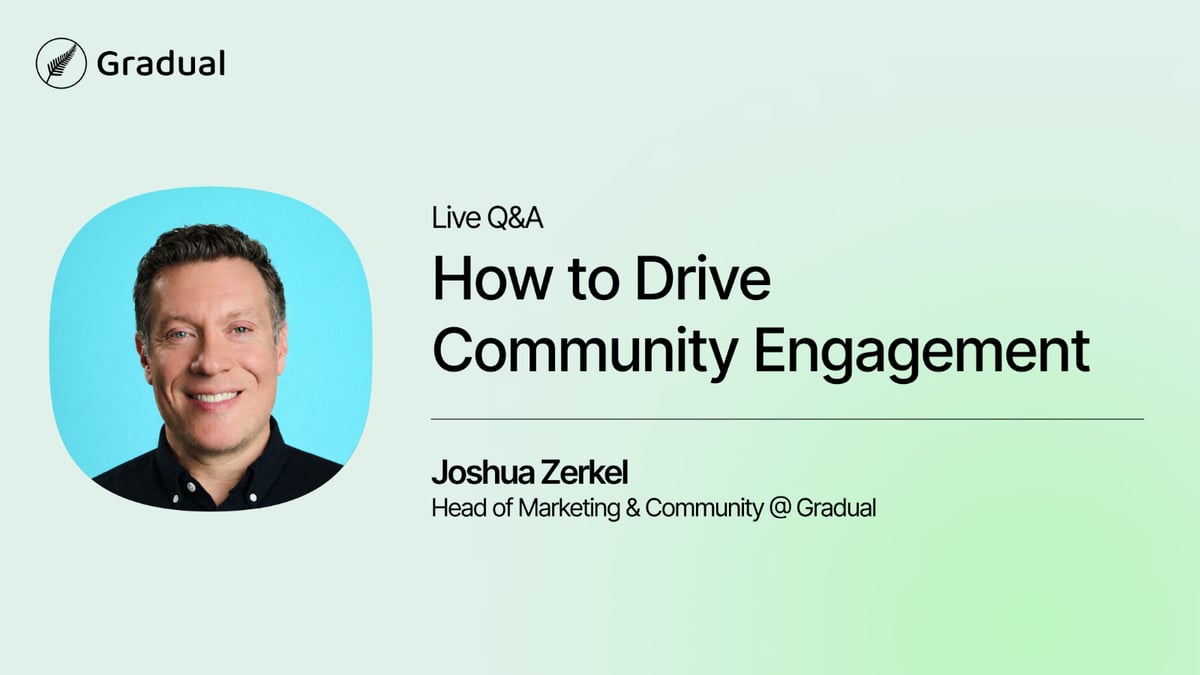
How to Drive Community Engagement: Live Q&A Recap
# Community
# Format: Event Recaps
How to connect participation, retention, audience fit, and measurement into one system for driving real community engagement.
July 22, 2026
Joshua Zerkel
I hosted a live Q&A focused entirely on community engagement, and it turned into one of my favorite sessions of the year, mostly because the questions were so specific and yet very universal. When people registered, they told us what they were actually stuck on, and I grouped those questions into four themes we worked through together.
I've spent about 20 years building community programs, including at Asana and Evernote, and I was a Gradual customer myself before I joined the team. A lot of what I shared came from things I've tried, watched work, and in a few cases watched fail.
Before getting into the themes, I wanted to level set on what engagement actually means. Engagement is members consistently finding enough value to participate, contribute, and come back. Activity alone doesn't capture that, and that distinction ended up mattering for almost every question we covered, because if you're optimizing for the wrong thing, more activity won't fix it.
Getting people to participate is the hardest part of the work
The first theme came from a handful of questions that were all asking some version of the same thing: how do you get people to participate instead of joining and then disappearing?
I think this is one of the hardest problems in community work, because participation doesn't happen automatically. You can have good technology, content you spent real time creating, and a decent number of members, and still struggle if people don't find value in interacting with each other.
One thing I've noticed is that teams tend to optimize for activity instead of interaction. Clicks are easy to produce. What matters more is whether one member creates value for another, because that's where community actually starts.
That reframes the question you ask when someone joins. It stops being "what button do we want them to click" and becomes "how do we help them find another person working through something similar." That's the beginning of the flywheel: one helpful interaction leads to another, and eventually members are creating value for each other instead of everything depending on the community team.
A good first interaction increases the odds someone else responds
We talked through a few practical ways to design that first interaction. Start with one meaningful first action, something obvious and worth doing, instead of asking people to figure out where to begin on their own.
Lower the level of expertise required to participate too. Some of the most valuable contributions are just "I'm dealing with the same thing" or a good follow-up question.
And guide new members toward conversations that are already active, since it's a lot easier to join something with momentum than to start from zero.
A few examples came up that are worth repeating:
- In a product community, ask what feature would save someone the most time, and why. It doesn't require deep product knowledge, and people often discover others solving the same problem.
- In a peer support community, encourage a reply like "I'm running into the same issue, has anyone found a good approach," which starts a conversation without requiring anyone to be the expert.
- In an implementation community, ask what someone's next milestone is instead of asking them to introduce themselves. Someone configuring SSO might connect with three other customers who just finished that exact work.
The common thread is that the first action should increase the chance that another member responds, not just check a box for the platform.
Communities become habits when each interaction leads into the next
The second set of questions were about getting people to come back a second time, and I think this is one of the most important questions in community work. Getting someone to join is marketing. Getting them to come back is community.
The mistake I see most often is designing individual experiences instead of thinking about how a member experiences the program over time. Every event, discussion, or course gets planned on its own, but members don't experience a community that way. They experience it as a series of interactions over time, and if every experience has a defined beginning and end, members have to decide all over again whether it's worth coming back.
A few things help here: designing every experience with a next step in mind, building recurring formats like monthly office hours instead of one-off programs, reconnecting people with conversations they missed, and closing the loop when someone's feedback actually leads to something. I also think relationships do more of this work than content gets credit for. Two members who meet during an office hours session are far more likely to register for the next one, because they already know someone will be there.
Executives and practitioners are hiring your community to do different jobs
Another great question: how do you make sure busy executives get value from the community and stay engaged? I think it points to something bigger than executives specifically.
Community is really a collection of audiences, each with different goals and different definitions of value. A practitioner solving implementation problems has very different needs than an executive thinking about strategy, and expecting both groups to engage the same way usually means neither one is getting what they actually need.
I'd encourage teams to stop treating frequency as a proxy for value. Someone who logs in every week isn't automatically more engaged than someone who shows up to one roundtable a quarter.
What matters is whether the experience you built for them is actually working for what they came there to do. A customer advisory board that meets four times a year and produces real product influence is a healthy program, even though it looks nothing like a peer support community.
Measurement earns credibility once it connects to a business outcome
The last theme was one almost every community leader eventually gets asked about: how do you measure this? I think teams often stop measuring too early, at participation, right when leadership is thinking in terms of business outcomes like renewals, adoption, or pipeline.
My approach is to work backwards. Instead of starting with which community metrics to track, I start with the business outcome we're trying to influence, then ask what customer behaviors we'd expect to see if that outcome were actually improving. Those behaviors become the engagement signals worth tracking, and if they're increasing alongside the outcome, that's the story worth telling.
Saying "we answered 500 questions this quarter" is fine on its own. Saying "questions got answered twice as fast, support tickets dropped, and CSAT improved" gives leadership something they can connect to the rest of the business.
Stepping back, I think all four of these ideas build on each other. Design for member-to-member value, give people a reason to come back, recognize that different audiences need different things, and measure engagement as evidence of progress rather than the goal itself. That's how I think about building an engaged community: as a system, not a list of tactics.
Thanks to everyone who joined and sent in questions ahead of time. They shaped the whole session. If you want to hear the full conversation, including a few questions we got to live, the replay is below.
Key Takeaways
- Engagement means members are consistently finding enough value to participate, contribute, and return, not just show measurable activity.
- The first action a new member takes should increase the odds that another member responds, not simply check a box.
- Communities become habits when every experience answers "what should someone do after this," instead of ending cleanly with no next step.
- Different audiences, like executives and practitioners, are hiring your community to do different jobs and shouldn't be measured against the same engagement bar.
- Engagement metrics gain credibility with leadership once they're connected to a business outcome the rest of the company already tracks.
FAQ
What does "engagement" actually mean in a community program?
Josh defines engagement as members consistently finding enough value to participate, contribute, and return to a program over time, rather than a single measure of activity like clicks or logins. The distinction matters because optimizing for activity alone, like more posts or more prompts, doesn't reliably solve participation problems.
How do you get new members to participate instead of just joining and going quiet?
Give them one clear, meaningful first action that's designed to create a response from another member, not just complete a task. Lowering the expertise required to contribute and directing new members toward already-active conversations both make that first interaction easier to have.
Why do members stop coming back after one good experience?
Most programs plan events, discussions, and courses as standalone experiences with a clear beginning and end. From a member's perspective, that means every experience is a decision point about whether it's worth returning, so building recurring formats and next steps into each experience helps turn one visit into a habit.
How should community teams measure engagement for leadership?
Start with the business outcome you're trying to influence, such as renewals or product adoption, then identify the customer behaviors you'd expect to see if that outcome were improving. Track those behaviors as engagement signals and report them alongside the outcome, rather than reporting activity numbers on their own.
Like
Comments (0)
Popular

Dive in
Related
31:24
Video
Event Replay: How to Drive Community Engagement (Live Q&A)
By Joshua Zerkel • Jul 22nd, 2026 • Views 30
Resource
Playbook: How to Measure Community Engagement During a Migration
By Patricia Feitosa • Jun 4th, 2026 • Views 18
Resource
Using Seasonal Campaigns to Drive Community Engagement
By Joshua Zerkel • Dec 4th, 2025 • Views 28
Resource
How Newsletters Can Drive Community Engagement and Strengthen GTM Alignment
By Joshua Zerkel • Dec 4th, 2025 • Views 31
31:24
Video
Event Replay: How to Drive Community Engagement (Live Q&A)
By Joshua Zerkel • Jul 22nd, 2026 • Views 30
Resource
Using Seasonal Campaigns to Drive Community Engagement
By Joshua Zerkel • Dec 4th, 2025 • Views 28
Resource
How Newsletters Can Drive Community Engagement and Strengthen GTM Alignment
By Joshua Zerkel • Dec 4th, 2025 • Views 31
Resource
Playbook: How to Measure Community Engagement During a Migration
By Patricia Feitosa • Jun 4th, 2026 • Views 18