
Gradual Community
Ask
Gradual Explained
November 17, 2026

The key to building community with intention
The key to building community with intention
# Community
# Format: Event Recaps

“Building community with intention” sounds easy enough.

Jamie Pierce-Cote
Jamie Pierce-Cote
The key to building community with intention
But if it’s really so simple, why are so many experiences seemingly designed with the wrong outcomes in mind?
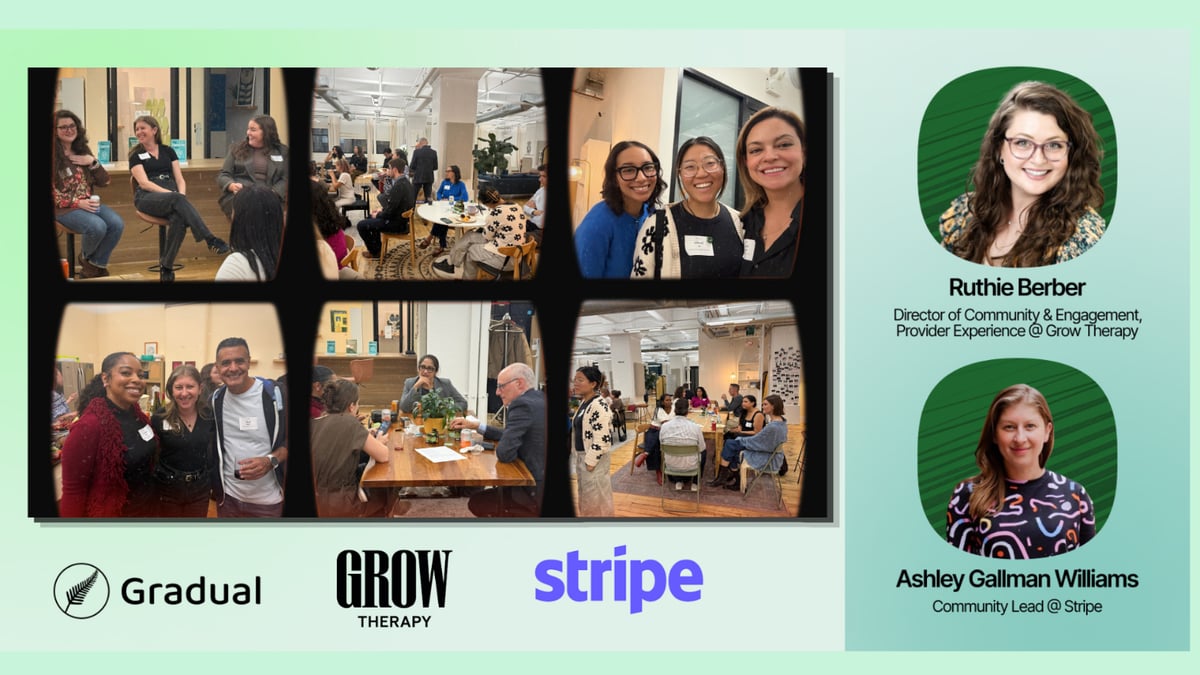
This is what I kept returning to while prepping for the recent conversation I moderated with Ashley from Stripe and Ruthie from Grow Therapy, and the conversation the three of us had last week seems to point to a very clear indication as to what it all comes down to: The PEOPLE.
This might sound obvious. Yet in practice, it’s surprisingly easy to lose sight of while moving from “we need to focus on community” to actually launching a full program.
So often as community builders, we’re focused on demonstrating value, streamlining systems, driving product usage, creating fun events, or doing anything we can to prove the undeniable value we know that community creates, even when the ROI feels elusive. 
Don’t get me wrong, these are all factors we must consider, but by focusing so much of our energy on them, especially in the early days, we are distracting ourselves from a far more important factor… 

The people

As community builders we’re not just measuring a dollar amount; we’re measuring something far more complex: the value of a relationship. And when it comes to relationships, and building communities with intention, the number one question we ought to be asking ourselves is:    
How deeply do you understand your people?
Not just how they’re using a product, or what content they’ve consumed, but who they really are. 
  • What are they trying to accomplish? 
  • What do they need? 
  • How do they spend their free time? 
This understanding is crucial.

Where Stripe’s community began

To show what this looks like in practice, I want to share the story of where Ashley and the Stripe community began. 
Ashley’s team didn’t start by scoping vendors, standing up programming, or launching an online forum.
They started by talking to their users.
Stripe’s audience base is vast—serving everyone from individual small business owners to the world’s largest organizations. Very quickly, their team realized that a generic space organized around “payments” wouldn’t really cut it. People needed a more meaningful reason to show up.
So, her team kept researching, and through this process, they actually found pockets of users who were already organically building community. What happened next? They brought this group into the process, and ensured that they were part of shaping things from the very beginning.
Ashley’s team began designing the platform and virtual experience only after observing how people naturally wanted to connect. They didn’t launch a shiny new experience hoping that people would find it. Instead, they designed an experience around the needs and behaviors that were already in place. People first.
You might be thinking, “surely this is common practice,” but in reality, especially with expectations to move fast, this is an undeniably crucial, yet easily forgotten step. 

The internal experience matters, too

Deeply understanding your members is only the beginning. The next challenge is translating those needs across your organization.
Or, better yet, bringing your cross-functional partners into the discovery process from the start.
Ruthie’s experience at Grow Therapy is a perfect example of why this matters: When her team decided to migrate their community— already tens of thousands of therapists strong—to a new community hub, she knew it couldn’t be treated as a project owned by the community team alone.
Before their migration was even underway, she brought together partners from product, support, security, data, and design, for a direct conversation. She shared what the community team had learned, why the existing experience was no longer serving members, and how each department would eventually play a role in what came next. 
Not every stakeholder was asked to take action right away. But when the time came to work through SSO, data migration, design, or member support, those teams weren’t hearing about the project for the first time. They already understood the larger goal, their expected role, and why it mattered for the community experience at large. Again, people first.
Honestly, listening to her share this felt like a masterclass in setting a community up for success. 
I think part of the reason it stuck with me so much, is because it reinforced another principle that also rings true: 
While a community functionally lives on a platform, its success often lives or dies within the four walls of your organization.
Your product team shapes what users receive. Design influences how the experience feels. Support helps resolve customer needs. And your leadership team decides whether the work receives the time, investment, and priority required to succeed. 
But the simple truth is that when these teams aren’t aligned, your members ultimately feel the gap. They don’t care which internal factors are at play. They care about their own experience… and how good (or bad) it feels.

So, the key to building community with intention? 

Get to know the humans on the other side of the experience you’re building. Understand what they need, what they value, and what would give them a meaningful reason to keep showing up.
Then, invest in your cross-functional relationships early. Become the connector. You don’t need to have every answer or personally own every piece of the work, but you should be able to help the people around you understand what your audience needs, why it matters, and the role they can play.
And I’ll personally add: Remember that it’s okay to slow down.
Carve out time for real conversation, thoughtful discovery, and genuine connection. Resist the pressure to jump straight into platforms, programming, and measurement before you understand the people at the center of it all.
Because the communities that truly succeed start by giving people a genuine reason to connect.
Comments (0)
Popular
avatar

Dive in

Related

Blog
Building Together: Inside the Gradual Community
By Joshua Zerkel • Oct 30th, 2025 • Views 93
Resource
Building Advocacy Funnels: From Community Members to Champions
By Joshua Zerkel • Dec 4th, 2025 • Views 26
Blog
Building Together: Inside the Gradual Community
By Joshua Zerkel • Oct 30th, 2025 • Views 93
Resource
Building Advocacy Funnels: From Community Members to Champions
By Joshua Zerkel • Dec 4th, 2025 • Views 26