
Gradual Community
+00:00 GMT

Webinar Recap: From Conversation to Collaboration: Community Tactics with Jenn Delconte
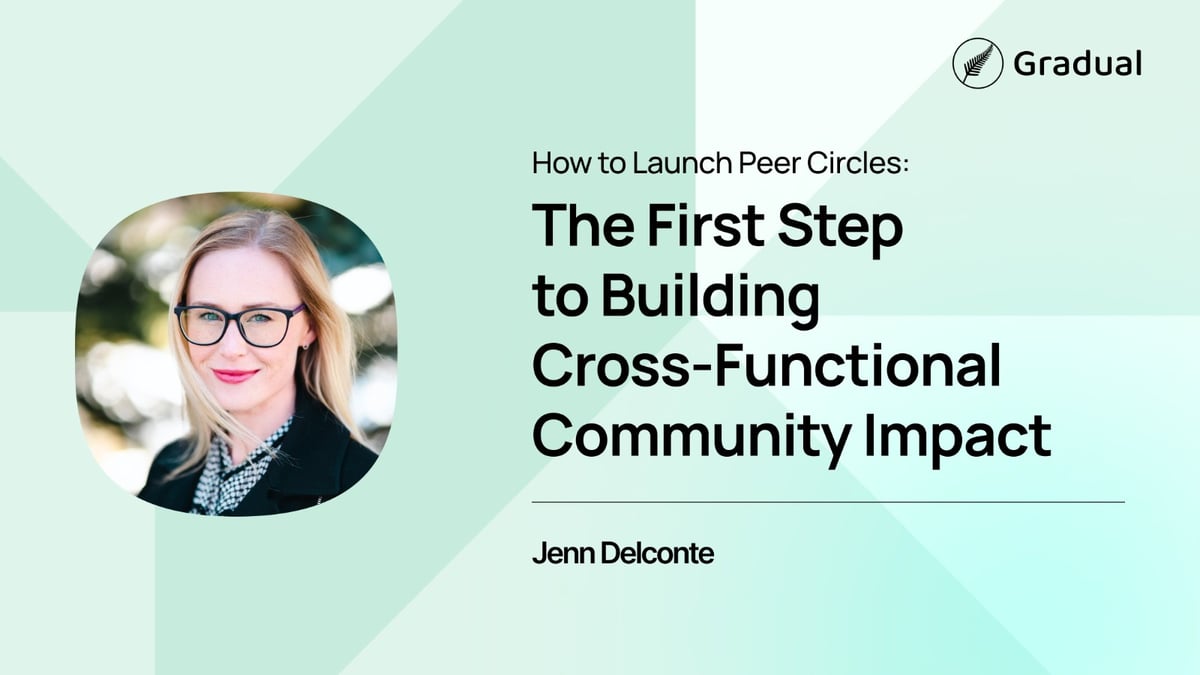
Webinar Recap: From Conversation to Collaboration: Community Tactics with Jenn Delconte
# Format: Event Recaps
# Theme: Community Building & DevRel
# Challenge: Advocacy

How Klue turned small peer discussions into a cross-functional engine for customer impact

October 21, 2025
Joshua Zerkel
Joshua Zerkel
Webinar Recap: From Conversation to Collaboration: Community Tactics with Jenn Delconte
In our latest Community Tactics with Gradual session, I had the opportunity to host Jenn Delconte, Community and Marketing leader, for an engaging and practical discussion about Peer Circles and how they can drive impact across teams.
Jenn has spent more than 15 years helping startups grow through connection, content, and advocacy. At Klue, she built the Compete Community from the ground up, growing it to over 15,000 members while strengthening collaboration between customers and internal teams. Her approach to Peer Circles shows what can happen when community programs are designed with both structure and heart.
When Jenn described her program, she explained that it wasn’t just another roundtable. It was a way to help customers connect, learn from one another, and build alongside Klue’s product teams. The results included more active champions, faster feedback loops, and a stronger sense of shared ownership between customers and the company.

Why Peer Circles work

Peer Circles began with a simple idea: create small, focused spaces where customers could talk about what was working and what wasn’t. “Customers told us they just wanted to connect with each other,” Jenn said. “They didn’t need another webinar. They needed a space to talk about what was really working for them.”
Each session included a mix of customers at different stages—some brand new, others long-time users—alongside internal leaders from Product, Customer Success, and Marketing. The result was an open exchange of ideas where both customers and teams learned together.
Peer Circles were also intentionally small. Each one was invite-only, with six to eight participants and a shared theme or goal. Before each session, attendees received a few simple discussion questions, a list of who else would be joining, and a link to related threads in the community to help the conversation continue afterward.
Jenn summed it up well: “It’s not about big numbers. It’s about creating a small, trusted space where people can actually talk and where we can listen.”

The process behind the play

Jenn walked through how Peer Circles came to life at Klue and how the process evolved over time.
Start with discovery. Before the first session, she interviewed 25 customers to learn what they wanted most from Klue’s community. The answer was consistent: more opportunities to connect with peers who understood their challenges.
Pilot small. The first Peer Circle brought six customers together to talk about AI and competitive intelligence. Klue’s VP of Product joined to listen, take notes, and answer questions. That first conversation became the model for many more.
Facilitate, don’t host. Each session had a facilitator whose role was to guide conversation, not dominate it. “The facilitator isn’t the VIP,” Jenn explained. “Their job is to help others feel comfortable sharing.”
Make it repeatable. Sessions lasted 45 minutes, with customers doing most of the talking. After each one, Jenn used tools like Gong and ChatGPT to create summaries for internal teams to review.
Close the loop. The insights that surfaced didn’t stay in a document. They were shared across Product, CS, and Marketing, where they informed product roadmaps, training, and messaging.
Over time, this simple rhythm turned Peer Circles into an engine for both engagement and alignment.

Building alignment across teams

One of the most valuable outcomes of Peer Circles was the cross-functional collaboration it inspired. “Everyone was talking to the same customers, but in different channels,” Jenn shared. “Peer Circles finally gave us a shared space to listen together.”
When Klue’s VP of Product began joining regularly, the benefits multiplied. Product teams heard customers describe their challenges directly. CS discovered new opportunities for adoption. Marketing found language that reflected the customer’s perspective.
Jenn also emphasized how meaningful it was for customers to see their ideas reflected in future updates and launches. That visibility helped participants feel part of the process and more invested in the company’s success. Many returned for future sessions or joined Klue’s advocate programs to keep contributing.

What Jenn learned along the way

Like any community initiative, Peer Circles evolved through experimentation. Some approaches worked immediately; others needed adjustment. Jenn’s reflections offer valuable guidance for any community builder:
  • Keep it small and focused. Smaller sessions invite deeper connection and conversation.
  • Avoid over-programming. When the format became too structured or treated as a lead-generation tool, it lost its impact.
  • Choose the right facilitators. The best hosts listen more than they talk.
  • Share learnings internally. Visibility across departments helps sustain momentum. Remember the human side. Programs that feel personal build more trust than those that feel transactional.
Jenn reminded everyone that the simplest efforts often have the greatest effect. “Most of the time people want the big numbers,” she said, “but when we drilled down into those smaller, more intimate engagements, there was a ton of insight we wouldn’t have captured otherwise.”

Leading with connection

One of the strongest takeaways from this conversation was the value of personal connection in community work. Jenn shared how sending one-to-one invitations—rather than automated emails—helped increase attendance and engagement.
“It’s doing the stuff that doesn’t scale,” she said. “People know when something’s automated, and they know when it’s real.”
That sentiment resonated deeply. In an era of AI and automation, the human touch still makes the biggest difference. When people feel seen, they show up and contribute more meaningfully.

My reflection

What I appreciate most about Jenn’s approach is how grounded it is. Peer Circles weren’t built from a complicated strategy. They started with curiosity, listening, and a willingness to test ideas in small ways before scaling up.
Jenn’s work shows that the most powerful community programs don’t always rely on new tools or large audiences. They succeed when people come together to learn from one another and feel heard.
For anyone looking to deepen customer engagement or connect internal teams more closely to the customer voice, Peer Circles are a model worth exploring. They remind us that genuine connection is the foundation for growth and progress.
▶️ To get you started, check out Jenn's Peer Circles playbook.
Comments (0)
Popular
avatar

Dive in

Related

Blog
Webinar Recap: From Activity to Impact: Executive Insights with Bill Johnston
By Bill Johnston • Nov 13th, 2025 Views 21
Blog
Webinar Recap: From Connection to Impact: Executive Insights with Brian Oblinger
By Brian Oblinger • Oct 31st, 2025 Views 59
© 2025 Gradual Community
Privacy Policy