
Playbook: Define What Community Is Meant to Influence
# Community
# GTM Strategy
# Format: Playbooks
Use this guide to connect community programs to the business decisions, outcomes, and teams they’re meant to shape.
August 12, 2026
Joshua Zerkel
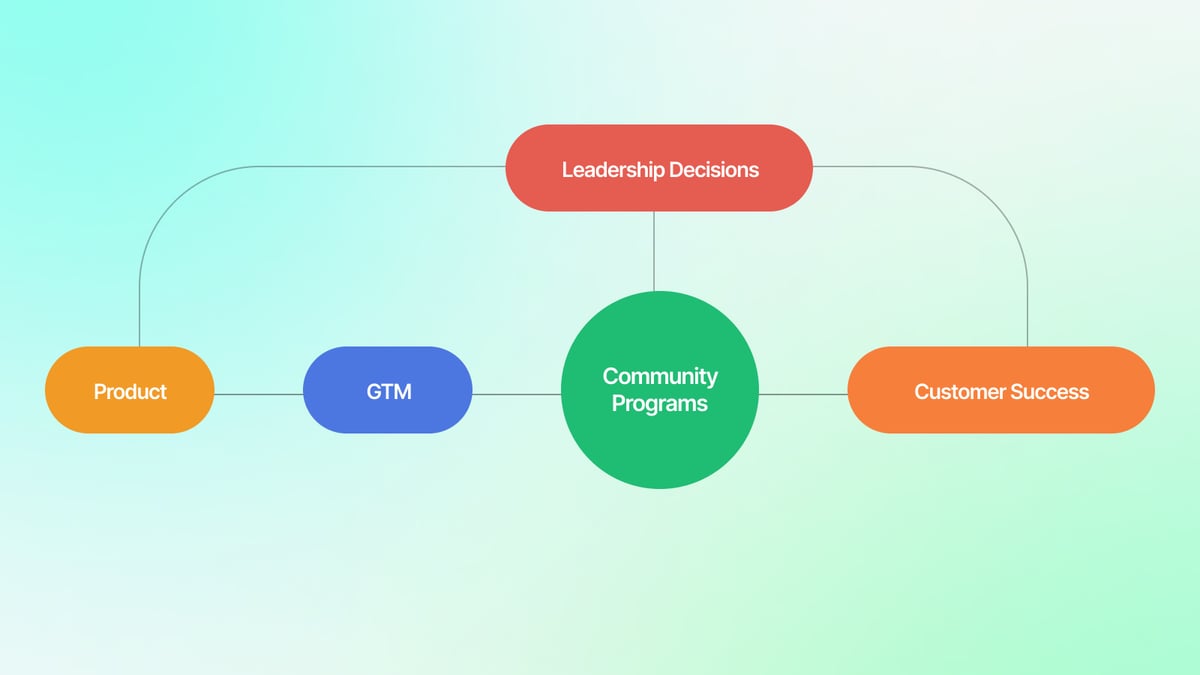
Community can create value in many ways, which is part of its strength and part of why it can become hard to explain. A single community program might support customer learning, product feedback, advocacy, retention, education, expansion, brand trust, and peer connection at the same time.
That range is useful, but it can also create ambiguity. When community is expected to help everyone equally, the work becomes difficult to prioritize and even harder to evaluate.
A focused community strategy is one where the team can clearly explain what the work is meant to influence. That does not mean reducing community to one metric. It means naming the business area where community is expected to create the most useful context, movement, or learning.
The goal is to make the work easier to connect to decisions. If a community program is designed to help customers adopt a product more successfully, the team should know which adoption behaviors matter. If the work is meant to support retention, the team should understand where customers tend to get stuck. If the goal is to help product teams learn from customers, the community team needs a clear path for turning conversations into useful insight.
Start with the business question
Before building or expanding a community program, start with the business question the work is meant to help answer.
This is a simple step that many teams skip because they already know they want more engagement, more participation, or more programming. Those can be useful signals, but they are rarely the actual reason the business invests in community.
A stronger starting point is to ask what the business needs to understand, change, or improve.
For example, the business question might be:
- Why are customers adopting one feature and ignoring another?
- What helps new users become confident enough to stay?
- Which customers are most likely to become advocates?
- What do customers need from each other that the company cannot provide alone?
- Where are buyers, users, or champions losing momentum?
These questions give community work a clearer role. They also make it easier to decide what to build, who needs to be involved, and what kind of signal would be useful.
This is where community starts to move from activity to influence. The team is no longer asking, “What program should we run?” The better question becomes, “What decision could this program help inform?”
Identify the primary influence area
Community often touches several parts of the business, but every initiative needs a primary influence area. This helps the team avoid overexplaining the value of one program to too many stakeholders at once.
The primary influence area is the business function or outcome the program is most directly meant to support.
A community roundtable might be primarily designed to support product learning. A peer group might be designed to support retention. A customer showcase might support advocacy and expansion. A new member onboarding program might support activation and product adoption.
There may be secondary benefits, but the primary influence area should be clear enough that the team can make decisions around it.
A simple way to choose is to ask:
- Which team would most benefit from what this program surfaces?
- Which decision could become stronger because of this work?
- Which customer behavior are we hoping to support or understand?
- Which internal priority does this connect to most directly?
If the answer is “all of them,” the scope is probably too broad. Community can be cross-functional without every program serving every function equally.
Map the stakeholders who need the context
Once the influence area is clear, identify the stakeholders who need the context community can create.
This step matters because community insights often lose value when they stay inside the community team. The work becomes more influential when the right teams understand what is being learned and how it connects to their priorities.
For a product-focused program, stakeholders might include product managers, user research, product marketing, and customer success. For a retention-focused program, stakeholders might include customer success leaders, support, lifecycle marketing, and account teams. For an advocacy-focused program, stakeholders might include marketing, sales, customer marketing, and executive sponsors.
The point is to identify who should be paying attention before the program begins.
A basic stakeholder map can include:
- Primary stakeholder: the team most likely to use the insight
- Supporting stakeholders: teams that may need to act on or interpret the signal
- Decision owner: the person or group responsible for changing direction
- Community owner: the person accountable for gathering and translating context
This keeps community from becoming a standalone activity. It creates a path for what the team learns to reach the people who can use it.
Define what useful signal looks like
A useful signal is information from community activity that helps the business understand what customers are doing, feeling, deciding, or struggling to act on.
Signals can come from many places: forum posts, live events, small-group conversations, office hours, comments, polls, member questions, support escalations, or informal peer discussions.
The challenge is deciding which signals matter for the business question at hand.
For example, if the goal is to understand feature adoption, useful signals might include the words customers use to describe the feature, the workarounds they mention, the moments when they get confused, or the use cases they share with peers.
If the goal is retention, useful signals might include common points of frustration, repeated questions from customers at the same stage, or peer advice that helps people stay engaged.
Engagement volume alone rarely tells the full story. A highly active thread may be useful, or it may simply show that members enjoy debating a topic. The team needs to understand why the activity matters and what it reveals.
A good signal is specific enough that another team can use it.
Choose programs that fit the goal
Once the business question, influence area, stakeholders, and signal type are clear, the program design becomes easier.
Different goals call for different formats.
A large webinar may be useful for education and reach. A smaller roundtable may be better for surfacing patterns and nuance. A forum thread may help gather asynchronous input. A customer council may support recurring product feedback. An office hours format may reveal where customers are getting stuck in real time.
The format should match the kind of context the business needs.
If the goal is to understand how customers talk about a problem, create a setting where they can speak in their own words. If the goal is to help customers learn from each other, design for peer exchange. If the goal is to identify blockers, make it easy for people to share what is confusing, incomplete, or slowing them down.
The program does not need to be complicated. In many cases, a smaller format with the right people will create more useful context than a larger program built around broad participation.
Build a simple influence brief
Before launching or expanding a program, create a short influence brief. This does not need to be a formal document. It can be a one-page working note that keeps everyone aligned.
The brief should answer:
- What business question is this program helping answer?
- Which part of the business is this meant to influence?
- Who needs to receive or act on what we learn?
- What kind of signals are we looking for?
- How will we share what we learn?
- What might change if this works?
This kind of brief helps community teams lead with clarity. It also gives stakeholders a better way to understand the program before they see results.
The brief is especially useful when community is new, under-resourced, or misunderstood. It shows that the team is thinking beyond participation and designing around business relevance from the beginning.
Keep the scope practical
Community teams often get asked to support too many goals at once. That is where things start to get fuzzy.
The practical move is to start with one clear influence area and build from there. A team can always expand once the pattern is working. Trying to prove every possible use case at once usually makes the work harder to understand.
Start with the decision that matters most right now. Design the program around the context needed to improve that decision. Share what is learned with the stakeholders who can use it. Then look for the next connection.
This is how community influence becomes more credible over time. The team builds a track record of helping the business understand customers more clearly and make better decisions because of it.
Key takeaways
- A focused community strategy starts with the business question the work is meant to help answer.
- Community programs become easier to evaluate when they have a clear primary influence area.
- Stakeholders should be identified before the program begins so insights have a path into the business.
- Useful signals are specific enough to help another team understand a customer behavior, need, decision, or challenge.
- A simple influence brief can help community teams connect programs to business relevance without overbuilding the process.
FAQ
What does it mean to define community influence?
Defining community influence means identifying which business decisions, outcomes, or teams a community program is meant to inform or support.
Why should community teams start with a business question?
A business question gives community work a clear purpose. It helps the team design programs that generate useful context rather than disconnected activity.
Can one community program support multiple goals?
Yes. Many community programs create value in several ways, but each initiative should have a primary influence area so the work stays clear and measurable.
What is an influence brief?
An influence brief is a short planning document that explains what a community program is meant to influence, who needs the insight, and how the team will share what it learns.
Like
Comments (0)
Popular

Dive in
Related
Blog
Context First: What It Takes for Community to Influence the Business
By Joshua Zerkel • May 4th, 2026 • Views 52
Blog
Context First: What It Takes for Community to Influence the Business
By Joshua Zerkel • May 4th, 2026 • Views 52