
How to Define Your Community Purpose and Goals
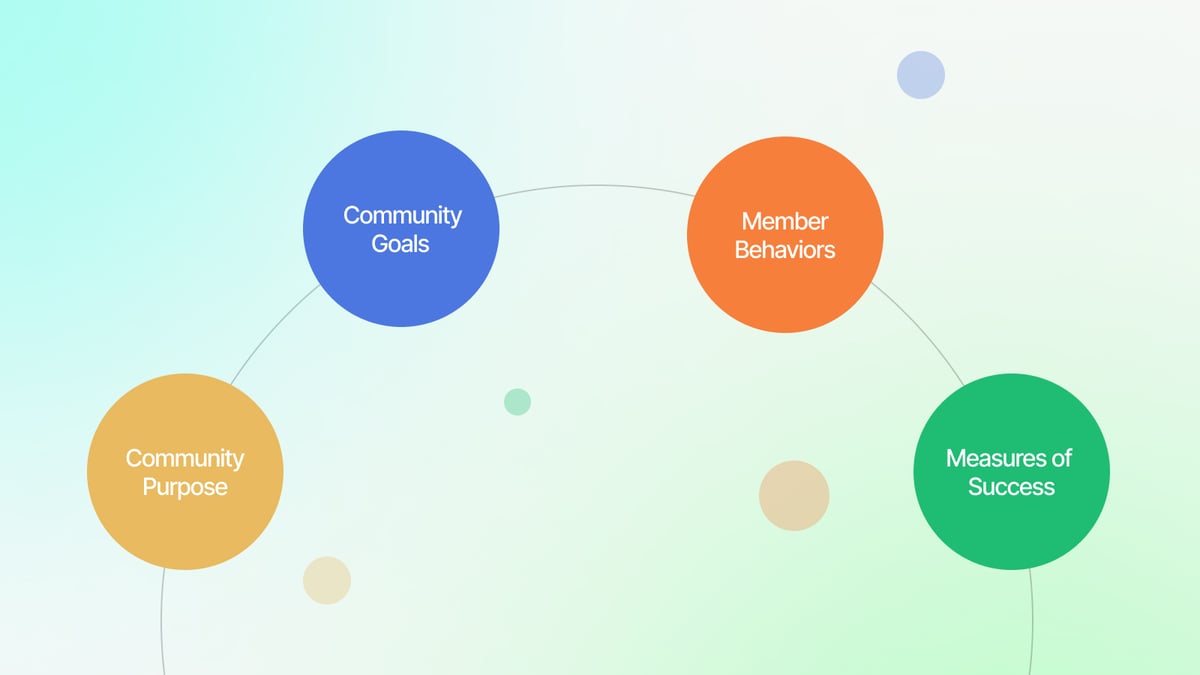
# Community
# Format: Playbooks
Define why your community exists, who it serves, and how to turn that purpose into goals your team can actually use.
July 22, 2026
Joshua Zerkel
At a glance
- Define the community’s purpose from both the company and member perspective.
- Separate business goals from member goals before trying to align them.
- Choose one primary business outcome for the first phase.
- Translate broad goals into observable member behaviors.
- Avoid “engagement” as a goal unless it connects to a more meaningful outcome.
- Set 30, 90, and 180-day milestones so stakeholders know what progress should look like.
Introduction
Most community planning conversations start with a pile of reasonable requests.
Customer Success wants better adoption. Product wants feedback. Marketing wants advocates. Education wants scalable learning. Executives want retention, expansion, or clearer customer signal. None of those are bad goals. The problem is trying to make the first version of the community carry all of them at once.
Members are usually coming from a different place. They want help, context, examples, connection, or confidence. They rarely wake up thinking, “I’d love to participate in a company’s customer engagement strategy today.”
That gap is where many communities get fuzzy.
A clear community purpose helps you connect the dots between what the business needs and what members will actually show up for. It gives you a way to make decisions, say no when needed, and explain why the community deserves investment.
This guide will help you define that purpose, choose the right early goals, and turn them into behaviors and milestones your team can use.
When this matters
Use this guide when you’re launching a new customer community, resetting one that has lost focus, or trying to align stakeholders before investing more time and budget.
It’s also useful during annual planning, executive business reviews, platform migrations, customer education planning, advocacy planning, or any moment when community is being asked to support more of the customer journey.
The truth is, community goals usually get harder as more teams see the value. Early clarity protects the program from becoming a catch-all for every customer-facing initiative.
What matters most
Start with both reasons the community exists
A customer community needs two reasons to exist.
The company needs a business reason to invest. Members need a personal or professional reason to participate. If either side is weak, the community will struggle.
I’ve seen teams get this wrong in both directions. Some communities become too company-centered, full of announcements, campaigns, and requests for feedback. Members quickly learn the space exists to serve the company. Other communities become pleasant but strategically disconnected. Members may enjoy them, but the business eventually questions why it’s funding the work.
The stronger path is to name both sides clearly.
A useful purpose statement might sound like:
Help customers learn from each other so they become more successful with the product, while giving the company better insight into customer needs and patterns.
That sentence does real work. It names the member value, the business value, and the relationship between them.
Separate business goals from member goals
Don’t start by forcing alignment. Start by making the two lists visible.
Business goals might include adoption, retention, education, advocacy, product feedback, support, customer connection, or expansion. Member goals often look more practical: get unstuck, learn from peers, find examples, meet people in similar roles, understand best practices, or feel more confident in their work.
When those lists are mixed together too early, the business goals usually win. That’s understandable. The company is funding the program. But members decide whether the community lives.
The better move is to write both lists separately, then look for overlap.
For example, if the business wants stronger adoption and members want better implementation examples, there’s a natural fit. If the business wants advocacy but members are still trying to understand the basics, advocacy is probably premature.
This is where good community strategy starts to become judgment, not just planning.
Choose the first business outcome carefully
Community can support many parts of the customer journey, but the first phase needs focus.
A community built for education will look different from one built for advocacy. A community built for support will make different tradeoffs than one built for executive connection. The events, discussions, content, moderation, reporting, and staffing all change depending on the primary goal.
The question I’d ask is:
If the community worked well over the next six months, what business outcome would we most want it to support?
Pick one primary outcome. Maybe two if they’re tightly connected, such as education and adoption.
This doesn’t mean other teams get no value. It means the first phase has a center of gravity. Without that, every stakeholder request sounds equally important, and the community team ends up operating with chicken wire and gum.
Translate goals into observable behavior
“Drive engagement” is where community plans go to get vague.
Engagement isn’t meaningless, but it’s incomplete. The real question is what kind of engagement matters and why.
If the goal is adoption, useful behaviors might include asking implementation questions, attending product education sessions, sharing workflows, or helping peers troubleshoot. If the goal is feedback, useful behaviors might include joining research discussions, responding to product prompts, or explaining unmet needs. If the goal is customer connection, useful behaviors might include introductions, peer replies, event attendance, and group participation.
This is the difference between activity and signal.
A goal becomes useful when you can point to a member behavior and say, “That’s what progress looks like.”
Sequence success over time
Communities don’t become valuable all at once.
The first 30 days are usually about alignment, setup, and early participation. The first 90 days are about seeing whether the planned behaviors are starting to appear. The first 180 days are about whether those behaviors are becoming consistent enough to inform future investment.
This matters because stakeholders often expect business outcomes before member habits have had time to form.
A 30-day success measure might be that the launch audience is clear and the first discussions or events are underway. A 90-day measure might be that members are returning and asking better questions. A 180-day measure might be that community participation is becoming part of how customers learn, connect, or share feedback.
That kind of sequencing keeps expectations grounded without lowering ambition.
Putting it into practice
- List the business outcomes the community could support. Gather the realistic possibilities, such as adoption, retention, education, advocacy, feedback, support, or customer connection. Expected output: A complete business goal list.
- Choose the first-phase priority. Select one primary outcome, or two tightly connected outcomes, for the first six months. Expected output: A clear first-phase business priority.
- Define the member need. Write down why customers would participate even if there were no company campaign attached. Expected output: A practical member value statement.
- Write the purpose statement. Combine the business outcome and member value into one clear sentence. Expected output: A one-sentence community purpose.
- Identify the behaviors that would prove progress. Translate the purpose into visible actions members can take. Expected output: A short list of observable member behaviors.
- Set phased success milestones. Define what progress should look like at 30, 90, and 180 days. Expected output: A milestone plan stakeholders can agree to.
Where teams get stuck
The most common sticking point is stakeholder pressure.
Everyone’s request may be reasonable. Product really may need feedback. Customer Success really may need adoption support. Marketing really may need advocates. The issue isn’t whether those goals matter. The issue is whether the community can support all of them well at the same time.
Experienced teams sequence the work. They don’t say, “No, never.” They say, “Not in this phase.”
Another common issue is confusing executive-friendly language with usable goals. “Increase customer engagement” may sound fine in a planning deck, but it won’t help someone decide what event to run next month or what discussion prompt to write tomorrow.
The way forward is to keep bringing the conversation back to member behavior. If you can’t describe what members should do differently, the goal isn’t clear enough yet.
Before you move on
You’re ready for the next phase when:
- The community has a clear purpose statement.
- The business goal and member goal are both visible.
- Stakeholders agree on the first-phase priority.
- You’ve named the member behaviors that matter most.
- “Engagement” has been tied to a specific outcome.
- You’ve defined 30, 90, and 180-day milestones.
- You know which stakeholder requests are out of scope for now.
What good looks like
A strong purpose and goals document should fit on one page.
Planning element | Example output |
Community purpose | Help customers learn from each other so they can adopt the product more successfully. |
Primary business outcome | Product adoption |
Primary member goal | Learn practical ways to use the product from peers and experts |
Observable behaviors | Ask implementation questions, attend workshops, share workflows, answer peer questions |
30-day success | Purpose agreed, audience defined, first programs launched |
90-day success | Members are returning, asking questions, and attending learning experiences |
180-day success | Community is becoming a regular destination for customer learning and peer support |
The point isn’t to make the document impressive. The point is to make it useful when decisions get messy.
How to know it's working
Use a mix of measures. No single metric will tell the whole story.
Activity metrics show whether people are showing up. Track things like registrations, attendance, posts, replies, questions, content views, and contributions.
Engagement indicators show whether participation has quality. Look for return visits, peer replies, members helping each other, repeat event attendance, and participation across more than one format.
Qualitative observations show whether the community is becoming useful. Pay attention to the kinds of questions members ask, the examples they share, and whether internal teams are learning things they wouldn’t have seen elsewhere.
Business-relevant outcomes connect the work back to the original purpose. Depending on the goal, that might include adoption signals, education progress, feedback quality, advocacy participation, or support patterns.
Don’t pretend attribution is clearer than it is. Community often creates context, confidence, and connection before it creates a clean dashboard line. The goal is to learn whether the right behaviors are emerging and whether they’re moving in the right direction.
Key takeaways
- Community purpose has to serve both the company and members.
- Business goals and member goals should be defined separately before they’re aligned.
- The first phase needs one clear center of gravity.
- Useful goals translate into observable member behaviors.
- Success should be phased across 30, 90, and 180 days.
- Engagement only matters when it supports a meaningful outcome.
Common questions
Can a community have more than one goal?
Yes, but don’t make every goal equal at the start. Choose the primary outcome first, then let secondary value emerge as the community matures.
What if stakeholders disagree on the goal?
Treat that as a strategy issue to resolve before launch. If stakeholders can’t agree on the purpose, the community team will inherit that conflict later.
Is engagement a bad goal?
No. It’s just incomplete. Engagement becomes useful when you define the behavior you want and the outcome it supports.
How often should we revisit community goals?
Revisit them during planning cycles, major company strategy changes, or when the community has clearly matured beyond its original phase.
Like
Comments (0)
Popular

Dive in
Related
Resource
Playbook: Define What Community Is Meant to Influence
By Joshua Zerkel • Aug 12th, 2026 • Views 27
Resource
Playbook: Define What Community Is Meant to Influence
By Joshua Zerkel • Aug 12th, 2026 • Views 27