
Gradual Community

Playbook: Measuring GEO and Shared Context Over Time
Playbook: Measuring GEO and Shared Context Over Time
# GTM Strategy
# AI
# Format: Playbooks
# Marketing & Growth
# Product
# Sales & Revenue

How to track generative visibility and internal alignment without reducing either to vanity metrics.

March 17, 2026 · Last updated on March 16, 2026
Anna Yuan
Anna Yuan
Jeremie Gluckman
Jeremie Gluckman
Joshua Zerkel
Joshua Zerkel
Playbook: Measuring GEO and Shared Context Over Time
By the time you’ve built a listening system and established cross-functional interpretation rituals, a new question tends to surface.
Is this working?
That question shows up in two forms.
  • First, are we becoming more visible in AI-generated answers and category discovery?
  • Second, are we actually becoming more aligned internally as a result of this shared signal?
Both matter. Measuring only one creates distortion.
This playbook outlines how to track external GEO performance and internal context alignment in a way that reinforces each other rather than competing for attention.

Separate visibility metrics from meaning metrics

It helps to distinguish between two types of measurement:
  • Visibility metrics tell you how you show up externally.
  • Meaning metrics tell you whether shared context is influencing internal decisions.
Blending the two creates confusion. Keeping them parallel creates clarity.
Start by explicitly naming both categories in your measurement framework so teams understand that success has multiple dimensions.

Build a disciplined GEO tracker

GEO performance can feel abstract unless you define it clearly. Start by identifying 25 to 50 representative prompts that mirror how real buyers phrase questions in your category. These should reflect informational, evaluative, and purchase-oriented intent.
On a consistent cadence, ideally monthly, document:
Are we mentioned?
  • Where are we positioned relative to competitors?
  • What tone is used in the description?
  • Which sources are cited?
Over time, this produces a longitudinal view of:
  • Mention frequency
  • Relative positioning shifts
  • Sentiment movement
  • Citation diversity
The point isn’t to chase fluctuations week to week. It’s to observe trends across quarters.
When citation diversity expands and positioning improves steadily, that often reflects consistent presence across threads, documentation, and ecosystem content.

Connect visibility to participation patterns

Visibility changes rarely happen in isolation. When reviewing GEO trends, ask:
  • Have we increased meaningful participation in high-signal subreddits?
  • Have recurring objections been addressed in help documentation?
  • Have messaging updates reflected public language patterns?
This helps teams see the relationship between structured engagement and external representation.
The conversation shifts from “Why did our ranking drop?” to “What changed in our ecosystem presence?” That shift builds discipline.

Track internal context adoption

External visibility is only half the equation. To understand whether shared reality is forming internally, look for indirect indicators across teams. Some examples include:
  • Are marketing and sales using similar language in materials and conversations?
  • Do product roadmap discussions reference recurring public friction points?
  • Are fewer meetings spent debating what customers “actually want”?
  • Do cross-functional planning sessions reference shared signal summaries?
You may choose to formalize this through periodic surveys or structured retrospectives. Ask teams whether external signal is influencing their work and how often they reference it in decisions.
Alignment tends to show up in tone and decision speed before it appears in a metric dashboard.

Create a quarterly context review

Once per quarter, step back and review both tracks together.
On one side, present GEO trend lines: mentions, positioning, sentiment, citations.
On the other, summarize internal shifts:
  • Language consistency across teams
  • Recurring objections addressed
  • Decision cycles shortened
  • Fewer narrative conflicts in planning
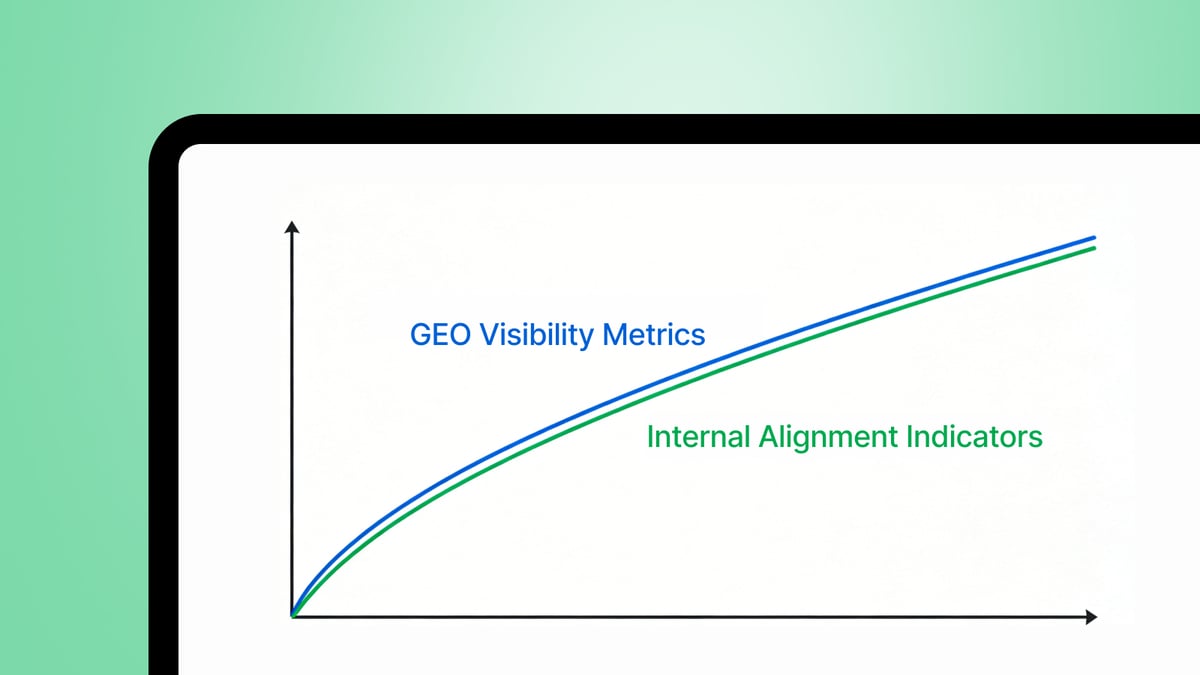
Discuss them side by side; not to prove causation, but to observe correlation. Over time, patterns become visible. As ecosystem presence strengthens, internal language often stabilizes.
This review becomes a shared checkpoint. It reinforces that context is compounding rather than resetting each quarter.

Resist overreacting to short-term fluctuations

Generative visibility can fluctuate due to model updates, seasonal search behavior, or shifts in conversation volume.
Internal alignment can also ebb and flow during high-pressure cycles. Reacting too quickly to short-term changes can create noise.
Instead, anchor evaluation in longer arcs:
  • Quarter-over-quarter movement
  • Consistent shifts in tone
  • Sustained improvements in citation breadth
Context compounds slowly, and measurement should respect that pace.

Use measurement to reinforce discipline, not performance anxiety

Measurement is most useful when it clarifies effort rather than creates pressure.
Share GEO trends transparently. Share internal alignment observations candidly. Frame both as learning systems rather than scorecards.
When teams see steady improvement, confidence grows. When gaps appear, discussion becomes grounded in shared data rather than speculation.
Over time, this rhythm builds trust in the system itself.

Recognize the compounding effect

Shared context rarely produces dramatic spikes. It produces gradual coherence.
As more threads inform documentation, and more documentation reinforces messaging, and more messaging aligns with product direction, the organization’s narrative becomes more stable.
Externally, that stability improves discoverability. Internally, it reduces friction.
Neither effect is instantaneous, and both strengthen with repetition.

Why measuring both dimensions matters

If you measure only visibility, you risk optimizing for surface presence without strengthening shared understanding.
If you measure only internal alignment, you risk operating confidently while remaining underrepresented externally. Tracking both keeps the system balanced.
External GEO performance tells you how the market sees you. Internal alignment indicators tell you how coherently you see the market.
The interaction between those two perspectives is where durable advantage begins to form.

Key takeaways

  • Separate visibility metrics from internal meaning metrics.
  • Track GEO consistently using representative prompts.
  • Review visibility trends alongside participation patterns.
  • Monitor indirect indicators of internal alignment.
  • Conduct quarterly reviews that examine both tracks together.
  • Avoid overreacting to short-term fluctuations.

FAQ

How many prompts should we track for GEO? Between 25 and 50 representative prompts usually provide enough coverage without becoming unmanageable.
How quickly should we expect GEO improvements? Meaningful movement typically appears over multiple quarters, especially as ecosystem presence becomes more consistent.
Can internal alignment really be measured? Direct measurement is difficult, but indirect indicators such as language consistency and decision speed provide useful signals.
What if visibility improves but alignment does not? That may indicate participation is increasing externally but signal is not being routed or synthesized internally. Revisit your shared interpretation rituals.
Comments (0)
Popular
avatar

Table Of Contents
Dive in

Related

Resource
Playbook: Building a Reddit Engagement System That Creates Shared Customer Context
By Jeremie Gluckman • Mar 12th, 2026 Views 12
Resource
Playbook: Measuring and Operationalizing Community Value
By Dani Weinstein • Feb 19th, 2026 Views 24
Video
Event Replay: From Reddit to Results - A Community Engagement Playbook for GEO
By Jeremie Gluckman • Feb 12th, 2026 Views 58
Resource
Playbook: Building a Reddit Engagement System That Creates Shared Customer Context
By Jeremie Gluckman • Mar 12th, 2026 Views 12
Resource
Playbook: Measuring and Operationalizing Community Value
By Dani Weinstein • Feb 19th, 2026 Views 24
Video
Event Replay: From Reddit to Results - A Community Engagement Playbook for GEO
By Jeremie Gluckman • Feb 12th, 2026 Views 58
© 2026 Gradual Community
Privacy Policy