
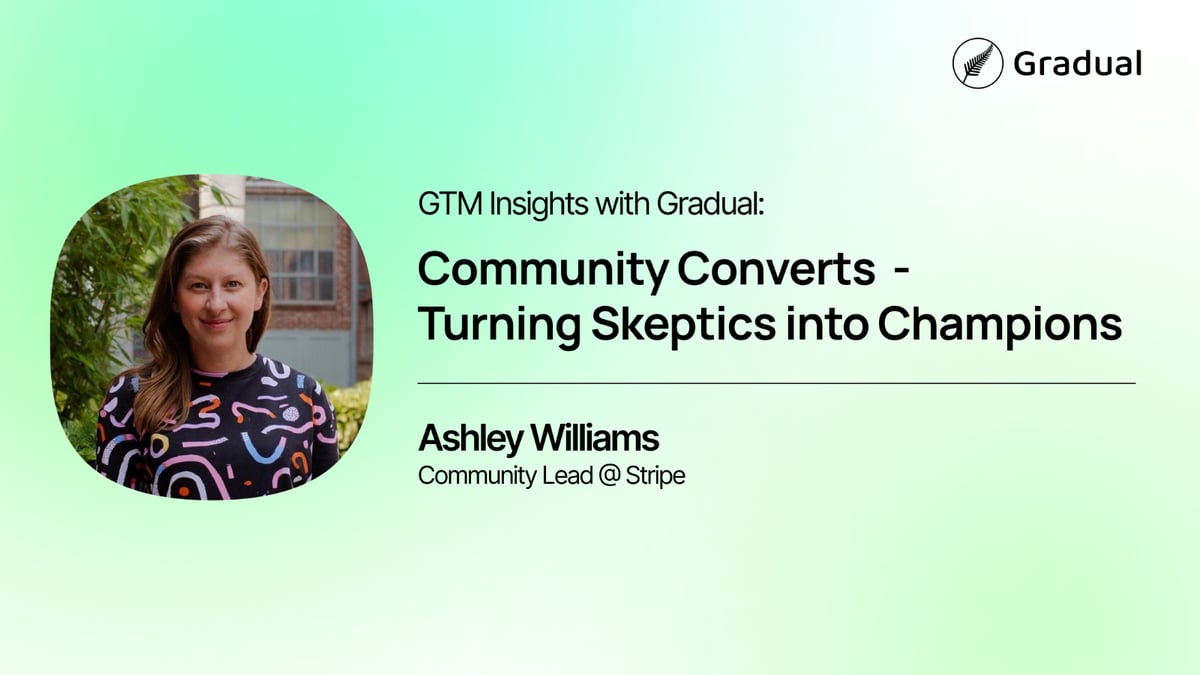
Ashley Williams on Making Community Clearer, Stronger, and More Trusted Internally
# Community
# GTM Strategy
# Format: Event Recaps
# Format: Thought Leadership
How community leaders can earn trust, build alignment, and make community legible across the business.
April 1, 2026
Joshua Zerkel

Ashley Williams
When I talk with community leaders, one challenge comes up again and again. The work itself is often strong. The hard part is helping the rest of the company understand what the work is, why it matters, and how it supports real business goals. That’s why this conversation with Ashley Williams felt so grounded in the reality of the job.
Ashley has spent more than fifteen years building communities across companies like Airbnb, Wix, ClassDojo, and now Stripe. What stood out in our conversation wasn’t just her experience. It was how clearly she named the internal work that community leaders often have to do alongside the external work. There’s the visible work of building programs, creating spaces, listening to members, and driving participation. Then there’s the less visible work of building trust inside the company, helping colleagues understand what community actually is, and earning the right for the function to grow.
Ashley framed the whole conversation around a simple but demanding challenge: turning skeptics into champions. And she was very direct about the fact that this rarely happens by accident. It happens because community leaders stay curious, pay attention to what the business needs, and keep explaining their work in ways that others can actually use.
Start by asking more than you’re told
One of Ashley’s clearest points was that no one is going to hand community leaders a perfect map. No one is going to say, here are the exact KPIs you should use, here is exactly how to explain your value, and here are all the stakeholders you need to win over. That can feel frustrating at first, but she framed it as a kind of freedom.
Her advice was to start by doing your own internal discovery. If you’re new to a company, meet the people you’ve been told to meet, but don’t stop there. Go beyond the list. Find the adjacent teams. Ask people what they hope community can unlock. Ask what they need. Ask what problems they’re trying to solve. Ask who else you should talk to.
That matters for two reasons. First, it gives you a more honest picture of what different teams actually think community is. Second, it helps you see where the support is likely to come from and where confusion is likely to show up. Ashley talked about mapping out likely champions and likely skeptics early, then continuing to update that view as the company evolves.
That part of the conversation stuck with me because it gets at something many community leaders feel but don’t always name. Internal alignment doesn’t begin with presenting a polished strategy. It begins with listening well enough to understand the expectations, assumptions, and misunderstandings already in the room.
Most skepticism is really confusion
One of the most useful parts of the conversation was Ashley’s framing of skepticism. She said that in her experience, it usually doesn’t begin with hostility. More often, it begins with confusion. People don’t understand what community is, so they can’t understand why it matters or how it could help them.
That showed up in a few ways during the discussion. Sometimes people define community based on whatever it meant at their last company. Sometimes they reduce it to a communication channel. Sometimes they use “community” as shorthand for events, email, or a Slack group. None of that comes from bad intent. It comes from incomplete context.
That’s where clarity becomes part of the work. Ashley talked about the importance of having a crisp elevator pitch that explains not just what the community team is doing, but why that strategy exists and how it connects to a specific business need. I added during the conversation that people often don’t need a generic definition of community. They need help understanding what community means in this company, at this moment, in service of these goals.
That’s a subtle distinction, but it matters. When people only hear the “what,” they tend to compare it to something they’ve seen before. When they understand the “why,” they can start to see why the shape of the strategy makes sense here.
Community has to evolve with the company
Ashley gave one of the strongest examples of this from her time at Wix. Early on, when the company was smaller, community played a meaningful role in grassroots word-of-mouth marketing. Later, as the company grew and the business context changed, that same framing no longer made as much sense. So the team shifted. Community became a way to gather user feedback and eventually support product adoption and movement through the product funnel.
I appreciated this part of the conversation because it pushed against the idea that community teams should defend one static model forever. Ashley’s point was that the value of community is real, but the way it creates value will change as the company changes. The business priorities evolve. The surrounding functions mature. The problems worth solving move.
That means community leaders have to stay close to the company’s broader strategy, not just their own roadmap. They need to understand the macro direction, watch for new pain points, and be ready to propose a shift before someone else tells them to make one. Ashley even suggested starting with pilots when a larger change feels hard to sell. That way, you’re not asking people to buy into an abstract idea. You’re giving them something concrete to react to.
Community works best as a platform, not a narrow program
Another idea that resonated throughout the conversation was Ashley’s view of community as a platform. She described community as foundational infrastructure that can support multiple business goals over time, rather than as a narrowly engineered program built for one team’s immediate need.
That framing helps with more than strategy. It also helps with internal trust. If community is treated as a single-purpose initiative, it becomes fragile. The moment leadership priorities shift, the function has to justify itself all over again. But if community is designed as a flexible system for connecting people, surfacing signal, and supporting different parts of the business, it becomes much more durable.
We also spent some time on the difference between audience and community, which felt important here. Ashley put it simply: you talk to an audience, but you talk with a community. An audience is mostly one-way. A community creates the conditions for people to engage with one another, not just with the brand. That distinction matters because it shapes how you build. If you start with the channel instead of the strategy, you end up reverse engineering the work around the tool. If you start with the community strategy, the platform choices become much easier to make.
The internal job is part of the real job
Ashley’s third principle was the one she called a little spicy: self-righteousness isn’t serving you. What she meant was that community leaders are questioned often, and the natural response can be frustration or defensiveness. But that reaction usually gets in the way of the real opportunity.
Her advice was to take an educator mindset instead. Be patient. Overcommunicate. Turn ambiguous Slack tension into a live conversation. Share regular updates. Present internally whenever there’s an opening. Treat explanation as part of the work, not as a distraction from it.
That landed especially well because it was so practical. Ashley talked about biweekly updates at Stripe, the value of templates, the importance of making time for internal communication rituals, and the power of having a clear one-pager, deck, and elevator pitch ready to go. She also made the point that the hardest skeptics often remain hardest because they’re being avoided. The moment you lean into the conversation, things start moving.
That’s probably the idea I kept coming back to after we wrapped. So much of this work comes down to whether we’re willing to keep entering the conversation with patience, specificity, and enough confidence to keep teaching.
Key takeaways
- Community skepticism often starts as confusion, not opposition.
- Internal discovery is part of the strategy. Community leaders need to ask more questions than they’re given answers.
- Community value is real, but the expression of that value should change as company priorities change.
- A durable community function behaves more like cross-functional infrastructure than a narrow program.
- Internal communication is not extra work. It’s part of how trust gets built.
FAQ
Why do internal stakeholders struggle to understand community?
Because many people only know community through prior experience, a channel they’ve used, or a partial definition. Without context, they can’t see the business value clearly.
How can a community leader earn trust internally?
Start by understanding stakeholder needs, communicate the “why” behind the strategy, share regular updates, and keep showing how community supports real business goals.
What does it mean to treat community as a platform?
It means building community as flexible infrastructure that can support multiple goals over time, rather than designing it too narrowly around one immediate use case.
What should a community leader do when facing skepticism?
Lean into the conversation. Ask questions, clarify the strategy, connect the work to that stakeholder’s goals, and stay patient long enough for understanding to catch up.
Like
Comments (0)
Popular

Dive in
Related
30:13
Video
Event Replay: Executive Insights with Gradual: Making Community Matter Internally
By Holly Firestone • Feb 5th, 2026 • Views 35
Blog
Event Recap: Community Measurement Your CFO Will Trust: Mark Birch On Making Impact Defensible with Mark Birch
By Joshua Zerkel • Jun 25th, 2026 • Views 29
30:13
Video
Event Replay: Executive Insights with Gradual: Making Community Matter Internally
By Holly Firestone • Feb 5th, 2026 • Views 35
Blog
Event Recap: Community Measurement Your CFO Will Trust: Mark Birch On Making Impact Defensible with Mark Birch
By Joshua Zerkel • Jun 25th, 2026 • Views 29