
Gradual Community
Ask

Making Community Impossible to Ignore With Michelle Baltrusitis from Fiverr
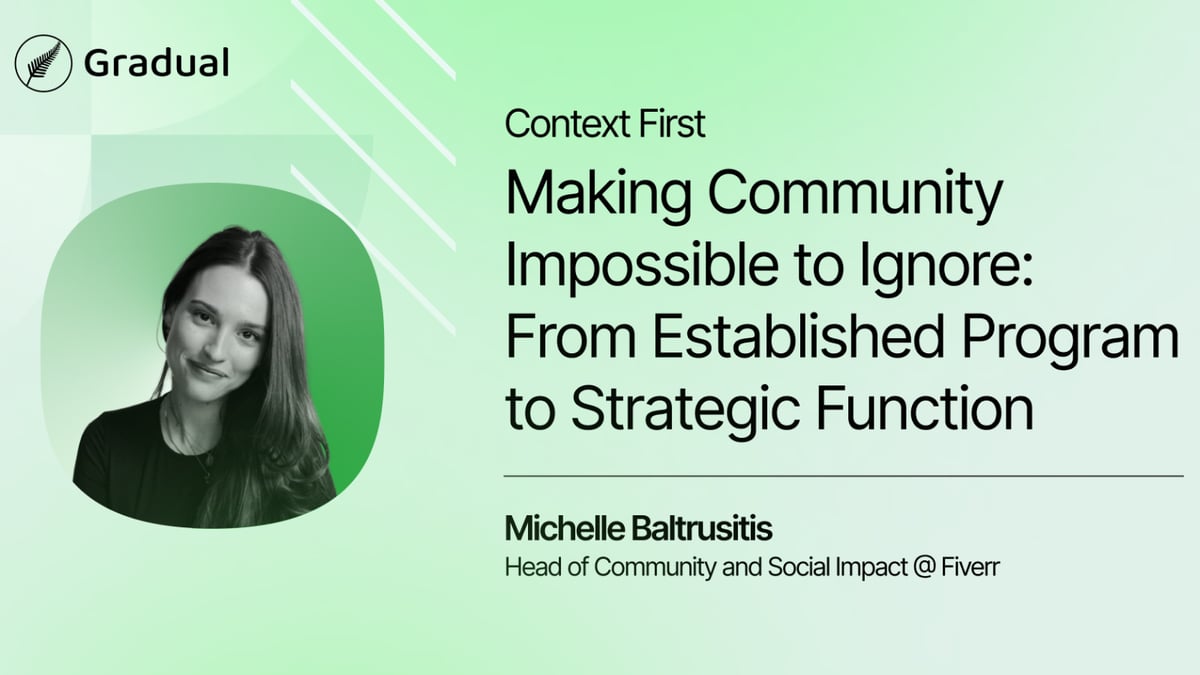
Making Community Impossible to Ignore With Michelle Baltrusitis from Fiverr
# Format: Event Recaps
# GTM Strategy
# Community

Michelle Baltrusitis shares how Fiverr rebuilt community around business goals, cross-functional partnerships, and shared outcomes.

May 13, 2026
Joshua Zerkel
Joshua Zerkel
Michelle Baltrusitis
Making Community Impossible to Ignore With Michelle Baltrusitis from Fiverr
A lot of community leaders don’t get to start with a blank page.
They inherit a forum, an event calendar, a group of active members, and a few internal assumptions about what community is supposed to do. There may be real energy there, but the strategy isn’t always clear.
That’s what made my conversation with Michelle Baltrusitis so useful. Michelle is the Head of Community and Social Impact at Fiverr, where she leads community strategy for freelancers. She stepped into a community structure that already had momentum, then worked to make the function more connected to the business.
Her background in management consulting showed up throughout the conversation, especially in how she listens before making recommendations. She described consulting as learning to walk into a room with questions instead of answers, which feels like a helpful posture for community work too. Community leaders are often close to members, close to friction, and close to the words customers actually use. The challenge is helping the rest of the company understand why that context matters.

Start with what the business already cares about

When Michelle began moving more fully into community leadership, she didn’t start by rebuilding everything around tactics. She paid attention to where Fiverr was headed and where community could create real value.
Fiverr is a two-sided marketplace, with buyers on one side and freelancers on the other. The community team focuses on freelancers, which means the work has to connect freelancer experience back to marketplace health. One major business priority at the time was trust: trust between Fiverr and freelancers, trust between freelancers and buyers, and trust that the company was listening to the people building businesses on the platform.
That priority gave the community team a useful lens. Externally, it led to community-centered brand work, including campaigns that highlighted top talent and put freelancers on a Times Square billboard. Internally, it shaped how Michelle’s team brought forum conversations, advisory board feedback, and freelancer insights back into the business.
A focused community strategy connects what members need, what the business needs, and where community can credibly help both.
That distinction matters. Community teams can get pulled into proving value everywhere. Michelle’s approach was more grounded: understand where community can be genuinely useful, then build from there.

Roadshows work best when they’re conversations

Michelle also talked about going on an internal roadshow to help other teams understand Fiverr’s community strategy. The practical part was important: she wasn’t simply presenting a deck and asking for support. She was listening for what each team cared about, what questions kept coming up, and what context they needed.
Before getting into specific programs, she oriented teams around how community could create value for Fiverr. She described three broad types of community value: cost savings, future-proofing, and growth. For Fiverr, community most clearly sat in the growth realm. From there, she could show how the team’s work connected to the direction of the business.
A good roadshow is part presentation and part discovery. When someone asks a question about community, it’s not always resistance. Sometimes it’s a clue. They’re showing what they care about, what they don’t yet understand, or where they might see themselves in the work.
That kind of translation is a big part of community leadership. You’re translating member needs into business language, business priorities into community programs, and community signals into something other teams can act on.

Build programs with other teams from the start

One of the ideas I kept coming back to was Michelle’s goal of not piloting new initiatives without a partner team. She was careful to say Fiverr isn’t fully there yet, which made the point feel more real. The goal is shared ownership wherever possible.
Community work built in isolation is easier for the business to dismiss. A team can run a strong program and still have it treated as nice-to-have if no one else has a stake in the outcome. When another team helps shape the work early, the program becomes easier to understand and harder to ignore.
Michelle shared Fiverr’s Shift Happens series as an example. The series helped freelancers understand AI and changing market needs, but it wasn’t built only by the community team. Fiverr’s verticals team helped shape topics based on business priorities and talent needs. The first episode focused on vibe coding because Fiverr was exploring potential partnerships in that space and wanted freelancers to be ready.
After the session, the team asked attendees whether they’d consider changing or opening a new service based on what they learned. Eighty-two percent said yes.
That’s a useful signal because it connects community education to marketplace behavior.
The work also continued after the live sessions. Fiverr’s SEO team used insights from the series to help create an AI hub for freelancers, turning a community moment into something that could keep supporting freelancers over time.

Create champions who can speak for the community

Michelle shared a definition of an internal champion that I really liked: someone who will speak up for the community you’re building for in rooms you’re not in.
That feels like the right bar.
Community teams can’t be in every conversation where member context would help. So part of the work is helping other people understand the community well enough to represent it responsibly.
At Fiverr, one way Michelle’s team supports that is through Community Pulse, a monthly report summarizing forum activity and the topics freelancers are discussing. Before sharing it broadly, the team checks those insights with customer-facing teams to see whether the same themes are showing up elsewhere.
That small step makes the insight stronger. Instead of saying, “The forum is talking about this,” the team can say, “We’re seeing this in the forum, and customer-facing teams are hearing similar things.”
It’s a simple way to make community insight more credible and more useful.

Bring the business closer to the community

One of my favorite examples was Freelancer Tuesdays.
Once a month, Fiverr opens its New York office to local freelancers so they can cowork, meet team members, and get perspective on their profiles or services. Sometimes those days become optional focus groups. Even when they’re less structured, Michelle’s team captures what they hear in a shared document so those insights can be referenced later.
Over time, leaders from Fiverr’s HQ office started asking when the next Freelancer Tuesday was happening because they wanted to plan visits around it.
That’s a meaningful shift. When leaders want to be in the room with the community, the community starts to occupy a different place inside the business.
Reports and dashboards matter, but sometimes the clearest signal comes from sitting with people and listening to how they describe their own experience.

The foundation still matters

Near the end, Michelle talked about the balance community leaders have to hold.
There’s the visible work: campaigns, events, recognition programs, webinars, and in-person moments. Then there’s the foundation underneath it: the forum, content infrastructure, member health, community operations, and the systems that make those visible moments possible.
Leadership may not always ask about the foundation, but community leaders know it shapes what’s possible later.
Michelle described the work as building a strong community foundation in the background while staying agile enough to respond to shifting business priorities. Priorities change. What mattered six months ago may not be what leadership is focused on now.
That balance is real. Community can’t only chase visible moments, and it can’t stay so focused on the foundation that the business never sees how the work connects to larger goals. The craft is in knowing how to hold both.

Making the case is part of the work

Toward the end, Michelle said something many community leaders will recognize. Some teams don’t have to keep explaining why their work matters. Community often does.
It can be frustrating, but Michelle has come to see it differently. She sees those moments as chances to bring people along and turn them into champions.
That felt like a grounded place to end. Community still needs explanation. It needs context. It needs someone to connect the dots between what members are saying, what the business cares about, and what the company can do next.
The work of making community impossible to ignore usually doesn’t happen through one program or one metric. It happens through the roadshow, the partner team, the forum report, the advisory board, the office day, the follow-up conversation, and the person who brings up the community point of view when you’re not in the room.
Over time, those moments compound. Community becomes easier to understand, easier to trust, and much harder to ignore.

Key takeaways

  • Start with the business context before rebuilding community programs.
  • Use internal roadshows to listen, translate, and build trust across teams.
  • Build new initiatives with partner teams whenever possible.
  • Turn community insights into signals other teams can understand and use.
  • Create internal champions who can represent the community perspective in rooms you’re not in.
  • Keep investing in the community foundation, even when the most visible work gets more attention.

FAQ

What does it mean to make community impossible to ignore?

It means connecting community work to business priorities, member needs, and internal decision-making so the organization can clearly see why the community matters.

How can community leaders build stronger internal alignment?

Start by understanding what each team cares about, then show how community can support those goals through member insight, trust, education, advocacy, or growth.

Why are cross-functional partnerships important for community programs?

Cross-functional partnerships create shared ownership. When another team helps shape the work, the results are easier for the business to understand and support.

What should community leaders do first when inheriting an established program?

Talk to people. Speak with internal stakeholders and community members to understand what’s working, what’s unclear, and where the strongest opportunities are.
Comments (0)
Popular
avatar

Dive in

Related

Video
Event Replay: Context First: Making Community Impossible to Ignore: From Established Program to Strategic Function with Michelle Baltrusitis
By Michelle Baltrusitis • May 13th, 2026 Views 7
Video
Event Replay: Executive Insights with Gradual: Making Community Matter Internally
By Holly Firestone • Feb 5th, 2026 Views 30
© 2026 Gradual Community
Privacy Policy
Your Privacy Choices