
Context First: Helping Members Build New Habits During a Migration
# Community
# Format: Event Recaps
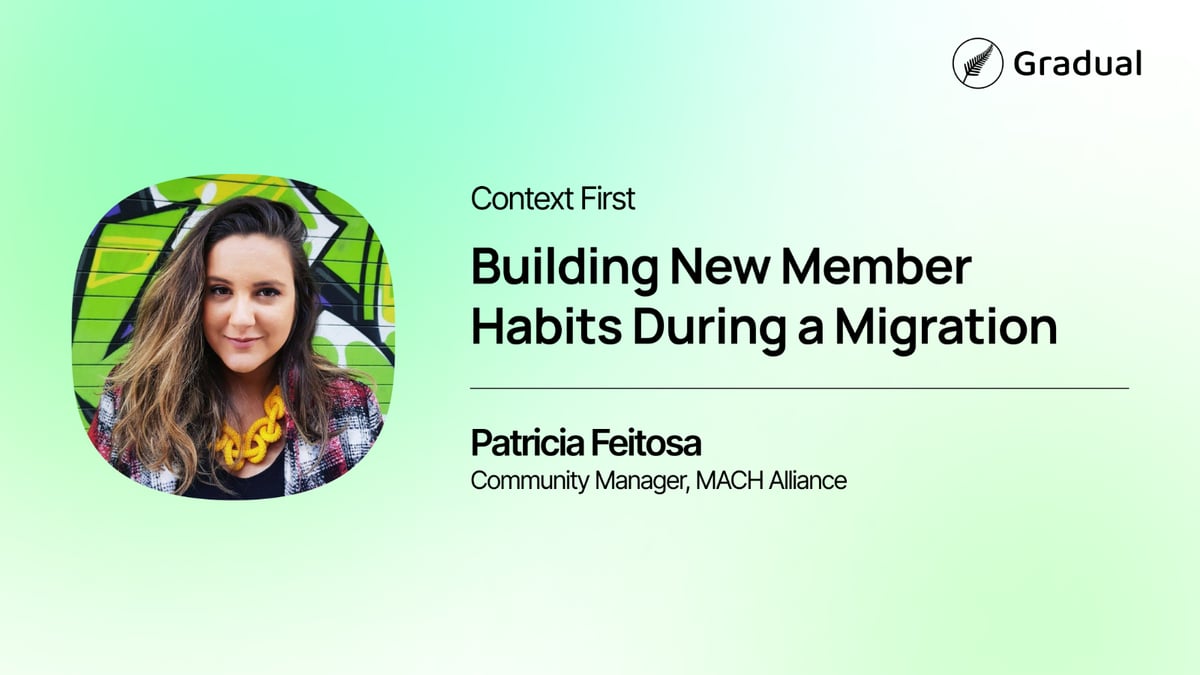
Patricia Feitosa shared a practical, grounded look at what it takes to guide members through change with more clarity, continuity, and trust.
April 10, 2026
Patricia Feitosa

Joshua Zerkel
If you’ve ever led a community migration, you know how quickly the conversation can get pulled toward tools. Which platform are you moving to? What needs to be rebuilt? What will members need to learn? Those questions matter, but they don’t quite get at what members actually experience.
That’s what made this conversation with Patricia Feitosa so useful. Patricia leads the Power of MACH Community at the MACH Alliance, and what she shared came from the real work of guiding a senior, global, time-constrained membership through change. Her focus stayed on the part of migration that community leaders actually have to manage day to day: helping people understand where to show up, how to participate, and why it’s worth building new habits in the first place.
Why migration gets hard long before launch
One of the most helpful parts of Patricia’s framing was how clearly she described the problem they were solving. The issue wasn’t that the community lacked places to gather. It was that value had been spread across too many places at once.
Before the move, members were navigating Slack, Hivebrite, Zoom, Google Meet, email, LinkedIn, the website, and other touchpoints. There were users across all of those surfaces, but activity had thinned out and the experience had become fragmented. Slack was serving more as a place for direct messages and team announcements than for meaningful peer interaction. Content lived in one place, events in another, and community value started to feel harder to locate.
That distinction matters. Fragmentation doesn’t always look broken from the outside. There may be active channels, a healthy member count, regular events, and a steady stream of content. But from the member’s point of view, every additional surface creates another decision. Where should this go? Where do I find that? Where are other people actually showing up?
For a senior audience, that friction adds up quickly. Patricia described a membership made up largely of director-level leaders and above, along with technical and cross-functional practitioners. These are people with crowded schedules and limited attention. If the path to value feels scattered, community gets deprioritized.
Starting with behavior instead of the platform
Patricia didn’t start by asking what the new platform should do. She started by trying to understand what members were already doing.
Before the migration, she interviewed colleagues on the central team, met with stakeholders, and mapped which channels members used most, which features mattered to them, what felt confusing, and what they most wanted to preserve. That work led to a member value document and an action plan, but more importantly, it gave the team a grounded understanding of what members actually needed.
That part of the conversation landed for me because it reflects a principle that’s easy to say and harder to practice: don’t lead with the platform. Lead with value.
A member-centered migration starts with behavior. It looks at the routines people already have, the jobs they’re trying to do, the friction they’ve learned to work around, and the value they’d immediately recognize if it became easier to access. In this case, one of the clearest needs was around networking and partnership discovery. Members wanted to find the right peers more easily and understand who they were talking to across the ecosystem.
So the team didn’t frame the move around feature adoption alone. They framed it around what would become easier. A searchable directory with filters for role, location, seniority, and market created a much stronger story than simply saying the community was moving to a new platform. It connected the change to something members were already trying to do.
Preserving continuity while introducing change
Another thing Patricia handled thoughtfully was continuity. She didn’t talk about migration as a clean break where one system turned off and another turned on. She described it as a phased process that respected what each channel already meant to members.
That shaped how the transition was communicated. In Slack, the team focused on what Slack behaviors would map to in the new space. In other channels, they emphasized where content would live next or how familiar actions would translate. The goal wasn’t to erase the old experience. It was to help members carry their understanding forward into a clearer one.
That’s a subtle but important difference. When people feel like they’re being forced to start from scratch, resistance tends to rise. When they can see continuity between what they already know and what comes next, the change feels more manageable.
Patricia also spoke about rolling the transition out in phases rather than treating it like a hard cutover. That gave the team room to onboard different groups in waves, communicate with more precision, and avoid overwhelming members with too much change at once. Slack, for example, wasn’t sunset immediately. It remained part of the transition for months, giving members time to adjust and helping the team guide them through a more gradual shift.
Designing around existing habits
One of the strongest tactical points Patricia made had to do with timing. Rather than introducing the new community in isolation, the team tied the launch to the MACH Alliance’s flagship conference.
That choice worked because it aligned with behavior the audience already had. These members were used to attending conferences, downloading event apps, and learning new tools in that setting. So instead of asking them to adopt a new platform out of nowhere, the team introduced the new experience in a moment when members were already primed for it.
Conference attendees became an early onboarding wave. They got access to the community around an event they were already planning to engage with, and the value was immediately visible through things like matchmaking, networking, and access to pre- and post-event content. Patricia described that first group as trailblazers and testers, which also gave the launch a sense of participation rather than passive adoption.
That stood out because it’s such a useful reminder that behavior change is shaped by context. People are more likely to form a new habit when it fits naturally into something they already expect to do.
Why senior audiences need more guidance, not less
One of the most memorable moments in the conversation came when Patricia said she was surprised by how much hand-holding a senior audience needed. Not because they weren’t capable, but because they didn’t have the time.
That distinction is easy to miss. It’s common to assume that highly experienced members, especially those in technical or executive roles, will naturally figure things out on their own. Patricia’s experience suggested otherwise. When people are busy, even small decisions can become barriers. If the community isn’t clearly in front of them, it drops down the priority list very quickly.
That meant simplification became a core part of the work. Patricia talked through several examples that made this concrete. The team focused on clear entry points so members could immediately understand where to go and why. They reduced the number of decisions members had to make on their own. When they saw that members didn’t connect with the label “forums,” they renamed that section “discussions.” During events, they made audience fit, frequency, and access points explicit so people didn’t have to interpret the experience for themselves.
She also called out the importance of repeated reminders. The team ran a steady cadence of updates, including recurring “what’s happening” communications that later moved into the newsletter. That kind of repetition can feel excessive from the inside, especially when the community team is living and breathing the transition every day. But from the member side, it often feels necessary. Reminders are part of what makes the experience usable.
Making the new space feel alive
Patricia also spent time on something that often gets overlooked in migration conversations: visible activity.
People are much more likely to engage when a space already feels active and useful. If a member lands in a new community and sees an empty or unclear environment, it’s hard to believe it’s worth returning to. So the team worked to make the space feel lived in. They kept content moving, elevated discussions on the homepage, and did direct outreach to remind members that something interesting was happening.
She also emphasized internal cheerleading, which felt especially important. Community teams aren’t the only people shaping member perception. Colleagues in adjacent departments often reinforce, clarify, or unintentionally muddy the message. Patricia made sure internal teams had manuals and short pitches they could use consistently when speaking with members. That kind of alignment helps reduce confusion and gives the migration more staying power.
Rethinking what engagement looks like
Toward the end of the conversation, Patricia shared something I thought was particularly useful for B2B community leaders: not all meaningful engagement is visible.
In many communities, success gets reduced to public signals like comments, likes, and posts. Those still matter, but they don’t always capture what’s actually happening, especially with a senior audience. Patricia described members who were logging in regularly, researching peers, sending direct messages, attending events, and even starting deals, without necessarily posting publicly in discussion spaces.
That’s an important reminder that engagement should be interpreted in context. In a business community built around networking, partnerships, and high-trust exchange, silent engagement can still reflect real value. Members may be using the space exactly as intended, even if the activity doesn’t always show up in the most visible metrics.
She also noted that the audience became more diverse over time, with stronger buyer participation than they’d seen in the legacy spaces. That shift created better conditions for problem-solving, product showcases, and business conversations that could lead to partnerships. The engagement may not have looked identical to the old model, but the quality had clearly improved.
What I’m taking away from Patricia’s approach
What stayed with me most after this session was how patient Patricia’s approach felt. She wasn’t trying to engineer a dramatic launch moment. She was creating the conditions for a new set of habits to take hold over time.
That meant listening before acting, connecting change to value members already cared about, preserving continuity where it mattered, and reinforcing the new experience often enough that it became easier to return than to ignore. It also meant staying open to what members were actually doing once the migration was underway, then adjusting the experience accordingly.
That’s the part of migration work that deserves more attention. A community move doesn’t succeed just because the technology is live. It succeeds when members begin to trust the new shape of the experience enough to make it part of their routine.
If you’re thinking about a migration, in the middle of one, or still trying to make sense of what members need after the move, Patricia offered a strong place to start: study behavior first. The platform matters, but only in the context of the habits it helps people build. That’s where the real work is, and that’s where lasting value starts to show up.
Key takeaways
- A community migration is a behavior change process as much as a platform change.
- Fragmentation creates friction, especially for busy, senior audiences.
- Member value should shape migration strategy before platform decisions do.
- Continuity, simplification, and repeated reminders help new habits take hold.
- Meaningful engagement may include quiet behaviors like research, direct messages, and repeat visits, not just visible posting.
FAQ
What is a community migration?
A community migration is the process of moving members, content, and participation patterns from one setup to another. In practice, it also involves communication, trust-building, and helping members form new habits.
Why do community migrations create resistance?
Most resistance comes from habit inertia and time constraints. Members may understand the reason for the change, but still need clear guidance and repeated reminders before a new routine starts to feel natural.
How do you help members adopt a new community platform?
Start by understanding what members already value and where they experience friction. Then make the new experience easier to understand through clear entry points, familiar language, useful guides, and steady reinforcement.
What counts as engagement during a migration?
Public activity matters, but it’s only part of the picture. Depending on the audience, engagement can also include peer research, direct messages, repeat visits, and event participation.
1
Comments (2)
Popular

Dive in
Related
33:07
Video
Event Replay: Context First: Helping Members Build New Habits During a Migration
By Patricia Feitosa • Apr 10th, 2026 • Views 28
Resource
Playbook: How to Prepare Members for a Community Migration
By Patricia Feitosa • May 26th, 2026 • Views 92
Resource
Playbook: How to Build New Participation Habits After a Community Migration
By Patricia Feitosa • May 28th, 2026 • Views 25
Resource
Playbook: Supporting Members After A Community Migration
By Ryan Paredez • Feb 27th, 2026 • Views 34
33:07
Video
Event Replay: Context First: Helping Members Build New Habits During a Migration
By Patricia Feitosa • Apr 10th, 2026 • Views 28
Resource
Playbook: How to Build New Participation Habits After a Community Migration
By Patricia Feitosa • May 28th, 2026 • Views 25
Resource
Playbook: Supporting Members After A Community Migration
By Ryan Paredez • Feb 27th, 2026 • Views 34
Resource
Playbook: How to Prepare Members for a Community Migration
By Patricia Feitosa • May 26th, 2026 • Views 92