
Gradual Community
+00:00 GMT

Webinar Recap: From Activity to Impact: Executive Insights with Bill Johnston
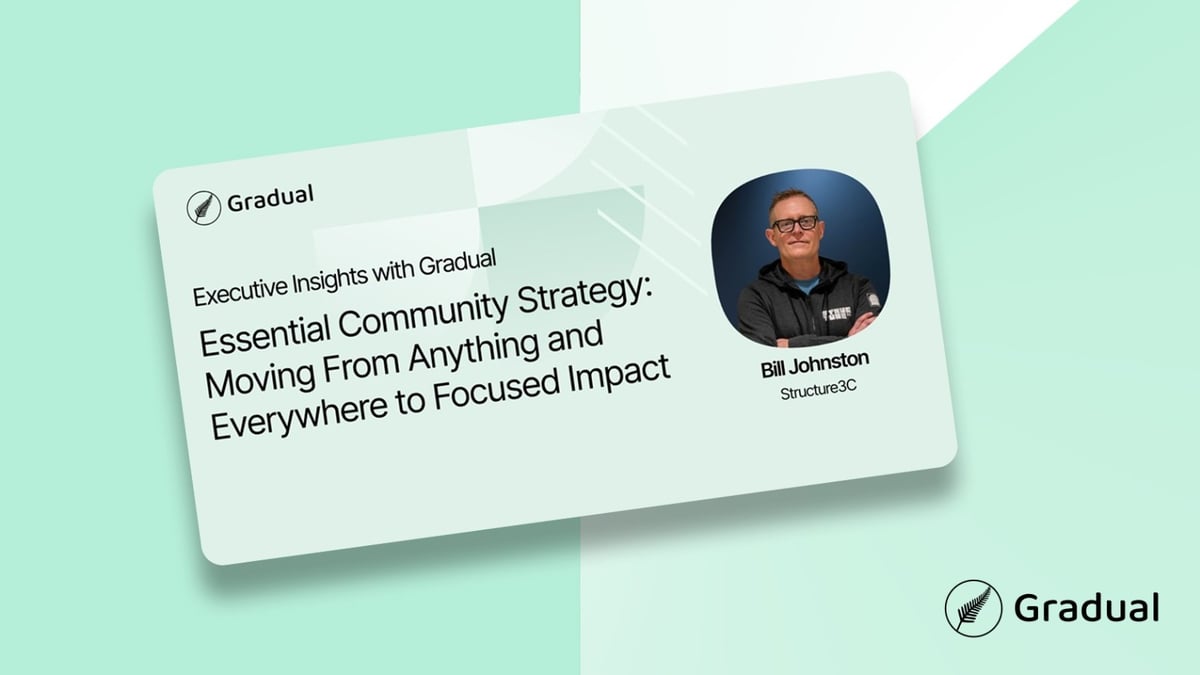
Webinar Recap: From Activity to Impact: Executive Insights with Bill Johnston
# Theme: Community Building & DevRel
# Theme: Leadership & Executive Perspectives
# Theme: GTM Strategy & Trends
# Format: Event Recaps
# Challenge: Cross-Functional Alignment

How community leaders can shift from scattered tactics to focused strategies that create lasting business value.

November 13, 2025
Bill Johnston
Bill Johnston
Joshua Zerkel
Joshua Zerkel
Webinar Recap: From Activity to Impact: Executive Insights with Bill Johnston
Community work often pulls us in many directions. There are always more places to engage, more programs to try, and more expectations to meet. That’s why this Executive Insights session with community strategist Bill Johnston resonated so strongly. It offered a grounded, approachable way to create a focused community strategy that aligns with business goals, honors customer needs, and produces real long-term value.
This article explains the key ideas from the session. It outlines why community is a strategic business asset, how to take an essentialist approach to planning, and what it looks like to move beyond support into more impactful use cases like innovation and advocacy. The goal is to help community and GTM leaders design programs that stay focused, meaningful, and sustainable.

Community as a strategic asset

Bill began with a simple but important shift in perspective. Community is not a channel or a collection of tactics. It is a network of relationships that already exists across customers, partners, employees, and advocates. The strategic opportunity lies in how intentionally a business chooses to activate and support those relationships.
He noted that many companies undervalue what they already have. This tendency—what he calls “contempt for existing relationships”—keeps organizations from seeing the long-term value communities create. Relationships built through community connect customers to each other and the company in ways that drive loyalty, learning, and shared progress over time.
Community also offers insight that product data or marketing analytics alone cannot. “The most central and valuable part of what we do is the network of relationships and the value of those relationships over time,” Bill said. When leaders treat community as a strategic asset, they open the door to deeper customer understanding and more aligned decision-making across the business.

The essentialist approach: focus on what matters most

To build a focused strategy, Bill encouraged leaders to take an essentialist approach. Start with a simple vision—a hypothesis, not a fixed plan—and understand that it will change as you gather insight. Pair that early vision with clarity about business goals and a real understanding of what customers need.
Rather than launching broad initiatives or copying competitors, strong community strategy grows from research and intentional listening. Where do customers gather today? What challenges are they trying to solve? What support or connection would meaningfully improve their experience?
From this alignment between business priorities and customer opportunity, a clear direction emerges. Bill recommends turning that direction into a set of small, testable investments. These bets can be measured, adjusted, and expanded over time. This keeps programs focused and prevents teams from spreading themselves too thin.
He also cautioned against starting with technology decisions. Buying a platform before defining goals, purpose, or resourcing needs is a common mistake. Effective tools follow strategy, not the other way around.

Adopting an ecosystem mindset

Bill also emphasized the importance of thinking beyond a single community destination. Early in his work at Autodesk, he focused on bringing all engagement on-domain. Over time he realized that customers often participate across a wider network of spaces. These can include user groups, partner communities, creator channels, and external forums.
An ecosystem mindset helps leaders understand where members already find value and where the company can add meaningful support. Some spaces may be worth hosting. Others may be better to recognize, resource, or simply connect to. The goal is not to be everywhere but to invest where the company and customers benefit most.
This approach helps teams expand their perspective beyond narrow use cases and consider the full landscape of engagement surrounding their product and industry.

Expanding the definition of value

Support and troubleshooting are still critical use cases, especially for technical products. But Bill encouraged leaders to look at the broader opportunities community creates for innovation, co-creation, and advocacy.
He shared examples of companies gathering lead users to provide feedback, test new ideas, and explore the future of their industry together. He also described how advanced advocacy programs can evolve into peer-driven communities where members build relationships, grow in their careers, and contribute more deeply to the brand.
Platforms that integrate content, connection, and shared experiences can help bring these possibilities to life. Events, peer groups, and structured discussions create space for deeper conversations that don’t fit into traditional forum structures.

Why community strategy is hard to sustain

Toward the end of the session, Bill spoke candidly about why community strategy is difficult to maintain. Community work is long-term, cross-functional, and dependent on leadership support. It requires collaboration across marketing, product, customer success, operations, and executive teams. It also requires patience, since value often compounds over time rather than quarter to quarter.
Organizational turnover can add friction, especially when new leaders are unfamiliar with the history or impact of community programs. But the companies that stay committed—those that focus on the essential, invest consistently, and build genuine relationships—create value their competitors cannot easily match.
As Bill noted, “You create enduring value if you attend to it.”

Key takeaways

  • Community is a strategic asset built on long-term relationships, not short-term transactions.
  • A focused strategy starts with a simple vision aligned to business goals and customer needs.
  • Research, iteration, and small bets help teams test ideas and scale what works.
  • Community extends across an ecosystem; companies should host, support, or connect intentionally.
  • Value expands when programs move beyond support into innovation and advocacy.
  • Sustaining strategy requires cross-functional alignment and consistent leadership support.

Frequently asked questions

What is an essentialist approach to community strategy? It’s a focused planning method that concentrates resources on a small number of initiatives that align directly with customer needs and business goals.
Why is community considered a strategic asset? It strengthens the network of relationships that drive long-term customer loyalty, insight, and value across many parts of the business.
How can leaders keep community strategy sustainable? By aligning cross-functional teams, securing executive sponsorship, and investing in programs that grow steadily over time.

Continuing the conversation

Bill Johnston’s essentialist approach offers a clear path forward for community and GTM leaders seeking focus, alignment, and meaningful impact. The ideas he shared show how organizations can use community to deepen relationships, learn from their customers, and build value that grows over time.
Comments (0)
Popular
avatar

Dive in

Related

Blog
Webinar Recap: From Connection to Impact: Executive Insights with Brian Oblinger
By Brian Oblinger • Oct 31st, 2025 Views 59
© 2025 Gradual Community
Privacy Policy