
Gradual Community

From Clarity to Confidence: Executive Insights with Brittney Aston
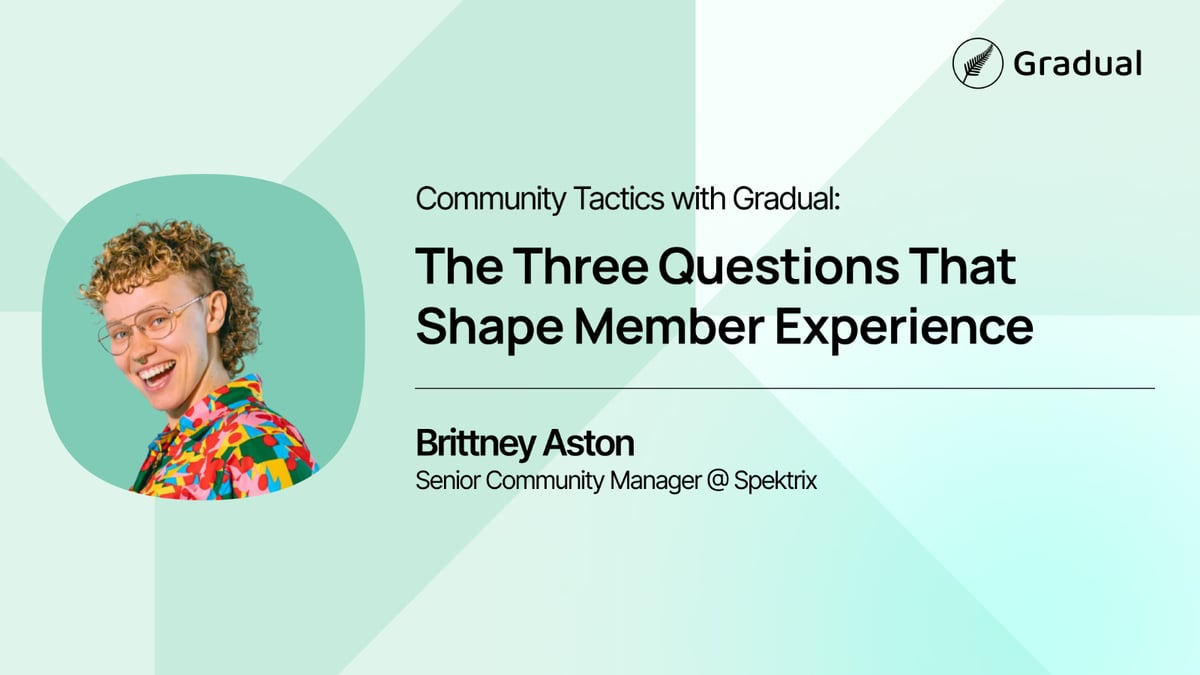
From Clarity to Confidence: Executive Insights with Brittney Aston
# Community
# GTM Strategy
# Format: Event Recaps

How three simple questions can reshape member experience and unlock healthier community participation

March 16, 2026
Brittney Aston
Brittney Aston
Joshua Zerkel
Joshua Zerkel
From Clarity to Confidence: Executive Insights with Brittney Aston
When community leaders talk about engagement, the conversation often drifts toward programs, content calendars, or platform features.
But in practice, participation usually comes down to something simpler. It comes down to how people feel when they enter a space.
During our recent Context First session, Brittney Aston shared a framework they use when designing and auditing communities. Brittney is the Senior Community Manager at Spektrix and has spent more than a decade building communities across technology, education, and creative industries. Their work focuses on the intersection of operations, member experience, and psychological safety.
The framework Brittney shared is intentionally simple.
When evaluating a community, they ask three questions:
  • Do people know where they are?
  • Do they know what they can do?
  • Do they feel safe doing it?
If the answer to any of those questions is no, participation tends to stall.
Those three questions became the anchor for our entire conversation.

Orientation shapes the first emotional signal

The first question Brittney asks when someone enters a community is straightforward.
Do people know where they are?
When new members arrive, they scan the environment quickly. They look for cues that tell them what kind of space they’ve entered and whether it’s meant for them.
If those cues are unclear, people hesitate.
Brittney explained that weak orientation often leads to anxiety. Members may lurk indefinitely or ask where they should post. Those moments are signals that the environment isn’t guiding people clearly enough.
The fixes are rarely complicated.
  • Clear structure helps.
  • Fewer spaces often help more than many.
  • Language should sound like how members actually talk, not like internal company terminology.
Brittney shared a simple rule of thumb they use when evaluating community navigation. If a new member has to think longer than a few seconds about where to go, they probably won’t go anywhere at all.
That moment of hesitation often becomes a quiet exit.

Participation needs visible paths

Even when members understand where they are, they may still hesitate to participate.
The second question Brittney asks addresses that moment.
Do people know what they can do here?
Communities often rely on vague encouragement. Leaders say things like “join the conversation” or “share your thoughts,” but those invitations can be surprisingly unclear.
Brittney designs participation paths instead.
Members should see obvious ways to engage, such as:
  • Ask a question
  • Share a win
  • Offer help
  • Provide feedback
  • Join an event
These small prompts reduce hesitation.
Brittney put it simply during the conversation. Clear invitations reduce hesitation.
When members know what participation looks like, they are far more likely to take the first step.

Psychological safety determines whether people speak

The third question Brittney asks is the one they spend the most time thinking about.
Do people feel safe participating?
Psychological safety is often misunderstood, which is part of why it can be controversial.
Brittney described psychological safety as the shared belief that the environment is safe for interpersonal risk taking. Members should feel comfortable asking questions, sharing ideas, or admitting uncertainty without fear of punishment, humiliation, or judgment.
Many communities assume safety exists because rules are posted. But safety is not something members read. It is something they experience.
Members are constantly reading signals in a space.
  • They notice how moderators respond to mistakes.
  • They notice whether leaders show humility.
  • They notice how basic questions are treated.
Those signals accumulate quickly.
Brittney offered a vivid metaphor during the session. A wild bird will only eat from a person’s hand when the environment consistently signals safety. The bird does not read a rulebook. It responds to repeated signals.
Communities operate in the same way.

Moderation tone shapes the emotional temperature

One of the strongest signals of safety comes from moderation.
Members watch how moderators respond to problems. The tone used in those moments sets the emotional temperature for the entire space.
Brittney shared a story from their own experience in an online forum. After posting a link to a nonprofit resource that might help another user, they were banned from the subreddit for thirty days without warning. The message they received from the moderator felt harsh and accusatory.
That moment ended their participation in the community entirely.
It also shaped how Brittney approaches moderation today.
Communities send signals constantly. Small moments determine whether people lean in or pull back.
When moderation feels harsh, people withdraw. When moderation feels respectful and calm, members remain engaged.

Signs that safety is forming

Psychological safety does not appear overnight.
It grows slowly through repeated interactions.
One of the signals Brittney looks for is when members begin answering each other’s questions without waiting for the community team. That shift shows that members trust both the space and their own voices.
Another signal appears when people feel comfortable asking vulnerable questions.
Those are the moments when communities move beyond surface participation and begin functioning as a true support system.
The opposite pattern can also appear.
If members consistently move conversations into private messages instead of asking questions publicly, that may signal discomfort with speaking openly in the community.
Those signals help leaders understand whether the environment is truly working.

Why this matters beyond the community team

When member experience improves, the benefits extend far beyond the community itself.
  • Support teams see fewer repeated questions because answers are easier to find.
  • Product teams receive clearer feedback from members who trust the space.
  • Marketing teams hear authentic stories that turn into advocacy.
  • Customer success teams see stronger retention as members build relationships with one another.
In other words, community becomes both a signal system and a support system.
But that only happens when people feel comfortable participating.

A simple audit any community leader can run

At the end of the conversation, Brittney returned to the three questions that started the session.
  • Do people know where they are?
  • Do they know what they can do?
  • Do they feel safe doing it?
Running a community through those questions often reveals friction quickly.
The surprising part is that many fixes are smaller than leaders expect. Clarity and consistency tend to unlock momentum faster than large redesigns.
For anyone responsible for member experience, those three questions offer a useful place to start.

Key Takeaways

  • Clear orientation reduces anxiety and helps members decide quickly whether they belong in a space.
  • Participation increases when communities provide visible engagement paths rather than vague invitations.
  • Psychological safety forms through repeated signals, not written policies.
  • Moderation tone sets the emotional temperature of the community.
  • Healthy communities eventually show members helping each other without relying solely on staff.

FAQ

What is psychological safety in a community? Psychological safety is the shared belief that members can ask questions, share ideas, and participate without fear of humiliation, punishment, or judgment.
How do you know if a community feels safe to members? Signals include members asking vulnerable questions, helping each other publicly, and participating without hesitation.
Why does orientation matter in community design? If members cannot quickly understand where they are or what the space is for, they often hesitate to participate.
What role does moderation play in member experience? Moderation tone signals how members will be treated. Calm and respectful moderation encourages participation, while harsh responses often shut it down.

Comments (0)
Popular
avatar

Dive in

Related

Blog
From Community Value to Internal Alignment: Executive Insights with Holly Firestone
By Holly Firestone • Feb 5th, 2026 Views 22
Blog
Webinar Recap: From Connection to Impact: Executive Insights with Brian Oblinger
By Brian Oblinger • Oct 31st, 2025 Views 76
Blog
Webinar Recap: From Activity to Impact: Executive Insights with Bill Johnston
By Bill Johnston • Nov 13th, 2025 Views 30
© 2026 Gradual Community
Privacy Policy