
Gradual Community
Ask

Design Community for Customer Adoption, Not Just Engagement
Design Community for Customer Adoption, Not Just Engagement
# Customer Success & Support
# Community

Turn community participation into meaningful customer progress.

September 16, 2026
Design Community for Customer Adoption, Not Just Engagement
A busy community can look like a successful community.
People are posting. Events are full. Members are logging in. Discussions are active.
Those are good signals. But they don't necessarily tell you whether customers are getting more value from your product.
That's the difference between engagement and adoption.
Engagement tells you that someone participated.
Adoption tells you whether that participation helped them make progress.
The goal isn't to stop measuring engagement. It's to connect engagement to the customer behaviors you actually want to influence.

Start with the behavior, not the activity

Before deciding what your community should offer, define what successful adoption actually looks like.
What do your most successful customers do differently?
Maybe they:
  • Complete onboarding faster
  • Use a key feature or workflow
  • Discover additional use cases
  • Complete training
  • Apply a best practice
  • Bring more of their team into the product
Once you know the behaviors you're trying to encourage, you can design community experiences around helping customers get there.

Find where customers can learn from each other

Some adoption challenges can be solved with better documentation or training. Others need something different.
A customer may understand exactly how a feature works but still wonder:
How are other teams actually using this?
That's where peer learning becomes valuable.
Customers can share workflows, examples, mistakes, and lessons that are difficult to capture in formal product education.
Look for the moments where customers understand the product but need help understanding what good looks like in practice.

Design around progress

Instead of asking:
What should we post this month?
Ask:
What are we trying to help customers do this month?
If the goal is adoption of a particular workflow, you might create:
  • A customer-led session showing how they use it
  • A discussion where members share their approach
  • A short course covering the fundamentals
  • A collection of customer examples
  • A Q&A where customers compare what's working
These aren't separate activities. They're different ways of helping customers reach the same outcome.

Connect formal learning with peer learning

Customer education can teach customers how something works.
Community can show them how other customers put it into practice.
A course can provide the fundamentals. A customer session can show those ideas in action. A discussion can help members compare approaches.
Formal learning provides structure. Peer learning adds context.
Together, they create a stronger path to adoption.

Measure what happens next

Engagement metrics still matter. Track attendance, participation, course completion, discussions, and contributions.
But don't stop there.
Ask:
What did the customer do next?
Did they try the workflow? Complete onboarding? Use more of the product? Discover a new use case?
You don't need to prove that every community interaction caused an adoption outcome.
Start by looking for patterns between who participates, what they participate in, and what they do afterward.

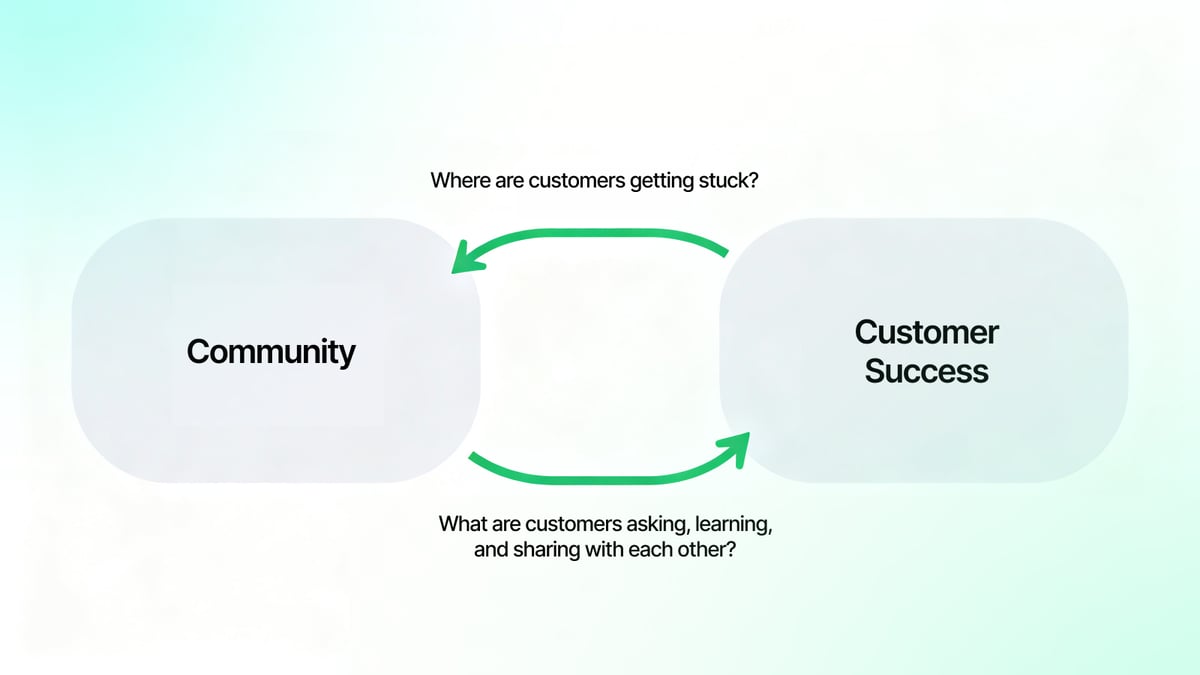
Close the loop with Customer Success

Customer Success already knows where customers tend to get stuck and which behaviors indicate progress.
Community can turn that knowledge into experiences customers can learn from together.
And the information should flow both ways:
Customer Success → Community: Where are customers getting stuck?
Community → Customer Success: What are customers asking, learning, and sharing?
That feedback loop helps both teams design around what customers actually need.

The question to start with

Instead of asking:
How do we get customers to engage more?
Try asking:
What do we want customers to be able to do better after they engage?
Then work backward.
That's where community starts moving from a place customers visit to something that actually helps them succeed.
Comments (0)
Popular
avatar

Dive in

Related

Resource
How to Design Community Onboarding
By Joshua Zerkel • Jul 27th, 2026 Views 20
Resource
Community Engagement Playbook: Building (and Rebuilding) Participation
By Joshua Zerkel • Dec 4th, 2025 Views 152
Resource
How to Structure a Community for Clarity, Engagement, and Scale
By Joshua Zerkel • Feb 6th, 2026 Views 98
Video
Event Replay: From Reddit to Results - A Community Engagement Playbook for GEO
By Jeremie Gluckman • Feb 12th, 2026 Views 97
Resource
How to Design Community Onboarding
By Joshua Zerkel • Jul 27th, 2026 Views 20
Resource
How to Structure a Community for Clarity, Engagement, and Scale
By Joshua Zerkel • Feb 6th, 2026 Views 98
Video
Event Replay: From Reddit to Results - A Community Engagement Playbook for GEO
By Jeremie Gluckman • Feb 12th, 2026 Views 97
Resource
Community Engagement Playbook: Building (and Rebuilding) Participation
By Joshua Zerkel • Dec 4th, 2025 Views 152