
Gradual Community
+00:00 GMT

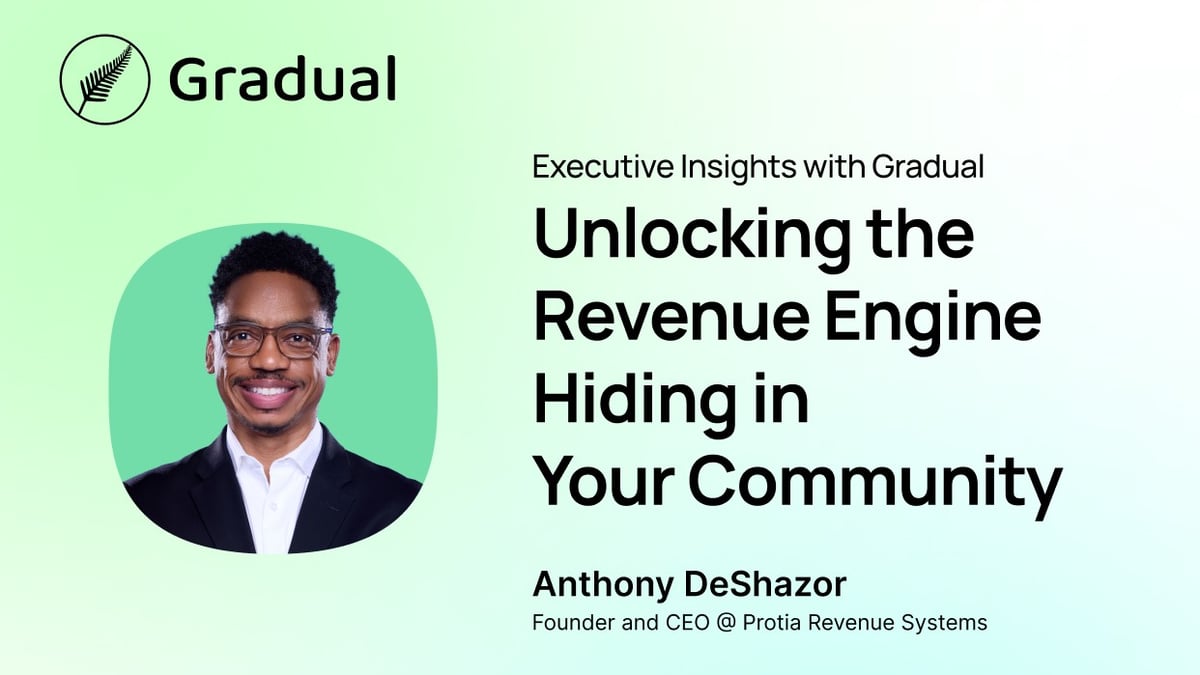
Webinar Recap: From Engagement to Revenue: Executive Insights with Anthony DeShazor
Webinar Recap: From Engagement to Revenue: Executive Insights with Anthony DeShazor
# Format: Event Recaps
# Theme: Leadership & Executive Perspectives
# Challenge: Cross-Functional Alignment

How Anthony DeShazor reframed community as a growth engine in our first Executive Insights session.

September 24, 2025
Joshua Zerkel
Joshua Zerkel
Webinar Recap: From Engagement to Revenue: Executive Insights with Anthony DeShazor
When I think about how many companies measure community success, it’s often the same story: activity counts. Logins, event registrations, forum posts. Those are useful signals, but they don’t tell the whole story. In our first Executive Insights with Gradual session, Anthony DeShazor reminded us that engagement is only the beginning.
Anthony is the Founder and CEO of Protia Revenue Systems and a three-time Chief Customer Officer. Over his 25-year career, he’s scaled SaaS companies to more than $1B ARR, driven 110% NRR with lean teams, and eliminated $400M in churn and compliance risk. His perspective on connecting customer value to business outcomes through intentional systems set the tone for the conversation.
“Community is not just about engagement. When it’s designed properly, it accelerates deals, retains customers, and drives expansion,” Anthony said.

Rethinking the role of community

What struck me was how clearly Anthony called out the choice leaders face. Too often, community is treated as a side project or a support channel. As he put it, “Are you going to let your community just be an engagement platform, or are you going to let it drive revenue for you?”
That framing resonated with me, because it reflects what I’ve seen in my own work. Communities can absolutely reduce support costs and build advocacy, but when they are connected to measurable outcomes, they become part of the growth engine.

Moving past “warm fuzzies”

Executives rarely question whether community is positive, but they do question whether it is measurable. As Anthony pointed out, “If you can’t measure it, it’s kind of like it didn’t happen.”
He shared a framework that I think every community leader should keep in their back pocket: track community-attributed revenue, community-influenced revenue, and deal velocity. Activity metrics are fine, but these three categories are what resonate with leadership.
For me, deal velocity was the eye-opener. If you can show that deals involving community close significantly faster than those without community touchpoints, that’s a powerful story to tell.

Real examples of impact

Anthony also shared a story from his own experience that made this point very tangible. At one company, every enterprise deal required at least two customer references. It slowed down the process until his team started hosting community events where prospects and customers could talk directly.
“By creating community events, digital or in-person, where prospects could talk to customers, we found that served as an actual deal accelerator,” he explained. “We didn’t have to cherry-pick references. Just getting people in a room was enough to build trust.”
I’ve seen this dynamic play out myself: prospects trust their peers more than they trust sales or marketing. Creating authentic spaces for those conversations is one of the most effective ways to accelerate decisions.

Building connections across teams

Another theme that stood out for me was how important it is for community to be connected across functions. Anthony put it this way: “My two favorite people on the executive staff are marketing and product. You want to make sure community is plugged into both.”
I agree. When community insights stay siloed, their value is limited. But when they amplify marketing campaigns, inform product roadmaps, and help sales build credibility, the impact is obvious.
As I mentioned during the session, “Warm fuzzies are not something you put on a dashboard. But when you tie community to revenue, that’s when executives really start to notice the impact.”

Building with intention

Anthony closed the session with a point that I think every community leader should hear: “Community has to be intentionally integrated into the overall revenue system. It cannot be a bolt-on.”
That requires designing communities from the ground up to connect with business outcomes, not just launching them as engagement programs and hoping for the best.

What I learned

Hosting this first Executive Insights conversation reinforced for me how important it is to keep shifting the narrative. As community leaders, we already know the human value of what we build. But we also need to show its business value, and Anthony offered a clear, practical way to do that.
This was the kickoff to a series designed to bring sharp perspective from experienced leaders. I left the session energized and with new ways to frame the impact of community. I hope you will too.
Comments (0)
Popular
avatar

Dive in

Related

Blog
Webinar Recap: From Activity to Impact: Executive Insights with Bill Johnston
By Bill Johnston • Nov 13th, 2025 Views 21
Blog
Webinar Recap: From Connection to Impact: Executive Insights with Brian Oblinger
By Brian Oblinger • Oct 31st, 2025 Views 59
© 2025 Gradual Community
Privacy Policy